

Why a generation raised on The Devil Wears Prada is starting to relate more to Emily Charlton than Andy Sachs
With The Devil Wears Prada 2 reviving conversations around fashion’s most enduring fantasy, many who grew up idolising Andy Sachs are viewing the original film through a different lens. For years, The Devil Wears Prada sold the idea that proximity to the system—and the influence and prestige it promises—could change the course of a life. That belief still lingers among young creatives entering industries built on aspiration, even as hustle culture’s grip loosens. For many, the character who now feels most recognisable is no longer Andy Sachs, but Emily Charlton: the one who wants the job badly enough to take it seriously, even when the rewards remain uncertain. In this personal essay, Carolina Lecce, a London-based student in Fashion Promotion, Communication and Digital Media, writes about fashion internships, rejection, ambition and the uneasy distance between what those careers promise and the reality of pursuing them.
Why The Devil Wears Prada 2 Still Makes Everyone Want In
It was a Friday, in London. A few hours earlier, I had received yet another message: “Sorry, we decided to move forward with another candidate.” The sentence has become almost automatic. Familiar. And yet, every time, it leaves something behind.
The unexpected sunshine, rare for London, pushes me outside. I walk without a real destination, more to clear my head than to get anywhere. Before I realise it, I’m in front of the Corinthia Hotel. And right at the entrance, a giant shoe, impossible to miss: The Devil Wears Prada 2.
Outside, a group of girls are gathered near the entrance, all wearing cerulean sweaters, as if the reference no longer needed explaining. I approach and ask what’s going on. “We’re journalists, we’re interviewing the cast.” I swallow the knot in my throat and, almost without thinking, say, “I write for my university magazine.” I don’t know why, but it works. One of them looks at me, hesitates for a moment, then lets me in.
And just like that, without an invitation, I’m inside. Not in the interview room, just outside, sitting in the corridor. In that strange in-between space where you see everything, but not enough to really be part of it. Around me, assistants rush past, PRs check schedules, and everyone seems to know exactly where they’re going—and why. I don’t. I’m just standing there, still and observing.
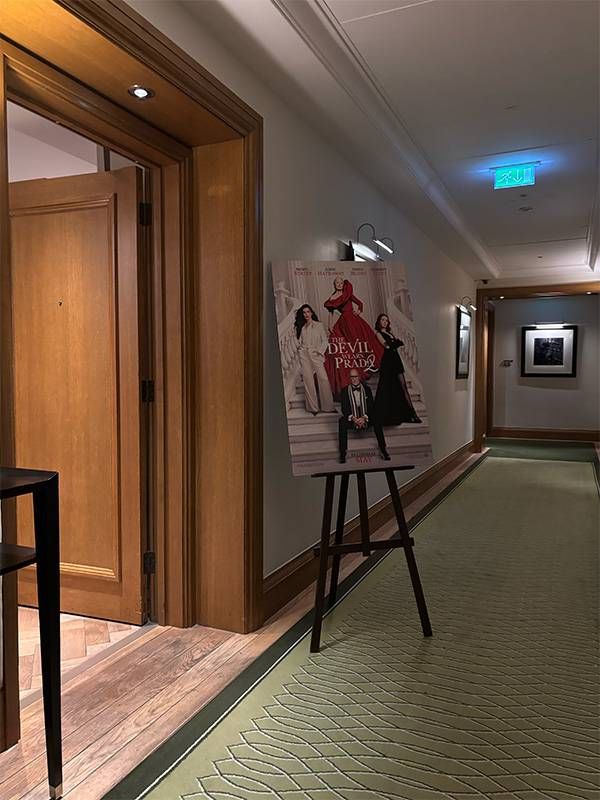
The corridor outside the press room becomes its own kind of runway: a liminal space where ambition, access and fashion’s fantasy economy quietly unfold. Courtesy of the author.
What It Feels Like to Be Close to an Industry That Never Quite Lets You In
Then something happens: Meryl Streep walks past, looks at me and says, “Hello.” I freeze, although not out of excitement or disbelief, but something more suspended, as if for a brief moment the distance between inside and outside had softened.
I stay there for hours, not knowing if anything else will come of it. Then, at some point, Meryl Streep/Miranda Priestly passes by again, smiles and says, “Hello girls,” her hand briefly brushing my shoulder. It’s a small gesture, but enough to make the whole experience feel real.
I leave with a feeling I can’t quite define—somewhere between satisfaction and frustration—like being very close to something that still isn’t mine.
Why Fashion Still Sells the Fantasy of Transformation
Only later, after finally watching The Devil Wears Prada 2 and reading the interviews with stylist Molly Rogers—the film’s costume designer and one of the most influential figures in the industry—does something shift.
Rogers doesn’t discuss fashion as something superficial; she speaks of clothes in relation to space, light, and the body moving through the city. When the Giorgio Armani reference emerges—along with the tribute and the decision to use those pieces at such a precise moment in the film—the whole thing suddenly carries more weight.
That’s when I think back to my internship at Armani, to the time when I was convinced I was living my Andy Sachs phase—able to touch those clothes, see them up close and understand, even without being told, how important they were. More than anything, I remember the constant feeling that it was the beginning of something, that someone would eventually notice me, and from there, my life would change. It didn’t. Not yet.
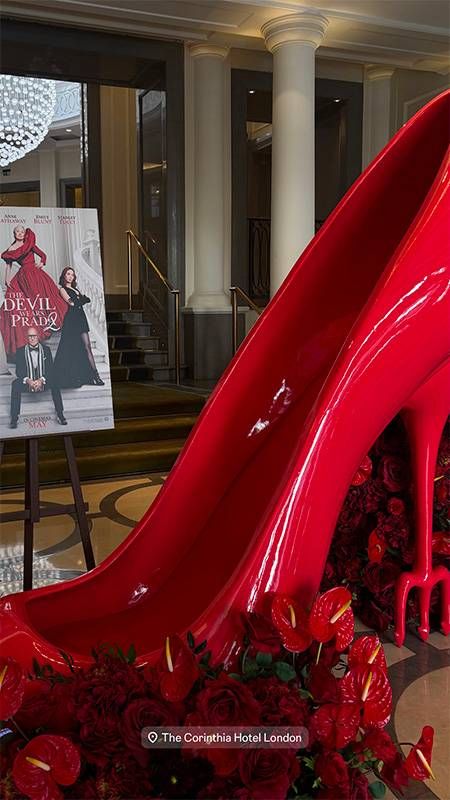
A giant red stiletto outside the Corinthia Hotel transforms The Devil Wears Prada 2 into a real-world fashion spectacle, blurring the line between cinema, branding and aspiration. Courtesy of the author.
How Emily Charlton Became the Character Everyone Understands Now
A few days later, I listen to the Vogue podcast, where Leslie Fremar—the real Emily Charlton—is interviewed by Chloe Malle, and something clicks. For years, I’d been waiting for my Andy Sachs moment, convinced that eventually everything would fall into place. But I was never Andy. I was Emily.
Played by Emily Blunt, Emily Charlton is the one who wants this badly enough to do anything for it—the one behind the line, “A million girls would kill for that job.” It no longer sounds ironic. If anything, it feels uncomfortably real, especially once the other phrase every fashion insider repeats enters the conversation: “We’re not saving lives.” And yet, everyone treats it as if we are.
The Truth Behind “A Million Girls Would Kill for That Job”
And that’s exactly where I am. I’m the one who wants it enough to take it seriously—even when it feels excessive, when no one is watching, when the doors stay closed, and you find yourself sitting in the corridor instead of inside the room. I’m no longer waiting for my life to be transformed; I’m starting to realise that these things rarely work in the idealised, dramatic way I once imagined.
I am Emily Charlton. And maybe that has less to do with transformation than with having the courage to keep trying, even when nothing unfolds in the way you expected. It may be less cinematic, but it feels far more real.
Carolina Lecce
Student in Fashion Promotion, Communication and Digital Media, London