
Trama Plaza: A new way to make sustainable fashion connect with people

Why sustainable fashion still struggles to connect, and how Trama Plaza uses experiential learning to drive behavioural change
Why does sustainable fashion still struggle to connect with people? Despite years of campaigns and growing awareness, consumer habits are slow to change. The challenge may not be a lack of information, but how that information is shared.
This article features Trama Plaza, a Milan-based collective that engages audiences through experiential learning, participatory formats and emotional involvement—focusing on genuine connection rather than mere explanation. As part of Istituto Marangoni’s Maze35 magazine series, developed with the Moleskine Foundation, this piece spotlights creative organisations that drive social impact through the Creativity Pioneers Fund. Together, these stories show how creativity can inspire change across disciplines, communities and geographies.
Why Sustainable Fashion Still Struggles to Drive Real Change
Founded in Milan in 2020, Trama Plaza is a non-profit collective led by Erica Brunetti that approaches fashion sustainability through art and shared practices, rather than traditional educational models. As emerged in our conversation with Brunetti, the project begins with a simple but critical insight: “knowledge alone is not enough to drive change.”
At its core is a clear intention: not only to inform but also to create a space where people can connect with the topic on a personal level. “Our goal is to provide information,” Brunetti explains, “but using a positive and engaging tone, without judgment. Emotion is the key.”
More broadly, this highlights a structural limitation in how sustainability is communicated. Facts often remain abstract, especially when dealing with complex systems such as global fashion supply chains. What is missing is an immediate point of contact—something Trama Plaza seeks to provide through experience.

Trama Plaza community portrait highlighting diverse voices shaping sustainable fashion through art, participation and collective dialogue. Courtesy of Trama Plaza.
How Trama Plaza Uses Experiential Learning to Rethink Sustainability in Fashion
As outlined in its manifesto, Trama Plaza does not treat creativity as an aesthetic layer, but as a functional tool, a way to translate complex systems into something people can feel.
Today, the collective unites over 70 members throughout Italy, mainly women from diverse professional and cultural backgrounds. As a distributed network, the project combines research, education and cultural production to advance sustainability in fashion through participatory formats.
The name’s origin reflects the collective’s positioning.
“Trama refers to the idea of reconstructing a social fabric, the network of people, stories and labour behind our clothes, while Plaza points to the public square, a space of openness, dialogue and collective action” – Erica Brunetti, Founder & President of Trama Plaza
The name also refers to the Rana Plaza tragedy in Bangladesh—the 2013 factory collapse that claimed the lives of over 1,100 garment workers. This event deeply influenced the project’s foundation and its focus on the human cost of fashion.
This framing also shapes how and where the collective operates. Instead of staying within formal institutions, Trama Plaza reaches out to schools, public squares and local communities, especially Milan’s Giambellino district—showing its commitment to accessibility and local engagement.
“We believe in a horizontal form of dissemination. It’s about involving citizens, institutions and companies together” – Erica Brunetti
Here, art isn’t just something to observe. It becomes a way to spark participation and meaningful interaction, rather than simply delivering a message.
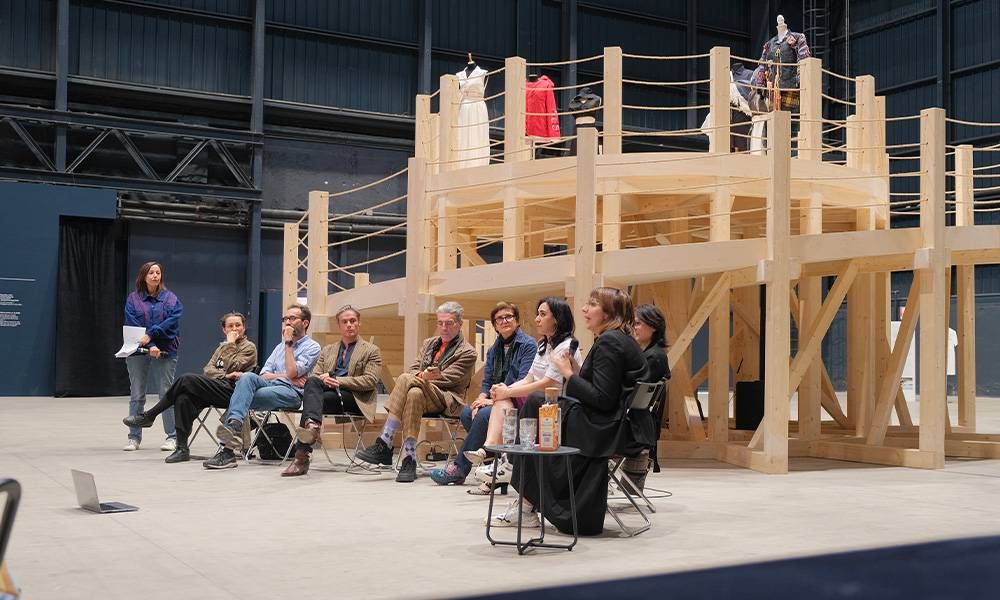
During Trama Plaza’s public Q&A at Pirelli HangarBicocca, industry experts discuss sustainable fashion within Tiravanija’s participatory installation. Photograph by Cecilia Laabidi. Courtesy of Trama Plaza.
From Content to Participation: How Sustainable Fashion Becomes Tangible
Rather than simply producing content about sustainability, Trama Plaza creates formats for people to practise and experience it firsthand.
A prime example is DECLÙ, a role-playing card game that allows participants to step into the fashion system. By collaborating and making decisions, players take on different industry roles, shifting from passive understanding to hands-on involvement.
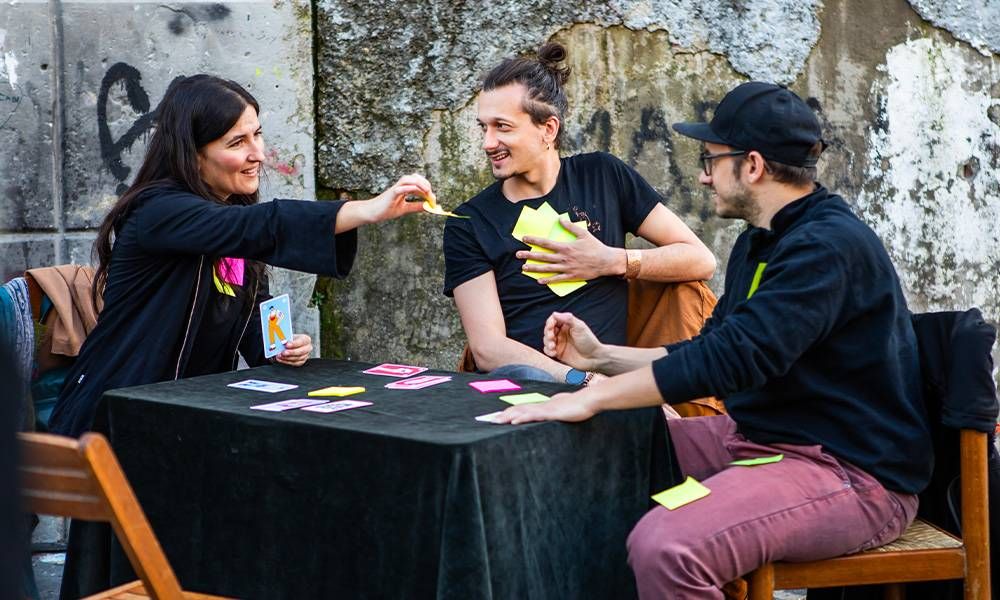
Participants engage with DECLÙ, Trama Plaza’s role-playing card game, turning fashion sustainability into a collaborative, hands-on experience through play and interaction. Photograph by Daniele Lazzaretto. Courtesy of Trama Plaza. The same logic applies to GIRALAMODA, a multidisciplinary performance that blends theatre, dance and music. Originally designed as a six-hour public event, the project narrates how the fashion industry works through a sequence of immersive scenes.
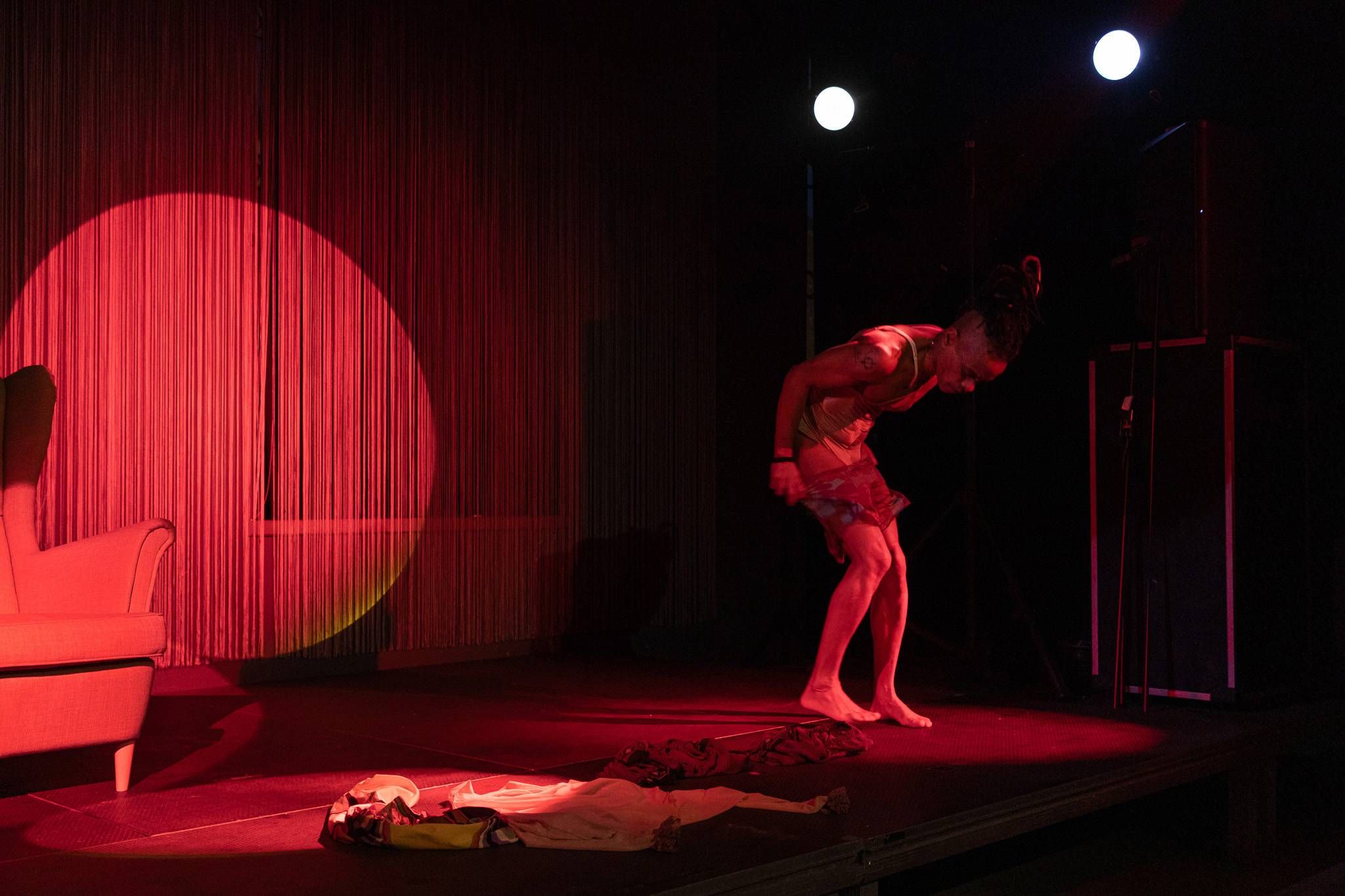
A scene from GIRALAMODA, Trama Plaza’s immersive performance blending theatre and fashion to explore sustainability through participation and storytelling. Photograph by Zoe Vincenti. Courtesy of Trama Plaza.
“People don’t expect to laugh or be entertained while reflecting on complex issues such as sustainability, but this is exactly what allows the message to reach them” – Erica Brunetti
Workshops are another key part of the project. In upcycling sessions, participants bring in clothes they no longer wear and transform them through practical activities. The emphasis is less on technical perfection and more on encouraging a new perspective.
“We don’t teach just techniques,” notes Brunetti. “We want people to reflect on the potential of what they already own.” Across all these formats, the goal remains the same: to make invisible systems tangible.
From Local Collective to Global Network: How Trama Plaza Connects Through the Creativity Pioneers Fund
A significant step in Trama Plaza’s development came in 2022, when the collective was selected for the Creativity Pioneers Fund by Moleskine Foundation and its coalition of partners.
The initiative supports cultural organisations worldwide that address social challenges through creative, unconventional methods. Alongside funding, it emphasises collaboration and network-building. For Trama Plaza, this recognition meant more than just financial support.
“The most important value was not the funding,” adds Brunetti. “It was the network.”
“The Creativity Pioneers Fund by Moleskine Foundation connects us with organisations from all over the world and opened up new possibilities for collaboration” – Erica Brunetti
This international dimension allows the project to grow its reach while staying grounded in local roots, sharing methods and practices across diverse settings.
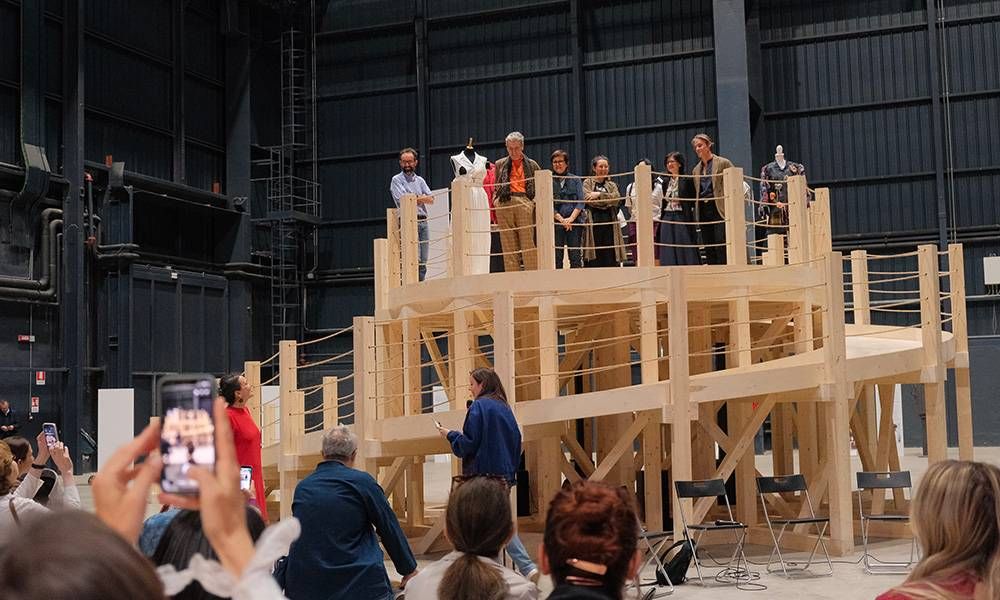
Audience and speakers engage in a circular talk format, breaking boundaries between public and panel during Trama Plaza’s sustainability-focused event in Milan. Photograph by Cecilia Laabid. Courtesy of Trama Plaza
Beyond Awareness: What Actually Drives Behavioural Change in Fashion
While the fashion industry continues to produce data and statistics, Trama Plaza points to a different way of communicating sustainability—one where effectiveness depends as much on format as on content.
If the challenge once lay in a lack of information, today there is an overabundance of it, and audiences still tend to overlook it—even when it resonates. This is where more immersive approaches become relevant, fostering deeper engagement and making complex issues more relatable.
Trama Plaza’s work is not about oversimplifying sustainability, but about making it something people can live and experience —not just understand—by creating opportunities for direct engagement with the system itself. It is through this shift that meaningful behavioural change can happen.
In other words, experience bridges the gap between knowledge and action. While it doesn’t replace industry reports, it adds an essential layer that helps people process, internalise, and potentially act on the information they receive.