
Folios is the cultural publication of Moleskine Foundation showcasing the theme of creativity for social change through the stories of the Creativity Pioneers around the world that are part of Creativity Pioneers Fund. This article inaugurates the new Maze 35 column, featuring articles from the latest 7th edition of the publication.
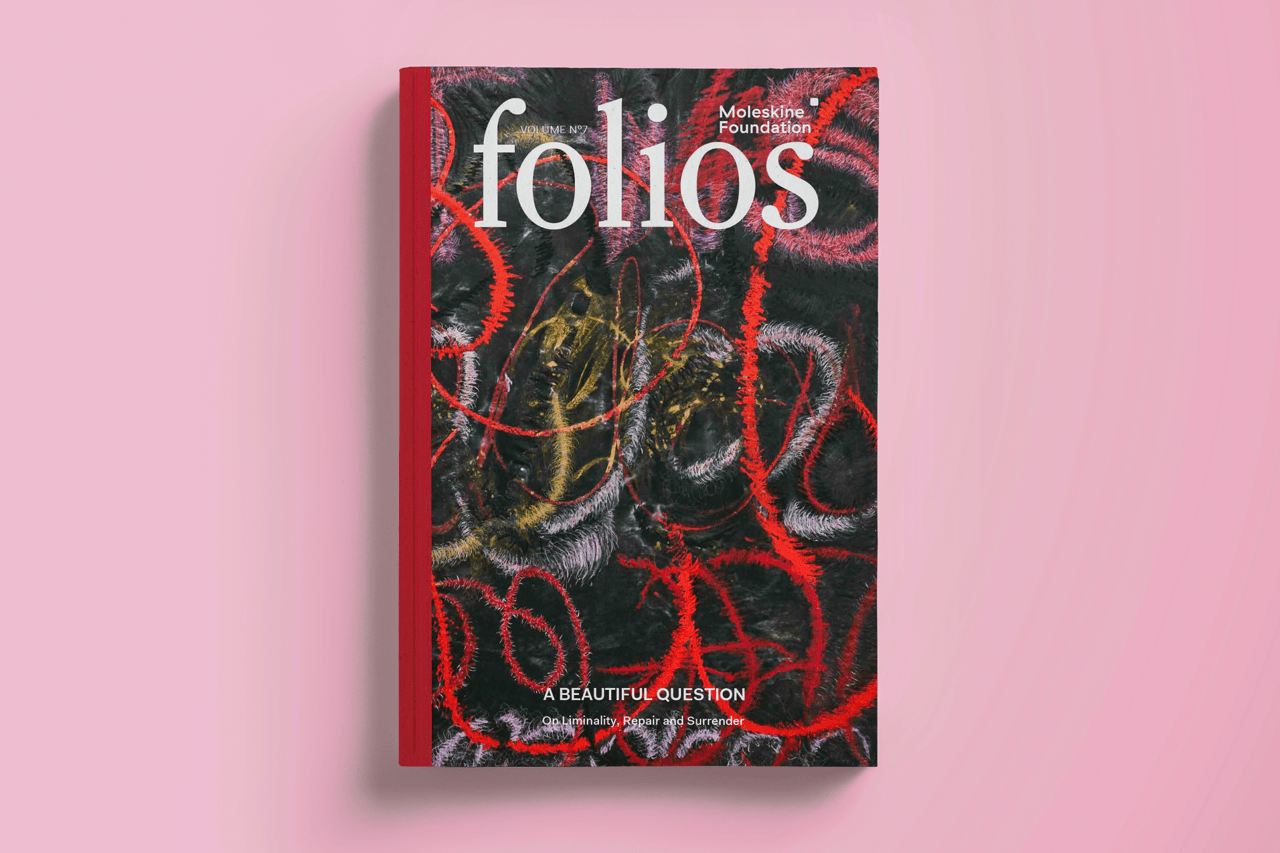
The cover of Folios Nº7, the cultural publication published by the Moleskine Foundation, from which this article is drawn Many of the poems I love ask beautiful questions. ‘Are we not of interest to each other?’, asks Elizabeth Alexander in her poem Ars Poetica #100 I Believe; ‘What will be the sacred words?’, asks Amiri Baraka in Ka ‘Ba; ‘How can I turn from Africa and live?’, asks Derek Walcott in A Far Cry From Africa; and ‘Will we ever know with open eyes the burden of the night?’, asks Máire Mhac an tSaoi in Mary Hogan’s Quatrains, are just some that I find compelling in their inquiry.
These questions are beautiful in all the ways that defy the demands for quick automated answers. These questions work our hearts and spirits more than they do our minds. A beautiful question may take our whole lives to answer, and we may still not arrive at an answer because the answer is not the point.
The nature of this question is that of a companion urging us to see more vividly, to feel more intensely and to listen with all our senses in order to think differently, and therefore be different.
A beautiful question may take our whole lives to answer, and we may still not arrive at an answer—because the answer is not the point.
In his book, Beauty, The Invisible Embrace, late Irish poet, philosopher and priest, John O’Donohue, reminds us that the Greek origin of the word ‘beauty’, ‘kallos’, is related to the Greek origin of the word ‘calling’, ‘kalon’. From this connection O’Donohue shares that beauty is not a neutral thing, but that which is actually calling us, and this ‘calling forth’ is also at the heart of creativity.
Beautiful questions are ones that call us forth.
The making of the Creativity Pioneers Fund (Fund) is conversational in process and in substance. And foundational to any good conversations are beautiful questions. In working with Creativity Pioneers, the cultural and creative organisations whose work of creativity for social change is the reason the Fund exists, we observed that what makes them wise is not that they are answering the world’s most pressing questions, but how they challenge not only the world, but themselves by asking their own beautiful questions.
‘Questions elicit answers in the likeness’, says journalist and author, Krista Tippett. The questions at the heart of the work of the Creativity Pioneers elicit magical thinking and the formation of any kind of answer mirrors the magic of the question itself.
In a world that keeps producing the same unwanted outcomes, how do we stir imaginations towards something new? In contexts where creativity is chronically undermined, how do we bring its full might to bear on the problems of the world? How do we cultivate connection in a deeply fragmented world? How does a people who have been systematically broken down restore a sense of self? How do we transform neglect into renewal for our people, our planet, and our shared prosperity? How can we amplify the muted voices?
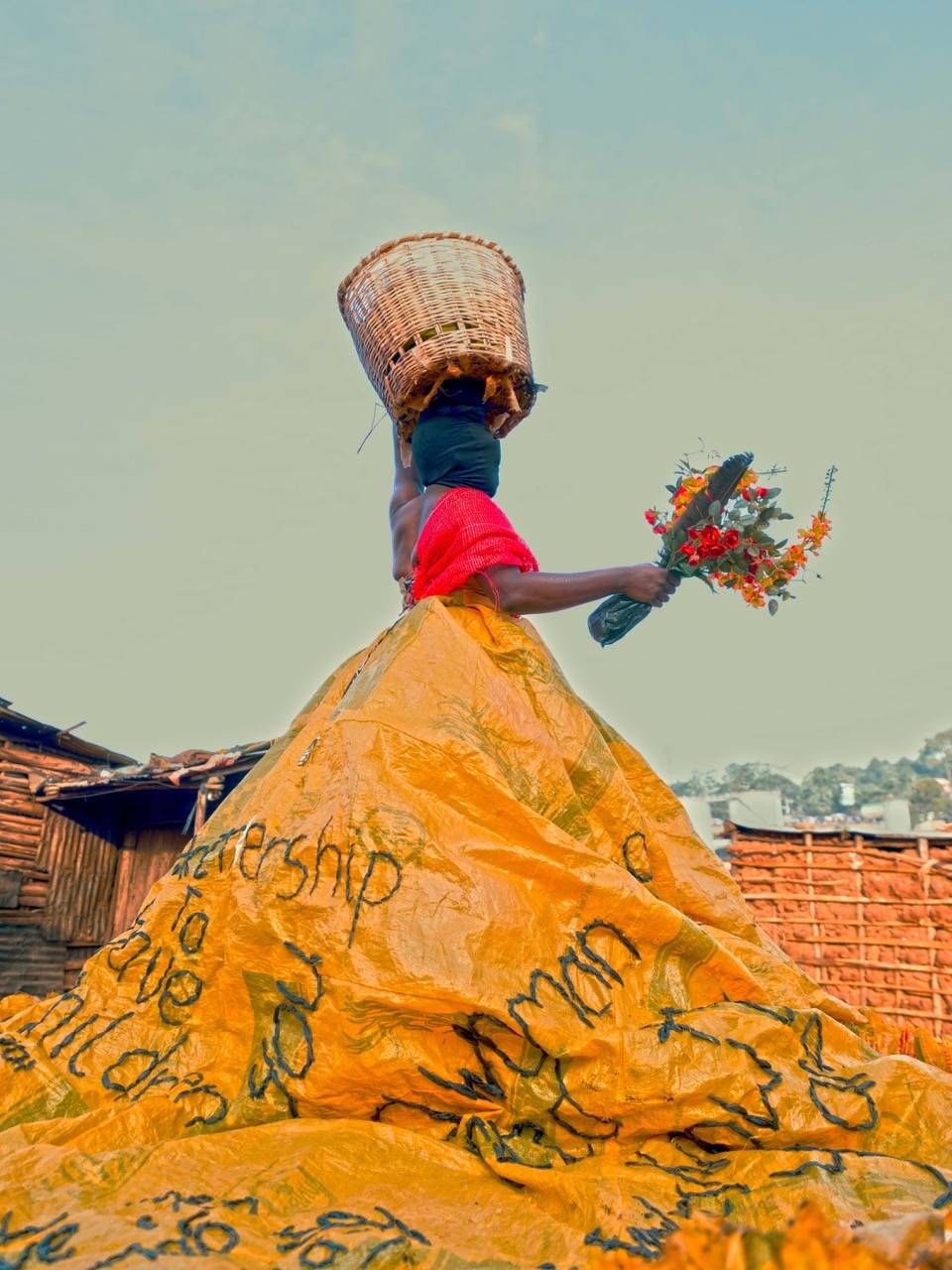
Sandra Suubi, Samba Gown, 2022, Mixed media, performance video and sculpture installation. Courtesy of Njabala Foundation for Folios, Moleskine Foundation These are just some of the questions calling the Pioneers forth.
Poet, David Whyte, who is featured in this edition, offers that ‘poetry has to come from the primary experience. Usually some primary experience of heartbreak’. It must be true then that the Creativity Pioneers are poets and their questions the poetry flowing from their primary experience of heartbreak from living life in their chosen sites of consciousness, in Maputo, London, Palermo, Bethlehem, Accra, Los Angeles, Johannesburg, Lisbon, and more localities which make up the pages of this Folios.
A beautiful question requires us to surrender to its magnitude and depth. To surrender to the journey on which the questions take the lead. To surrender to the unknown, and perhaps unknowable, with a deep sense of humility that we do not do this work alone. We do it in constellation, not only with our peers and our communities, but with forces perceptible and imperceptible, greater than our own human enterprising.
To be accompanied by a beautiful question demands of us that we shed our discomfort with the liminal, which is the nature of the journey itself. To find meaning in never quite arriving. To befriend the transitional state, as Simon Njami articulates in this edition, ‘where we must face the emptiness of determination’. The emptiness of a horizon perpetually receding even as we do the hard work of never quite getting to the desired destination but knowing that it is in this liminal space that we find not the answer, but ourselves. Liminality discourages us from arrival and rather encourages us towards presence. The Creativity Pioneers, seized by their own beautiful questions, are the ones who are courageously, with this clarifying presence, facing the world as it is.
The companionship of a beautiful question is one that is reparative if we surrender and are present with it. As we faithfully journey with the question, we begin to tend to what is broken, not just in the outer world but in our inner worlds too. Living the beautiful question is by its nature generative of new inner landscapes which will make for better outer worlds and collective futures.
The beautiful questions have a gravitational pull, as Adama Sanneh puts it in his foreword, a pull that comes with the force of these three words: liminality, surrender, and repair.
To be accompanied by To be accompanied by a beautiful question a beautiful question demands of us that we demands of us that we shed our discomfort shed our discomfort with the liminal—which with the liminal—which is the nature of the is the nature of the journey itself.
This Folios is dedicated to the questions pulling the Creativity Pioneers forth. Questions which have shaped not just their work, their organisations or communities, but which have reshaped them as human beings, enabling them to cast new eyes upon the world. And it’s from new sights that new ideas can emerge, and perhaps new and better ways of being.
Folios is more than a publication. It is a discovery engine for creativity for social change, using words to guide us in the journey of rediscovering old language, while also developing new language, and having new conversations to drive and enhance creative action. The conversation we started six editions ago continues here.
Welcome in!
Lwando Xaso
Editor of Folios





.jpg)
.jpg)