
What happens to unsold beauty products? L’Oréal’s answer is an upcycled installation
Inside L’Oréal’s upcycled installation by Istituto Marangoni alumnus Riccardo Lucii, transforming unsold cosmetics into art and rethinking waste
Inside L’Oréal’s upcycled installation by Istituto Marangoni alumnus Riccardo Lucii, transforming unsold cosmetics into art and rethinking waste
What happens to unsold beauty products? Each year, thousands of cosmetics are pulled from shelves: unused, unopened, and often destined for the trash. But what if these objects could re-enter the conversation as raw materials? At L’Oréal Italia’s Milan headquarters, one installation answers that question. Created by Istituto Marangoni alumnus Riccardo Lucii, The Beauty Circle transforms discontinued cosmetics into works of art, exploring the intersection of sustainability and design. The project also shines a light on how the beauty industry is rethinking waste, what happens to items once they lose their commercial value, and how contemporary artists are turning them into something meaningful. That’s why we visited L’Oréal to meet the creative minds behind the project, starting with Lucii.
From Discarded Cosmetics to Art: Inside The Beauty Circle
A testament to how discarded objects can be part of the beauty conversation again, The Beauty Circle is the result of “Artistic Exhibition Beauty Hub,” a creative partnership between L’Oréal Italia and Istituto Marangoni.
More than 60 proposals from the Istituto Marangoni Alumni Community responded to the call, each interpreting L’Oréal’s identity through a unique artistic lens, from sculpture to installation. Riccardo Lucii’s work stood out for its clarity and symbolic power, turning upcycling into a precise visual statement. Shaped by his education at the Milano Design School, Lucii approaches the project with a spirit of experimentation and research.
Made entirely from discontinued L’Oréal products, The Beauty Circle brings together the five values at the core of the Beauty Hub—Beauty, Italian Heritage, Sustainability, Wellbeing and People—transforming what was once purely functional into a new, harmonious whole.
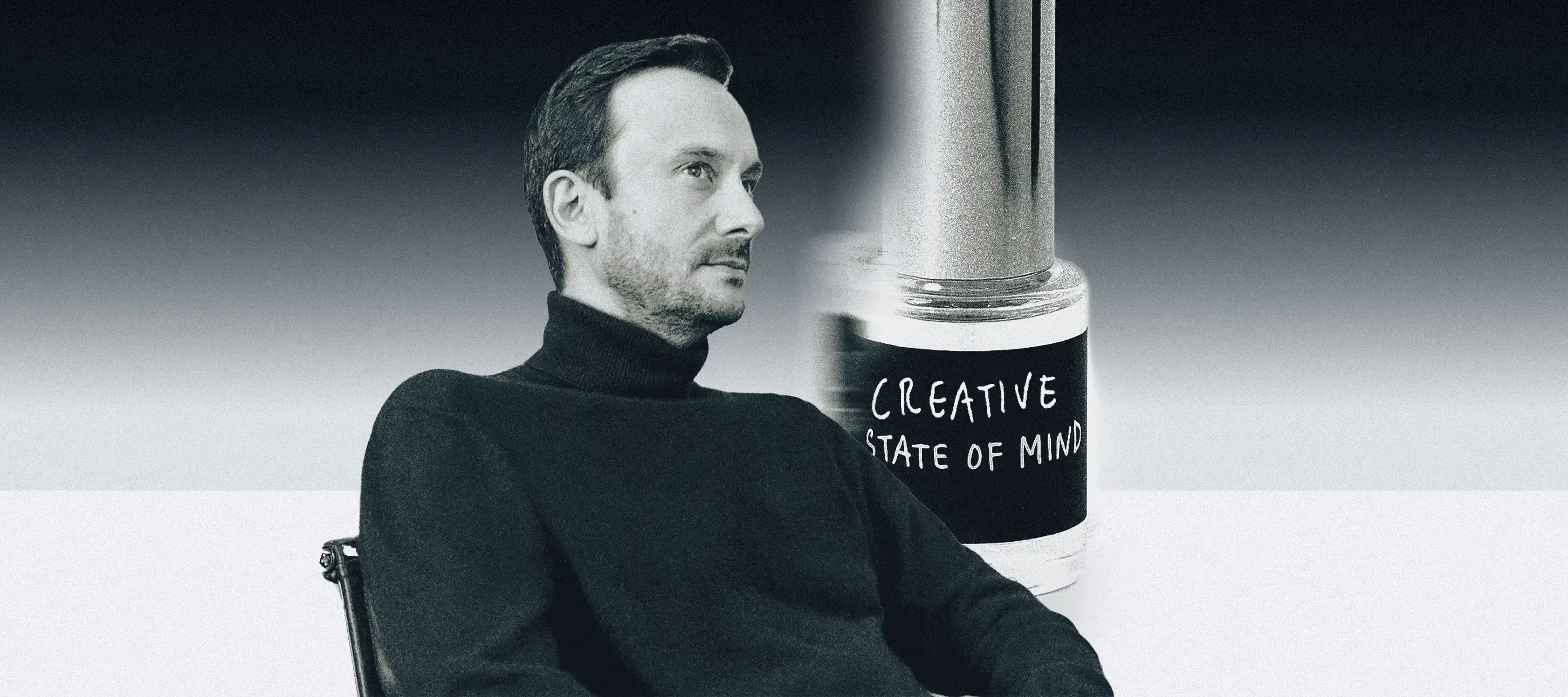
Now installed in the entrance hall of L’Oréal Italia’s Milan Headquarters, the piece invites visitors to pause and reconsider beauty as something mutable, collective and continually redefined. We spoke with Riccardo Lucii about processes, sustainability and the role of creative challenges in shaping contemporary practice.
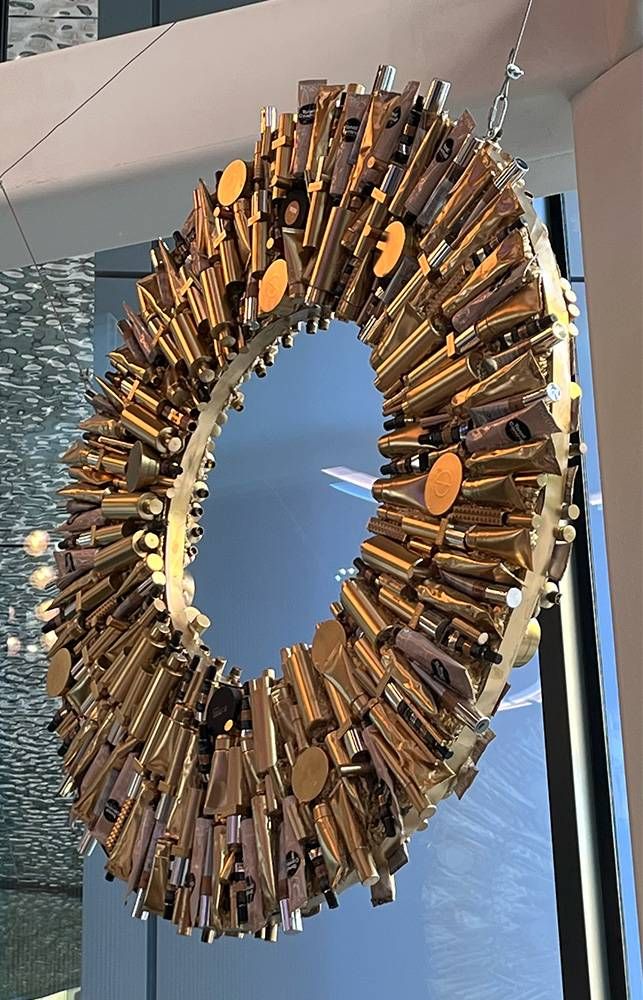
The Beauty Circle by Riccardo Lucii transforms unsold L’Oréal cosmetics into an upcycled installation, rethinking waste through circular design and sustainable beauty practices. Courtesy of the author
Upcycling Unsold Beauty Products as a Creative Process
The Beauty Circle is built from products that could no longer be sold. How did you turn upcycling into a visual narrative that expresses L’Oréal Italia’s values of beauty, sustainability and innovation?
Riccardo Lucii: My approach wasn’t about reusing single products as individual objects, but about grouping them together and giving them a new meaning through their collective presence. It was a very manual process, based on association, placing one element next to another until they started to communicate visually.
How did you find the final composition?
Riccardo Lucii: I invested a lot of time experimenting with different combinations, searching for a sense of balance and harmony. Only when the final composition felt right to me, I knew the work had found its form.
Building an Installation from Discontinued Cosmetics
How many iterations did it take to arrive at the final “Circle”?
Riccardo Lucii: Several attempts… and many hours! Sometimes I would spend an entire working day just understanding the right placement of each object, testing different configurations. Once the structure became clear, there was a more technical phase that was faster, though still very hands-on. I carefully marked the position of every single bottle, which then had to be repositioned again afterwards.
How many products are included in the installation?
Riccardo Lucii: Roughly 400. The initial research actually involved nearly 600 products, but through a process of selection, while positioning them, we arrived at the final number. They range from very small items to much larger ones.
Why Recycled Art Is Gaining Momentum in Contemporary Culture
From a sustainability perspective, what does it mean to transform non-marketable products into an artwork?
Riccardo Lucii: I think it’s an extremely powerful concept. Many artists have explored this path before, and often very successfully. Art based on recycling has definitely become a growing trend in recent years. But beyond trends, I believe it creates a very positive emotional response in people when they encounter the work. It changes the way discarded objects are perceived.
How the Beauty Industry Is Rethinking Waste and Product Value
How important is it for a young artist to engage with a company like L’Oréal and with an identity-driven space such as the Beauty Hub?
Riccardo Lucii: Collaborating with a brand such as L’Oréal means moving beyond unrestricted creativity and into a dialogue shaped by strong, articulated values. Translating them visually adds depth to the process, turning limitation into a space where creativity gains structure and purpose.
Visualizza questo post su Instagram
How did this experience influence your creative approach?
Riccardo Lucii: I strongly believe in the value of challenges. This one was particularly complex: it seemed simple at first, but I knew it would become demanding. When a solution appears very minimal or essential, there’s usually a great deal of detailed decision-making behind it.
When Creative Constraints Drive Innovation in Sustainable Art and Design
Did this project push you out of your comfort zone? If so, how did it shape your approach?
Riccardo Lucii: Not really intimidating. The fashion sector naturally connects with the Luxury Industry, where this Company sits. Professionally, I already work across both sectors in my current agency, so for me it felt like a very natural process.
Can Perception Redefine What We Recognise as Beauty Today
The artwork is displayed in a space that is experienced every day by employees and visitors. What kind of reflection would you like to spark in those encountering The Beauty Circle at L’Oréal Italia Headquarters?
Riccardo Lucii: I would like people to reflect on the concept of beauty itself, which I believe often lies in the eyes of the beholder. Through the creation of visual harmony, by bringing together products that individually might no longer be considered “beautiful,” it’s possible to rediscover beauty through a technical and artistic process. In a way, the work becomes a small lesson: an invitation to look more carefully, and to learn how to recognise beauty even where it seems to have been lost.
What advice would you give to students and young creatives starting out on a path like yours?
Riccardo Lucii: My advice is to try as many things as possible. The challenges that seem most complex, or least aligned with what you think is your path, are often the ones that help you grow the most. You always come out of them stronger, more experienced, and more aware of your potential.
Art, Waste and Meaning: What Changes When Value Is Reconsidered
In the end, the work leaves us with a simple but powerful question: what do we choose to see as beautiful? Because beauty, as The Beauty Circle suggests, emerges through the act of looking, and the meaning we give to what we see.
Silvia Tarini
Editor, Milano

.gif)
 BEAUTY The future of beauty professionals: New skills, new education, new cultural standards 01/04/2026