

How do you design a logo for a real client? The Casa Italia project for the Italian Embassy in London reveals the full process
Designing a logo for a real client is a world apart from creating one as a classroom assignment. It demands strategic thinking, cultural awareness, and the ability to translate complex values into a clear visual identity. But what happens when the client is an embassy, and the brand must represent not just an organisation, but an entire nation?
The Casa Italia logo, created for the Italian Embassy’s new cultural hub in London, exemplifies identity design in practice, translating research, concept development and institutional dialogue into a contemporary visual symbol. The creation of the Casa Italia logo—the new home of the Italian Embassy in London—offers a compelling case studyin identity design. What began as a design competition evolved into a professional brief, challenging Istituto Marangoni students in London to navigate the full logo design process, from research and concept development to refinement and institutional presentation.
So how do you design a logo for a diplomatic institution while keeping it modern and relevant? The Casa Italia project reveals what truly defines successful branding: clarity of purpose, negotiation between culture and context, and the discipline to translate complex meaning into something deceptively simple.
What Does It Take to Design a Logo for an Embassy?
When the Italian Embassy in London partnered with Istituto Marangoni London to launch a design competition for the visual identity of Casa Italia—its new cultural headquarters—the challenge was clearly defined.
Casa Italia was conceived as a bridge between culture, diplomacy and commerce—a strategic asset and a symbol of Italy’s renewed diplomatic presence in the UK. In other words, it was envisioned as an emblem that would inspire innovation and foster international dialogue within London’s global context. The logo, therefore, needed to express this sense of connection without relying on visual clichés, conveying both openness and relevance.
A project of this nature inevitably carries a distinct layer of responsibility. Designing for an embassy is an act of representation. Institutional branding holds symbolic weight, and from typography to proportion, every graphic decision shapes how the organisation is perceived across cultural and political contexts.
Why a Strong Design Brief Shapes Every Successful Logo
Before any sketching began, the process started with the client brief. In professional logo design, understanding the brief is often more important than the initial concept. Who is the audience? What values should the brand communicate? Where will the logo appear—on print, digital platforms, or architectural signage?
For the Casa Italia logo, the Italian Embassy made several specific requests: to express Italy’s diplomatic presence in the UK, to operate within London’s visual landscape, to balance tradition and modernity, and to create a flexible visual system suitable for diverse applications.
This was not a university project, but a real client design competition with institutional visibility—so the expectation was industry-level thinking from day one.
Inside the Logo Design Process of a Real Client Project
The logo design process evolved through experimentation and continuous feedback. Visual research explored both Italian graphic heritage and British design culture, and London itself became an inspiration.
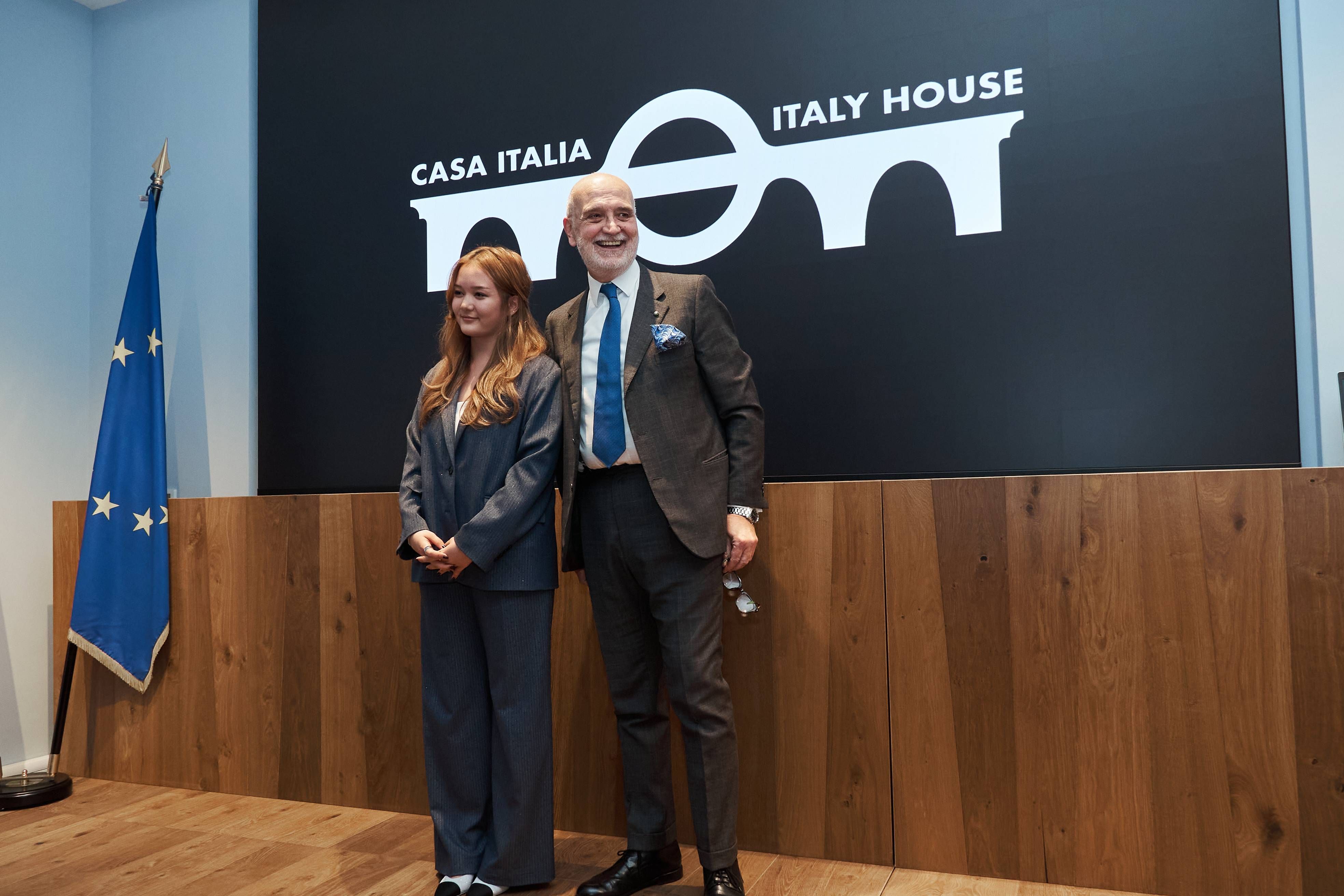
Jamilya Orak, third-year Visual Design student at Istituto Marangoni London, with the Italian Ambassador to the UK, Inigo Lambertini From this research emerged the winning concept by Jamilya Orak, a third-year Visual Design student at Istituto Marangoni London. Her proposal centred on two interlocking keys: one representing Italy, the other the United Kingdom. Together, their forms create a graphic bridge between the two nations, with a central circular element evoking the iconic London Underground roundel.
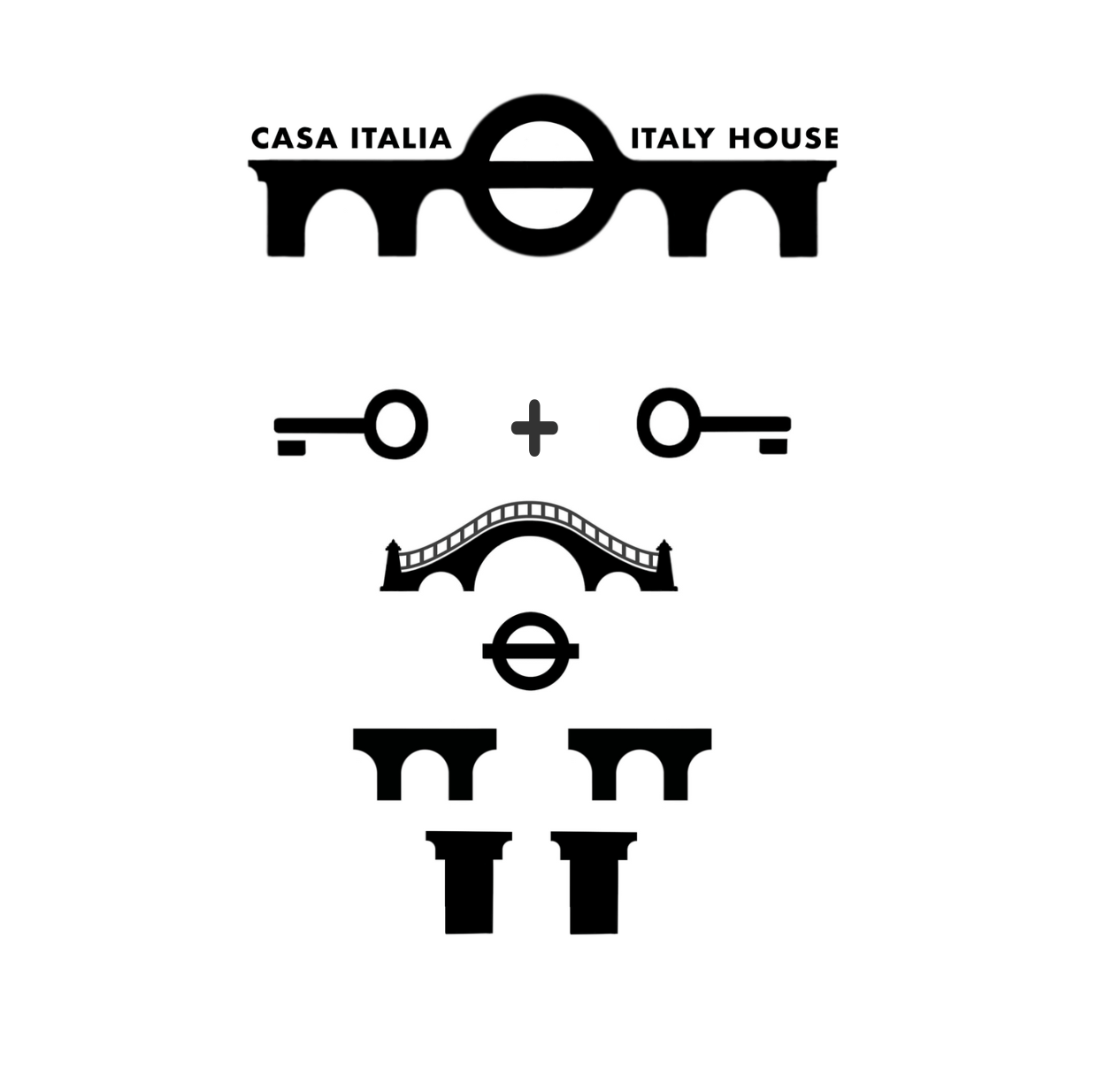
“I started by researching symbols that already shape identity and movement within London. The London Underground was a big inspiration: it’s iconic, graphic and instantly recognisable,” explained Jamilya Orak. “From there, I designed an emblem of two keys to represent the diplomatic relationship between Italy and the UK. The aim was to bring together history, place, and partnership in a single, coherent visual symbol.”
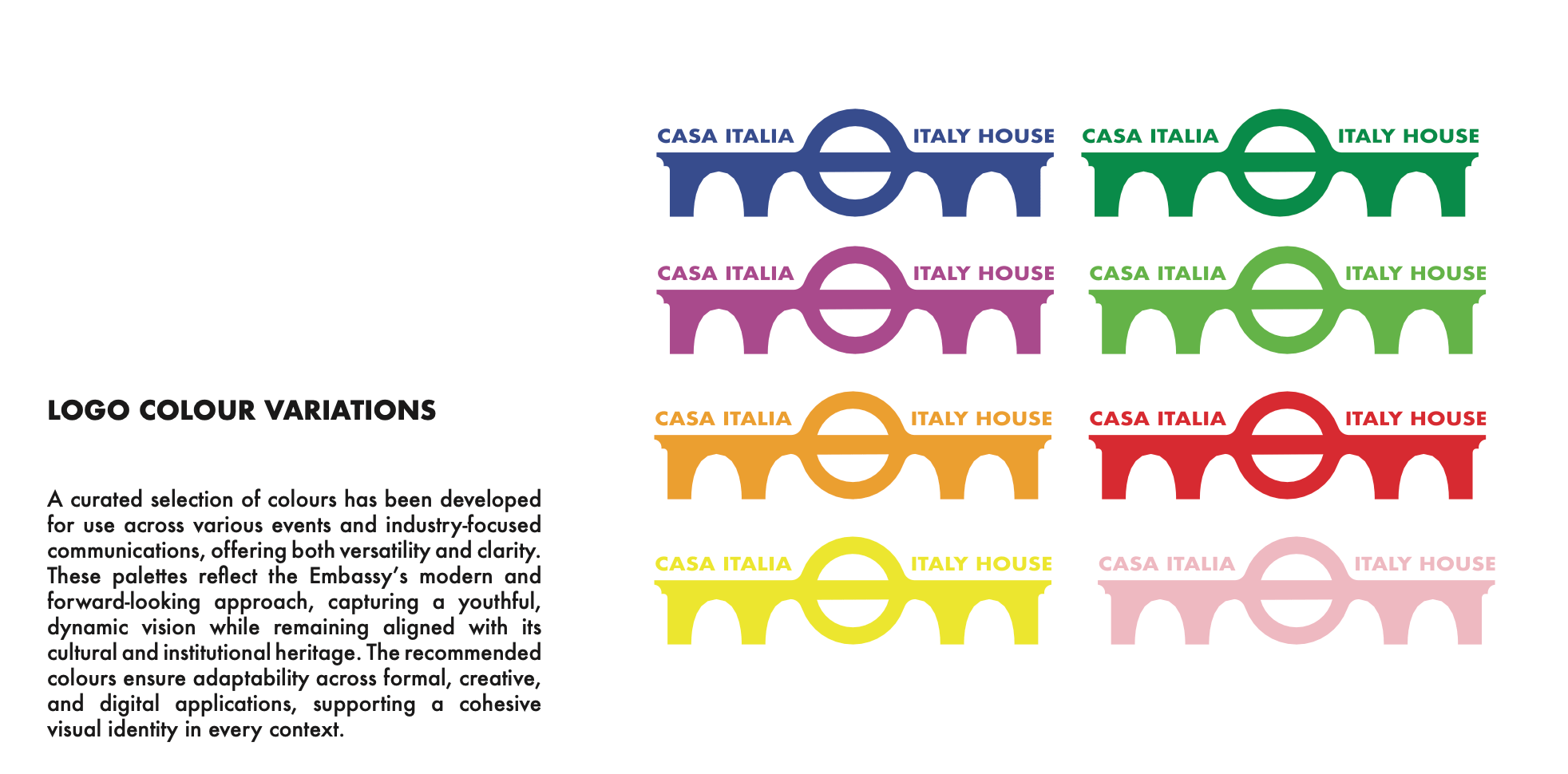
The strength of the mark lies in its discipline. The interlocking forms create a balanced, contemporary silhouette, while references to historical graphic traditions lend depth without overwhelming the composition. The resulting brand identity combines Italian minimalism with bold British avant-gardism, creating a confident presence suited to London’s design scene.
In Institutional Branding, What You Remove Defines the Mark
“The logo is a promise. The logo is not the brand itself. It is a form of expression of the brand” – Jörg Zintzmeyer, Logo Design (Taschen)
Design requires restraint. “When a project carries cultural and diplomatic meaning, the temptation is often to overcomplicate it—to add symbols, references, or decorative elements,” stated Patrick Morgan, Visual Design Unit Leader at Istituto Marangoni London. “Yet strong logo design often calls for the opposite: in professional branding, confidence often lies in what is removed,” Morgan emphasised throughout the competition, encouraging students to refine rather than embellish.
Equally crucial was feedback, with iteration being central to the process. Concepts were tested, challenged, and honed through structured critique, mirroring the way real-world design studios operate. “Feedback is everything”, confirmed Morgan. “It broadens a student’s perspective and gives them a deeper, more realistic understanding of design as a profession. Learning to evolve ideas and respond constructively to evaluation is fundamental to becoming an independent creative.”
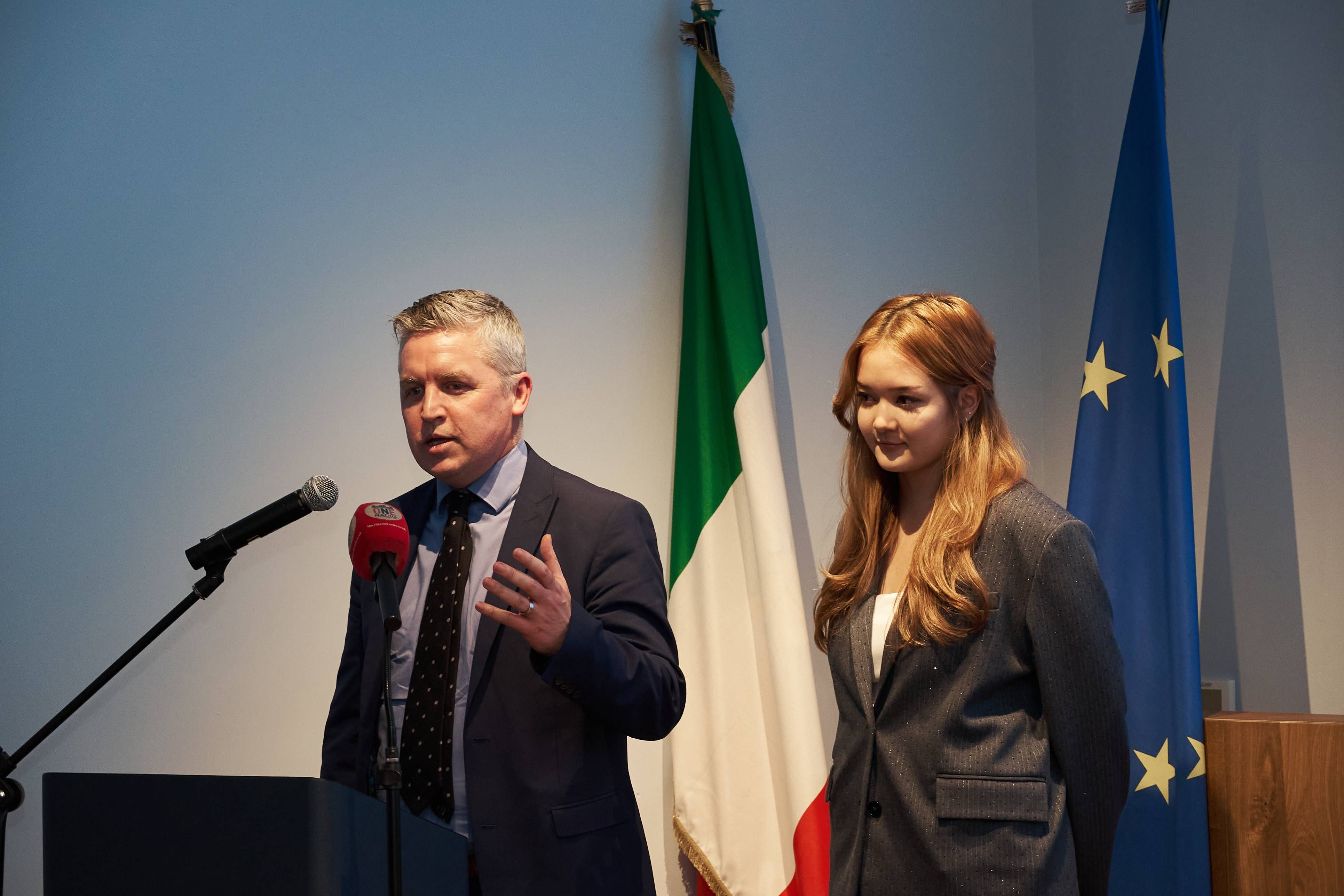
Jamilya Orak, winner of the Casa Italia logo design competition, with Istituto Marangoni London’s Visual Design Unit Leader, Patrick Morgan, at the Italian Embassy conference marking the inauguration of Casa Italia, January 2026 “Seeing students’ projects move from concept to potential production—and ultimately being showcased or adopted by an institution—is incredibly motivating,” Morgan added, noting that for the school it marked a moment of recognition not only for its emerging designers, but for the entire Visual Design department. “We were incredibly proud.”
When a Student Project Becomes an Official Visual Identity
For many participants, Casa Italia represented their first experience working on a live branding project. Unlike hypothetical briefs, this project carried tangible consequences: the winning design would move beyond the studio and into official use. As Patrick Morgan explained, “This demonstrates the high level of expectation and trust placed in Istituto Marangoni students. The winning design becomes an industry-level piece that will live on, representing an institution beyond all of us. That’s the kind of experience that stays with a designer for life.”
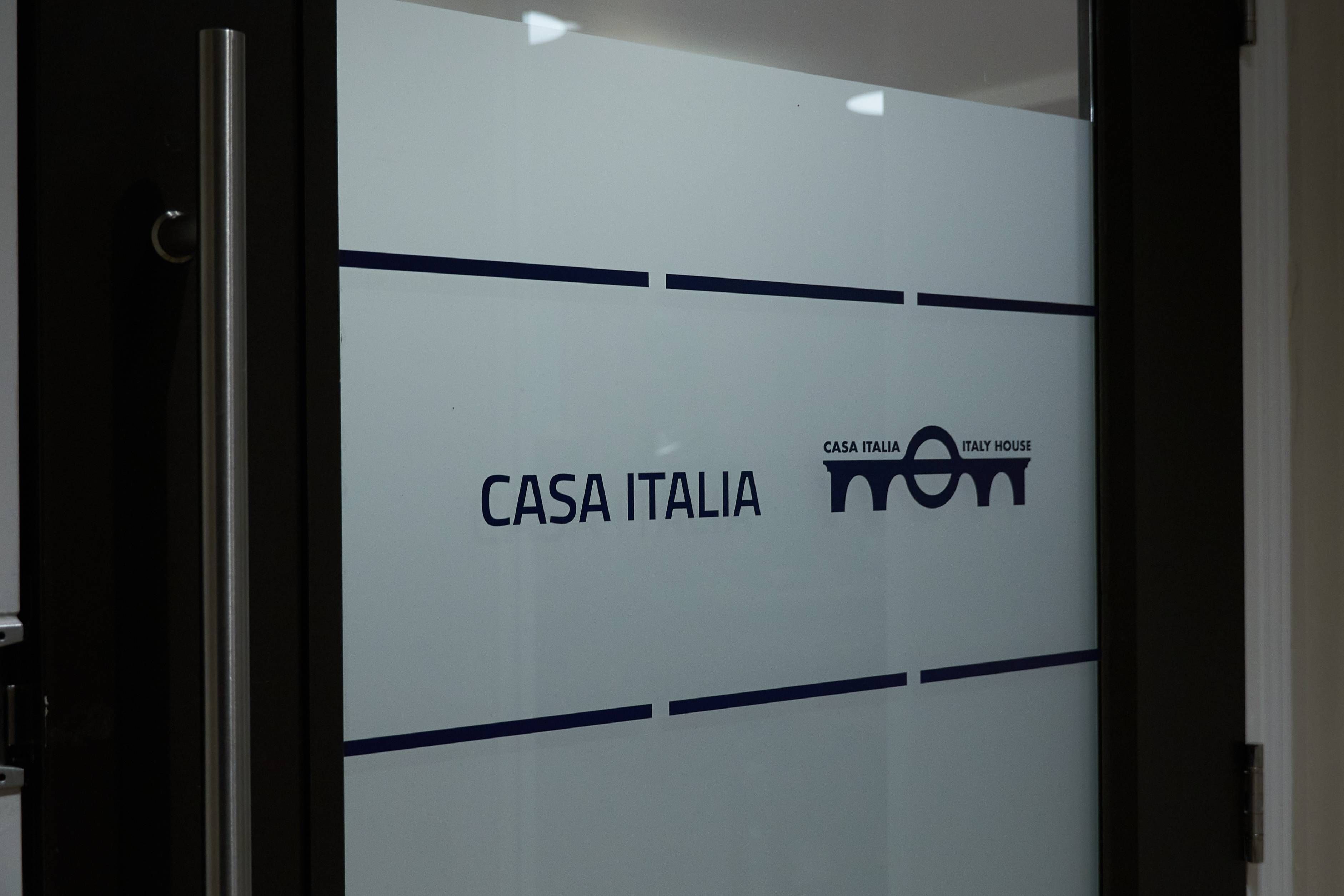
The Casa Italia logo displayed on the door of the new home of the Italian Embassy in London When Jamilya Orak’s logo was selected and later presented at the inauguration of Casa Italia in January 2026, the moment marked a transition from academic project to professional achievement. “It was a cycle of emotions: excitement, shock, pride,” she reflected. “It’s surreal when something you sketch in a classroom becomes real and recognised on such an institutional level.”
For design students, projects like this redefine what a portfolio can represent. A real client commission showcases not only aesthetic sensibility and research depth, but also strategic thinking and professional maturity. In Patrick Morgan’s words, “by the time they complete their academic journey, with experience of this level in their portfolio, students feel ready to step straight into the industry. Many even gain the confidence and skills to launch their own entrepreneurial ventures. Today, having that mix of practical skills, informed learning and industry exposure is essential.”
How Working with a Real Client Transforms a Design Portfolio
The Casa Italia case study illustrates several key principles for anyone learning to design logos professionally: a strong concept begins with research; a clear client brief anchors the creative process; institutional branding demands restraint and precision; iterative feedback strengthens ideas; and real-world projects accelerate professional confidence.
Ultimately, the success of the Casa Italia logo lies not only in its visual clarity but in the process behind it. The project demonstrates how academic environments—when aligned with industry standards—can simulate the realities of professional design practice. As Morgan advises students facing complex briefs: “Take every project seriously, even the ones that feel overwhelming. You never know which idea might travel beyond the classroom and take on a life of its own.”