
Biophilic lighting design: How a student project became an award-winning piece
From student project to award-winning design, VIDA shows how biophilic principles influence contemporary interiors and wellbeing
From student project to award-winning design, VIDA shows how biophilic principles influence contemporary interiors and wellbeing
What is biophilic lighting design, and why is it becoming central to how we experience contemporary interiors? More designers are turning to nature-inspired principles due to their impact on how we feel in a space. Light, in particular, plays a key role in creating a sense of calm and balance while fostering emotional connection and wellbeing.
While established names continue to define the field, emerging talent is driving innovation, and Brazilian designer Mariana Prestes serves as a compelling example. Her project VIDA, originally conceived as a student assignment, has evolved into an award-winning lighting design rooted in biophilic principles, translating the relationship between humans and nature into a sculptural object.
We spoke with Prestes about the inspiration behind VIDA, how it transitioned from an academic concept to production, and what it feels like to see a classroom idea reach the global design stage.
What Is Biophilic Lighting Design?
Biophilic lighting design is an approach to lighting that draws on patterns, forms and references found in nature to influence how a space is experienced. Beyond illumination, it considers how light interacts with materials, proportions and spatial rhythms, often using organic lines, softened contrasts or diffused sources to evoke natural conditions.
In this way, lighting becomes part of a design language that fosters a sense of balance and emotional connection in contemporary interiors, turning functional elements into an atmospheric experience.

VIDA lighting installation explores biophilic design principles, combining organic forms and soft light to enhance atmosphere and wellbeing in contemporary interiors. Courtesy Vida
How Personal Identity Shapes a Designer’s Creative Path
Mariana Prestes describes herself today as a multidisciplinary designer and visual artist, although, as she admits, “it took some time to fully embrace that identity.”
Originally from Porto Alegre in southern Brazil, her career didn’t begin in product design at all. After graduating in Social Communication – Advertising in 2008, she spent several years working as an executive in advertising agencies. Creativity, however, was always present in her life. She grew up surrounded by art and design: her mother is a journalist specialised in architecture, art and design, while her father works as a cultural producer.
After seven years in advertising, Prestes decided to follow a different creative direction and began working in surface design. Using watercolour techniques, she created collections of decorative patterns that often portrayed endangered species of Brazilian flora and fauna.
Many of these pieces were inspired by the landscapes and ecosystems of southern Brazil—themes that would later become central to VIDA’s concept.
How Nature Continues to Inform Contemporary Design
The VIDA project was born during the pandemic in 2020, when Prestes enrolled in the online Product Design Short Course at Istituto Marangoni. For the final assignment, Professor Gustavo Martini asked students to design a lamp that represented their origins, culture and hometown.
For Prestes, inspiration immediately pointed back to Rio Grande do Sul, the southern Brazilian region where she grew up. One of her key references was the Yellow Cardinal, the most endangered bird species in Brazil, found only in that region. Prestes had previously portrayed the bird in watercolour as part of one of her surface design collections.
The bird’s survival depends on a specific tree species, but it also benefits from open pasturelands created by cattle grazing. This interplay between human activity and nature underlies VIDA’s central idea.
“The lamp became a metaphor for coexistence,” explains Mariana Prestes. “Just as birds often rest on electrical wires installed by humans, the design explores the possibility of balance between the natural world and human intervention.”
Originally titled Life Balance, the concept combines straight structural lines representing human rationality with soft curves inspired by the rolling hills of the Pampa biome in southern Brazil. Small points of light appear to rest delicately on the rods, like birds landing on branches or moments of equilibrium within nature.
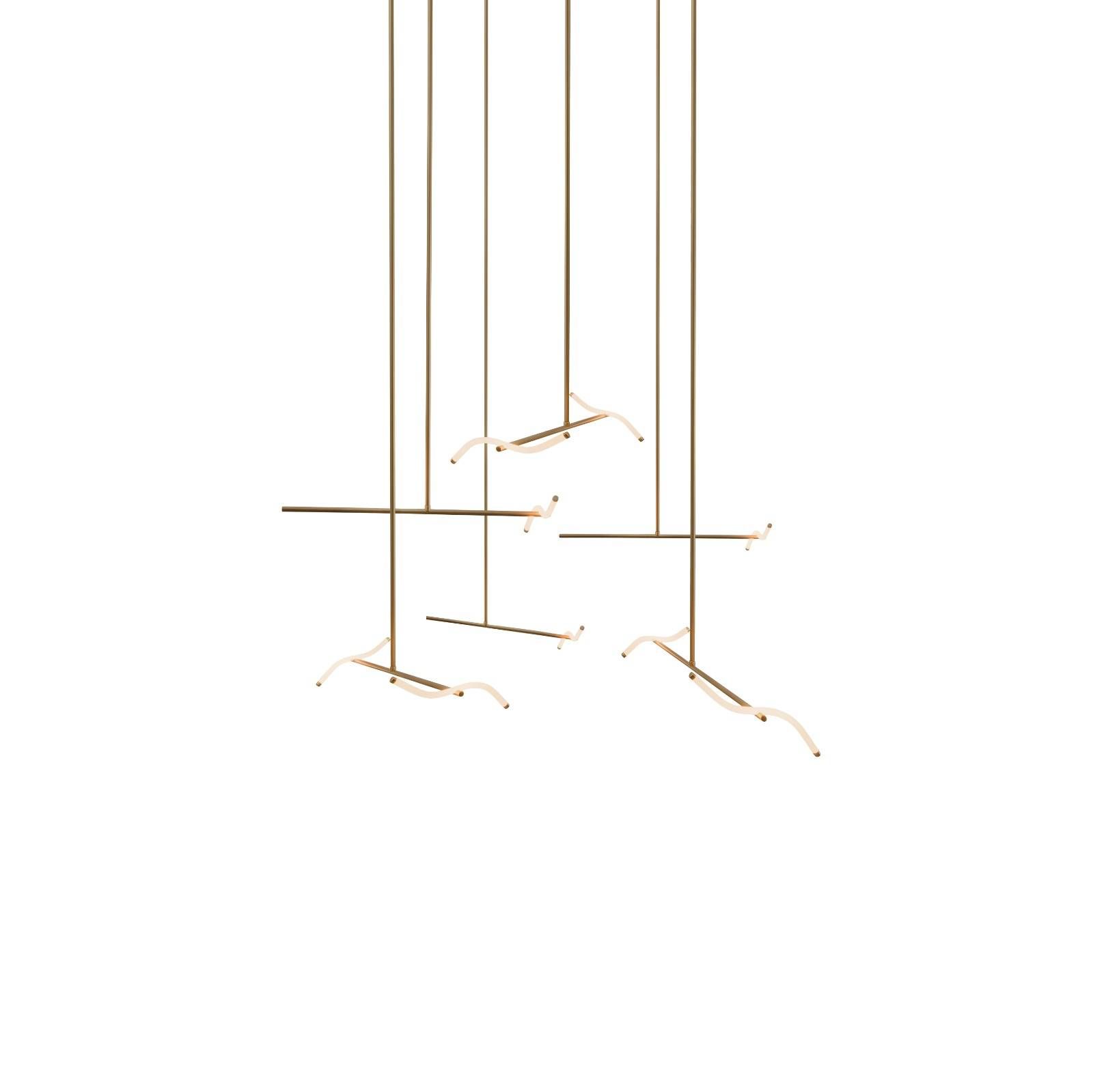
VIDA modular pendant system by Mariana Prestes translates nature-inspired forms into flexible lighting configurations for architectural and interior design projects. Courtesy Vida
From Concept to Object: The Visual Language Behind VIDA
Emerging designer Mariana Prestes usually begins her creative process with keywords and visual references rather than examples of existing products. For VIDA, these inspirations included landscapes, birds, electrical power lines, and contrasts between organic and structural forms.
From there, she began sketching extensively. “Despite my background as a visual artist, my product sketches are often very simple lines and quick explorations,” she notes. Gradually, the concept evolved into a system of vertical rods paired with flowing curves.
The first version of VIDA was envisioned as a single ceiling pendant composed of several rods. Encouraged by positive feedback from Professor Gustavo Martini and Stefano Caggiano, coordinator of the Product Design programme at Marangoni, Prestes continued developing the concept.
After completing her Master’s degree in Product & Furniture Design in Milan, where she refined the project, she presented VIDA to Itens Collections through its director, Mariana Amaral, who immediately expressed interest in producing it. However, the pandemic delayed production, and prototyping only began at the end of 2024.
During development with Itens Collections, the design evolved into a modular system of individual pendants with different heights and lengths. This made transportation easier and enabled architects to create unique installations—linear, circular, or sculptural—so that each VIDA configuration is slightly different. The lighting technology was also refined: the original LED strip was replaced by an LED tube solution, developed with Amaral and her technical team. A small groove integrated into the metal rod allows the light source to rest delicately within the structure, reinforcing the idea of balance.
“When a design becomes a product, it is never the result of one person alone; it is always the outcome of collaboration,” Prestes points out.
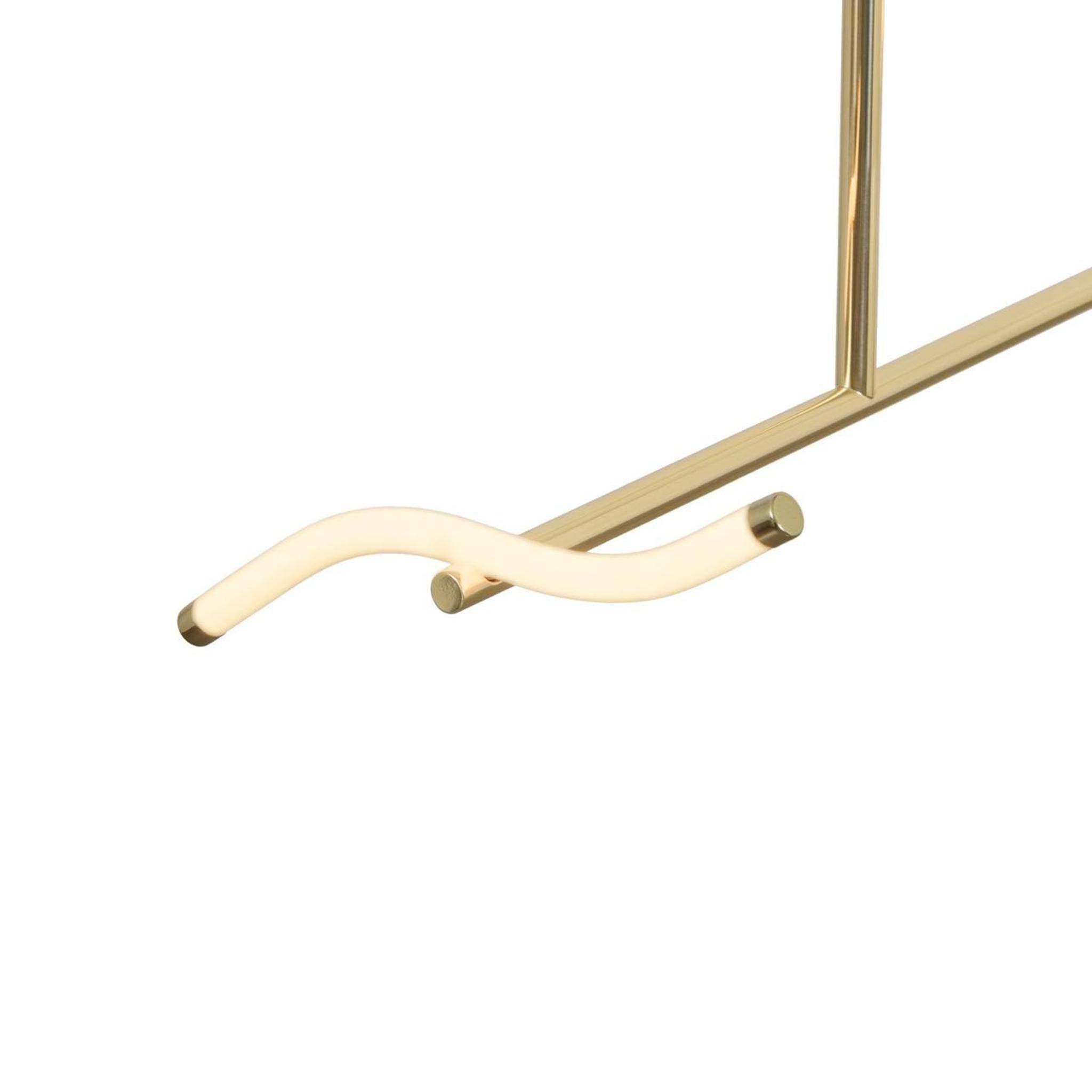
Detail of VIDA lighting shows the balance between structural metal rods and organic LED curves inspired by natural rhythms and biophilic design. Courtesy Vida
How Lighting Design Influences Mood, Atmosphere and Wellbeing
Beyond its visual language, VIDA was designed to communicate a sense of balance. “More than reflecting my idea of a possible coexistence between humans and nature, I wanted the lamp to feel sculptural and elegant within a space,” Prestes adds.
Interestingly, she has noticed that many people describe a sense of calm when interacting with the piece; some even say it feels “almost meditative.” For the emerging designer, this response is deeply meaningful as one of her goals is to create objects that contribute to wellbeing in everyday environments.
Why Award-Winning Design Signals More Than Recognition
When VIDA received the iF Design Award, one of the most respected recognitions in global design, the moment was deeply emotional for Prestes. While winning the award had long been a professional goal, receiving it with the very first product she ever designed made the achievement even more special.
The recognition also marks an important milestone in her transition from advertising to design—a path that “required persistence and commitment.” Prestes also highlights the importance of her collaboration with Itens Collections: “it has strengthened my motivation to continue exploring new directions in product and furniture design.”
Among the voices who inspire her most is Italian multidisciplinary designer Elena Salmistraro, who also mentored her during the Master’s programme at Istituto Marangoni Milano.
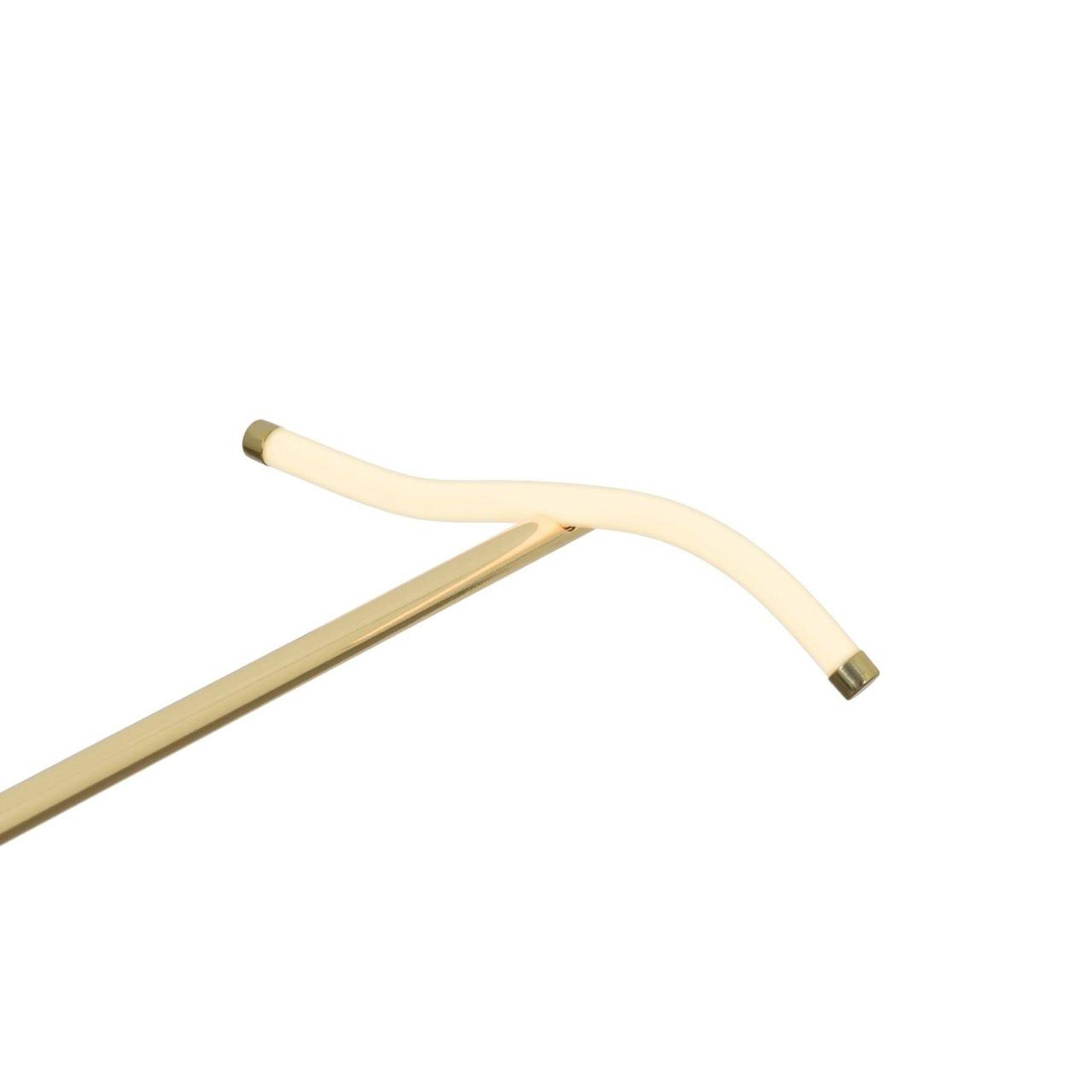
Close-up of VIDA lamp highlights the integration of light and form, reflecting the coexistence between human design and nature in contemporary lighting. Courtesy Vida
Turning a Design Idea into a Real Product: Lessons for Emerging Designers
Looking back, Prestes emphasises the importance of mentorship and encouragement throughout the project’s development. “As an international student in Milan, I felt supported and welcomed while developing my ideas,” she says. “The feedback from professors Martini and Caggiano gave me the confidence to present the project to industry partners.”
For students hoping to turn academic projects into real products, Prestes offers simple advice: “trust your ideas.” Functionality is essential, she notes, but projects are stronger when they also carry emotion, cultural identity, and personal meaning. “I encourage young designers to stay curious, visit museums, observe the city, learn from nature, and seek inspiration beyond the design world,” she adds. “By combining cultural roots, artistic inspiration, and thoughtful design thinking, designers can create objects that truly improve people’s lives.”
Ultimately, Prestes believes design has the power to positively impact the world—when created with passion and care.
Paola Toia
Editor, Milano







.jpg)
.jpg)