

How did a $2.99 Trader Joe’s tote bag become a global status symbol?
The Trader Joe’s tote bag is now a global status symbol: a $2.99 grocery bag driving resale mania, cultural debate and a new generational identity
The Trader Joe’s tote bag is now a global status symbol: a $2.99 grocery bag driving resale mania, cultural debate and a new generational identity
How did a $2.99 grocery tote become one of the decade’s most unlikely status symbols?
The Trader Joe’s tote bag—a simple canvas carryall with reinforced handles and a proudly retro logo—has evolved from supermarket staple to global cult favourite. No designer pedigree, no influencer push, no online shop. Yet it’s photographed, resold, analysed, and obsessively hunted. What began as a practical shopping bag has shed its anonymity to become a generational badge of taste, irony, and belonging. How did it happen, and why now?
How the Trader Joe’s Tote Bag Went Viral Without Marketing
The rallying cry for the Trader Joe’s bag hype didn’t come from a runway show or celebrity endorsement, but from pure observation. Audio producer Holly Davies wrote on Substack about spotting the bag everywhere—on shoulders that seemed to have nothing in common, whether geographically, socially, or stylistically.
That intuition sparked a deeper investigation by The Wall Street Journal, which set out to untangle the strange rise of this cross-category it-bag: part practical workhorse, part accidental symbol of a loosely defined community.
Visualizza questo post su Instagram
Why the Trader Joe’s Tote Bag Is So Popular
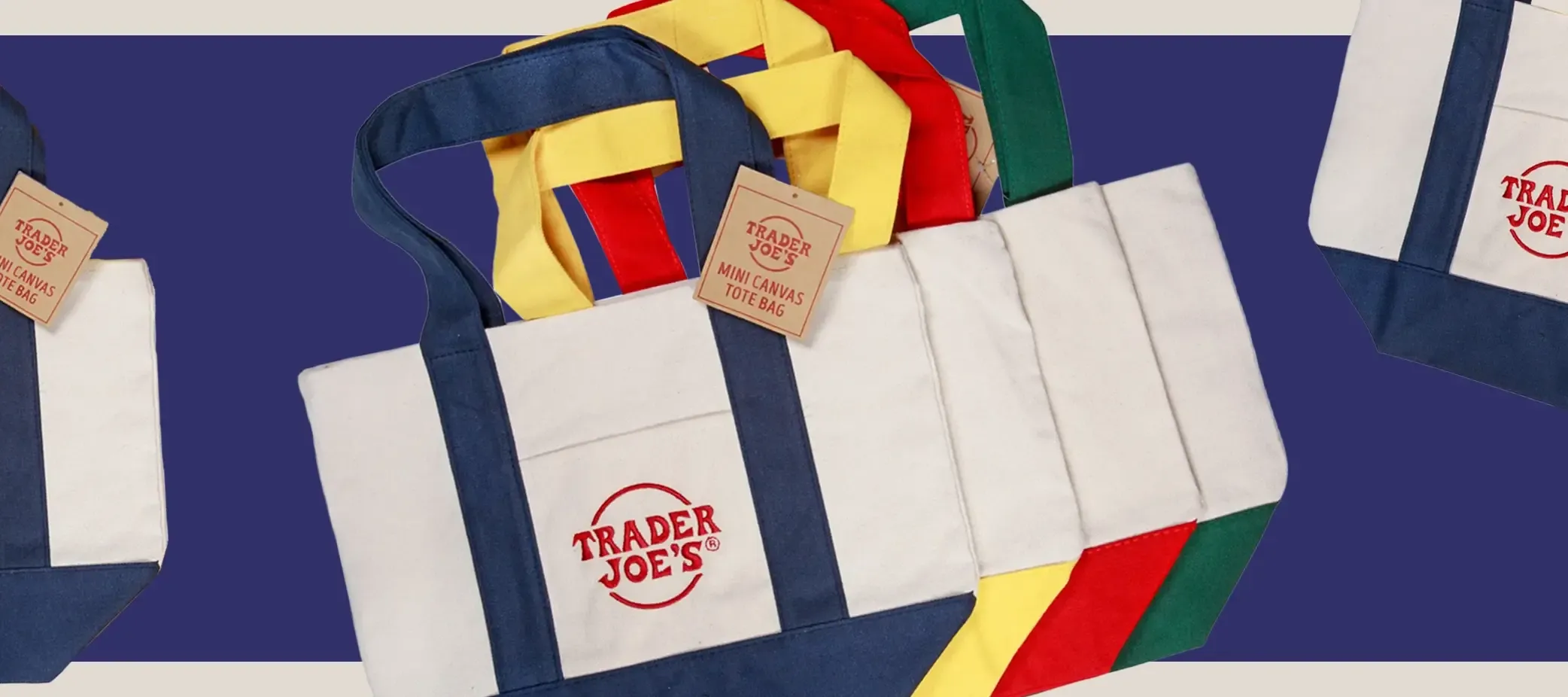
Let’s look at the bag itself. The colours vary, but the most beloved version remains the rough, classic white-and-blue canvas with the red embroidered logo—never rebranded, never “cleaned up” for Instagram. The Trader Joe’s mini tote, with its green handles, is especially coveted.
Price? $2.99 for the mini, slightly more for the larger sizes, if you’re lucky enough to find them at one of Trader Joe’s 618 U.S. stores. Ordering online doesn’t help: by company policy, nothing ships. And that’s precisely where the Trader Joe’s tote bag scarcity myth begins.
The Trader Joe’s Tote Bag Resale Phenomenon
When something is cheap, useful, and hard to find, desire fills the gap. The resale market for Trader Joe’s tote bags has blown up, stretching from Europe to Asia on dedicated platforms. What started as a humble, eco-domestic object, meant to carry groceries and bear weight, has become a full-on cult object.
One limited-edition bag reportedly hit the surreal resale peak of $50,000. Yes, for a grocery tote. At that point, it stops being an accessory and becomes a story that people want to own, share, and show off.
@inmacurrr Por 3’99$ te unes al club 👜 😂#traderjoe #totebagviral ♬ Solo quiero ser uno de ellos - BetterGood
The Appeal of a Bag That Refused to Become a Brand
So why this bag, and why now? First, the aesthetics. Clean but not sterile, retro without trying. The logo is unapologetically old-school, machine-embroidered, and untouched by modern branding trends. In an era of aggressive minimalism, the Trader Joe’s bag stands out by staying the same.
According to the company, the bags are made in Vietnam—hardly artisanal lore—but authenticity now is less about origin and more about perceived intention. Trader Joe’s, famously allergic to conventional marketing, never meant for this to happen. And that might just be its greatest strength.
Why Tote Bags Work as Walking Advertisements
Tote bags have long been an underrated marketing weapon: silent, mobile, and everywhere at once. Harrods figured this out back in the 1990s, spreading its prestige through iconic plastic bags rather than organic cotton. The principle hasn’t changed.
Word of mouth remains the most powerful marketing tool, and wearing a bag through the city amplifies that power exponentially, without ever saying a word. The message travels quietly and persistently on your shoulder.
Visualizza questo post su Instagram
What Your Tote Bag Says About You
Over time, the tote bag has evolved into something of a wearable manifesto. Much like sports jerseys or team scarves, it signals belonging. In the early 2000s, carrying a Rough Trade tote meant aligning yourself with a certain kind of music and a whole musical philosophy.
Today, that tradition lives on. Carry a MUBI tote? You love cinema. The New Yorker tote, printed since 2014? You’re into long-form journalism and opinion pieces. Shakespeare & Company in Paris? You’re a romantic, probably bookish, definitely nostalgic.
The Semiotics of the Tote Bag
In this sense, tote bags are now the last spontaneous frontier of social classification—a quiet graphic business card. They’re a semiotic playground that would have delighted Umberto Eco and invited multiple readings through Roman Jakobson’s communication theory.
The tote’s metalinguistic code extends far beyond the object itself, shifting the focus from carrying things to carrying meaning.
The Tote Bag as a Test of Performative Masculinity
What remains undeniably social, and even a bit political, is the tote’s role in how we perform identity today.
In the summer of 2025, The New York Times ran a tongue-in-cheek guide to spotting a “performative male”—the opposite of toxic masculinity. Step one? Look for a tote bag. Step two? Check what he’s reading. If it’s Sally Rooney or Dolly Alderton, congratulations: you’ve found the epitome of the performative male. But that’s a whole other story.
A $2.99 Trader Joe’s Tote Bag as a Global Status Symbol
For now, the Trader Joe’s tote bag sits at a fascinating crossroads: inexpensive yet exclusive, practical yet symbolic, anonymous yet instantly recognisable.
In other words, the Trader Joe’s viral tote bag trend is proof that in an over-branded world, sometimes the most powerful status symbols are the ones that never set out to be symbols at all.









.jpg)

.jpg)