
Does the fashion calendar still make sense as the climate changes?
Europe’s heatwaves are exposing a growing mismatch between fashion’s seasonal rhythm and a rapidly changing climate
The fashion calendar was built for a climate that no longer exists. Paris Fashion Week Men’s SS27 became an unexpected stress test for an industry still tethered to seasonal rhythms that have grown profoundly unpredictable. As Europe endured record-breaking heatwaves and temperatures soared near 40°C, the week revealed how quickly a decades-old system is falling out of sync with the environment it was built around. Bridging that gap is one of the defining challenges for fashion’s next chapter.
How Rick Owens Turned Extreme Heat Into a Design Statement
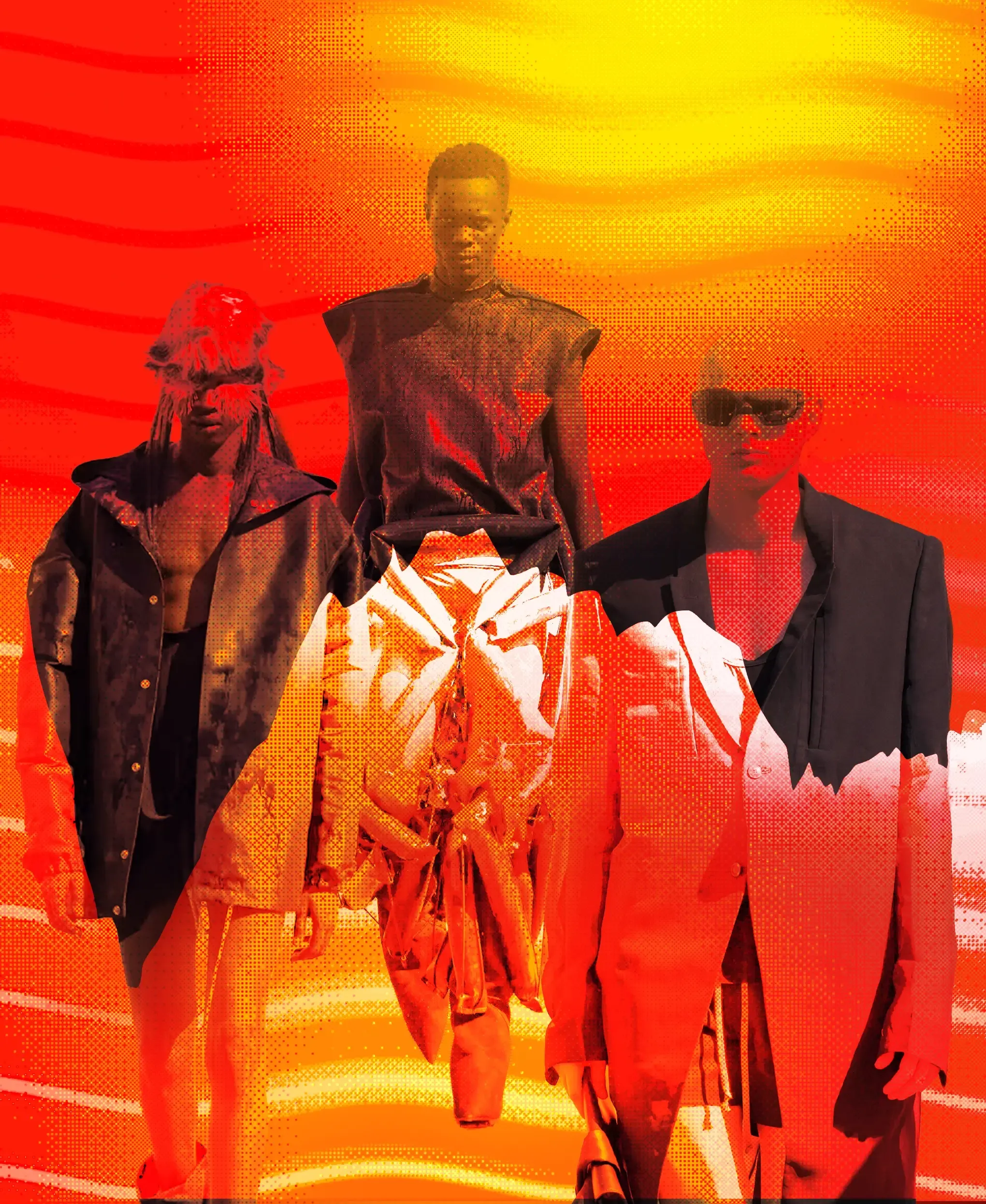
The most symbolic response to the climate crisis came from Rick Owens’ men’s SS27 show, where the runway was rescheduled from midday to 10 a.m. to avoid the day’s most intense and potentially dangerous heat. It was a pragmatic decision, but also one that perfectly illustrated the industry’s new reality.
Even more striking was the collection itself, which anticipated the conversation. Garments were cut open to expose the body, tailoring skewed asymmetrically across silhouettes, and several looks incorporated battery-powered cooling fans hidden inside the clothes.
Rick Owens described the collection as an exploration of menace and uncertainty, and perhaps nothing feels more threatening today than the increasingly visible consequences of climate change.
Visualizza questo post su Instagram
Fashion Week Was Never Designed for 40°C
There was something almost surreal about watching Spring/Summer 2027 collections amid extreme weather. Outside the venues, editors scrambled for shade between appointments, and guests clung to handheld fans and iced water to stay cool.
Many brands handed out parasols, chilled towels, and misting devices to keep audiences comfortable, while some venues struggled to maintain tolerable indoor temperatures.
Fashion has always floated slightly above reality, spinning fantasies that transcend everyday life. But climate change is now exposing the limits of that illusion. When extreme heat affects production, logistics, attendance and even the physical well-being of everyone involved, the traditional runway format suddenly appears surprisingly fragile.
The industry has spent years discussing sustainability in terms of materials, supply chains and carbon emissions. Today, another question demands attention: Can Fashion Week itself survive rising temperatures without fundamentally reinventing itself?
Why the Fashion Calendar No Longer Matches the Seasons
For decades, the fashion industry has adhered to a rigid seasonal calendar. Women’s Autumn/Winter collections are unveiled in February and March, while Spring/Summer collections are presented in September. Men’s Fashion Week follows its own schedule, with collections shown in January and June, followed immediately by the haute couture shows. It is a rhythm inherited from another era – one in which seasons were more predictable and weather extremes far less common.
Climate change is disrupting that certainty. Europe is warming faster than almost every other continent, with increasingly frequent and intense heatwaves becoming the norm rather than rare exceptions.
As temperatures rise, the mismatch between the traditional fashion calendar and real climatic conditions grows starker. Consumers experience warm autumns, unpredictable winters, and extended summers, while brands continue to present collections according to a timetable established generations ago. The very concept of “seasonal dressing” is beginning to lose its meaning.
Visualizza questo post su Instagram
The Next Fashion Week Will Be Designed Around the Weather
Rather than dismissing this year’s heatwave as an isolated inconvenience, fashion could see it as an opportunity to rethink one of its oldest traditions.
Morning presentations, like Rick Owens’ shift, may become increasingly common. Evening runway shows could return not only for their cinematic atmosphere but also for the practical benefit of cooler temperatures for audiences, models, and production teams alike.
Indoor venues with robust climate control could replace dramatic outdoor settings, even at the cost of some of the visual drama that has long defined fashion weeks.
Technology could soon play a much bigger role. The hybrid formats pioneered during the pandemic proved that digital audiences are not necessarily a compromise. Livestreams, immersive broadcasts and virtual experiences can complement physical events, reducing travel while expanding global reach. Rather than packing hundreds of editors and buyers into a few exhausting days, fashion weeks could evolve into longer, more flexible, and less physically taxing.
At the same time, collections themselves may evolve. The rise of trans-seasonal dressing already reflects changing consumer behaviour, but future collections may go even further, abandoning rigid seasonal categories altogether. Designers are now experimenting with breathable tailoring, adaptive construction, cooling textiles, and technical materials that combine luxury with functionality. Performance, once reserved for sportswear, could become one of fashion’s most desirable forms of innovation.
Climate Change Is Redefining Fashion’s Rules
Of course, none of these solutions comes without compromise. Indoor venues demand significant energy, longer fashion weeks drive up production costs, and digital presentations cannot fully replace the emotional impact of a live runway. Fashion has always relied on spectacle, human interaction, and the unique electricity of hundreds of people witnessing a collection together. That magic is difficult to replicate on a screen.
Yet history shows that fashion has always evolved in response to social changes. It has survived wars, financial crises, pandemics, and technological revolutions because reinvention is part of its DNA. Climate change may simply become the next catalyst for transformation.
Rather than resisting reality, the industry now has an opportunity to redesign itself around it, creating formats that are more resilient, more inclusive, and ultimately more relevant.
Visualizza questo post su Instagram
The Runway Is Changing Because the Climate Already Has
The biggest lesson from this Paris Fashion Week Men’s SS27 is that climate is no longer just influencing fashion trends: it is influencing fashion itself. The runway can no longer pretend that seasons behave as they once did, nor can designers ignore the physical conditions in which their collections are presented and ultimately worn.
The question, then, isn’t whether fashion can survive global warming. It almost certainly will. The real challenge is whether it can evolve quickly enough to ensure that tomorrow’s runway remains as visionary as the clothes it celebrates.
Angelo Ruggeri
Journalist and Tutor for Styling, Business and Design Course and Master’s Programmes, Milan





.jpg)