

Award-winning student projects in AI, lighting and visual communication are entering contemporary design culture in 2025–2026
A student project rarely stays confined to where it was made. Especially in design—perhaps one of the most open fields for emerging creatives—ideas circulate far beyond their academic origins through exhibitions, international awards and design platforms, all while carrying traces of the research and experimentation that shaped them.
In recent months, projects from Istituto Marangoni Milano Design have been recognised by the iF Design Award, D&AD New Blood, the ADCI Awards, the European Product Design Awards, and Sergio Cereda Design Awards. These honours matter, yet what stands out across these works is an approach to design where the process remains visible in the outcome. Discarded directions are still perceptible, alongside material investigation and the time required for a vision to gain clarity.
At a certain point, however, these works stop being seen as mere prototypes. As they circulate through broader creative and cultural contexts, they start to stand on their own, generating meaning beyond where they were first developed and contributing to a future of design now driven by a new generation of talent.
The projects gathered here represent only a portion of what has emerged so far between 2025 and 2026. With much of the year still ahead, the visibility of emerging designers in contemporary product design and visual communication continues to expand, leaving space for new perspectives and further exploration.
VIDA: Why Emotional Lighting Design Is Defining Interior Spaces
VIDA, a lighting project by Brazilian multidisciplinary designer and visual artist Mariana Prestes, was recently recognised at the iF Design Award 2026 for a piece that feels remarkably assured— balancing form and symbolism without allowing either to dominate.
Visualizza questo post su Instagram
What begins as a lamp unfolds into something layered, with light functioning alongside a broader emotional and material language. Every element appears measured, from the proportions of the object to the relationship between texture and structure.
That control is ultimately what gives the work its presence. Mariana Prestes, an Istituto Marangoni Milano Design alumna, avoids overstatement entirely, allowing the project to hold attention through precision and the confidence of an idea carried through consistently from concept to final execution.
REFRACT: How Contemporary Eyewear Design Is Changing the Way We Experience Form
With REFRACT, awarded third place at the Sergio Cereda Design Awards 2026, Mahra Mustafa explores eyewear through the interplay of perception, light, and human interaction.
Visualizza questo post su Instagram
Built around the idea of unity, the project unfolds through geometry, reflections, and gradual shifts in form that alter the way the piece is perceived from different angles.
REFRACT is not immediate; it invites time, attention and interaction, something often overlooked in objects designed for quick consumption.
Eyewear Finalists: How Emerging Designers Are Reinterpreting the Same Creative Brief
Alongside REFRACT, finalist projects by Istituto Marangoni Milano Design students Anping Chu, Camille Ferreira, and Gustav Craft show how a single starting point can lead to very different outcomes.
Some of these designs lean toward performance, with ergonomics and movement informing the object itself. Others feel closer to small-scale architecture, exposing structure and materials with intention. Some turn to sustainability or identity, exploring how a product can communicate beyond its immediate function.
What stands out is not a single direction, but the way each student’s project fully commits to its own internal logic.
PEBBLE: Why AI Product Design Is Entering Domestic Space
With PEBBLE, winner of the European Product Design Awards 2025, Camille Ferreira explores the intersection of technology and creativity, refining raw AI concepts into elegant, human-centred solutions, much like natural elements gradually smoothing a rough stone.
Visualizza questo post su Instagram
The project gives one of our most familiar devices—the laptop—a dedicated presence within the domestic space rather than letting it fade into the background.
Ferreira’s approach engages with a highly contemporary subject while avoiding unnecessary complexity and maintaining a minimal presence.
ONE BAG: When Emergency Design Meets Sustainable Product Innovation
ONE BAG, developed by Anastasiia Ovsiannikova and awarded an Honourable Mention at the European Product Design Awards last January, approaches emergency design through a balance of functionality, durability and personal dignity. Designed for situations of crisis and forced displacement, the project begins with an urgent question: what becomes essential when someone must leave everything behind?
Visualizza questo post su Instagram
Developed for real emergency conditions, the bag combines waterproof materials, a lightweight structure and a dual-compartment system that protects sensitive belongings while keeping essential items immediately accessible. Graphic symbols and colour codes introduce another layer, allowing the object to stay recognisable and personal even in crowded or unstable environments.
By using recycled plastic and a one-for-one donation model, the project broadens the conversation around social responsibility and sustainable product design.
BLOOM and CHINATOWN, MILANO: How Visual Communication Design Addresses Identity
Within Visual Communication Design, two projects recognised with Bronze at the ADCI Awards 2025—BLOOM by Davide Lazzoni and CHINATOWN, MILANO by Isabella Fernandez de Castro—take distinct directions, yet share a focus on narrative and social observation.
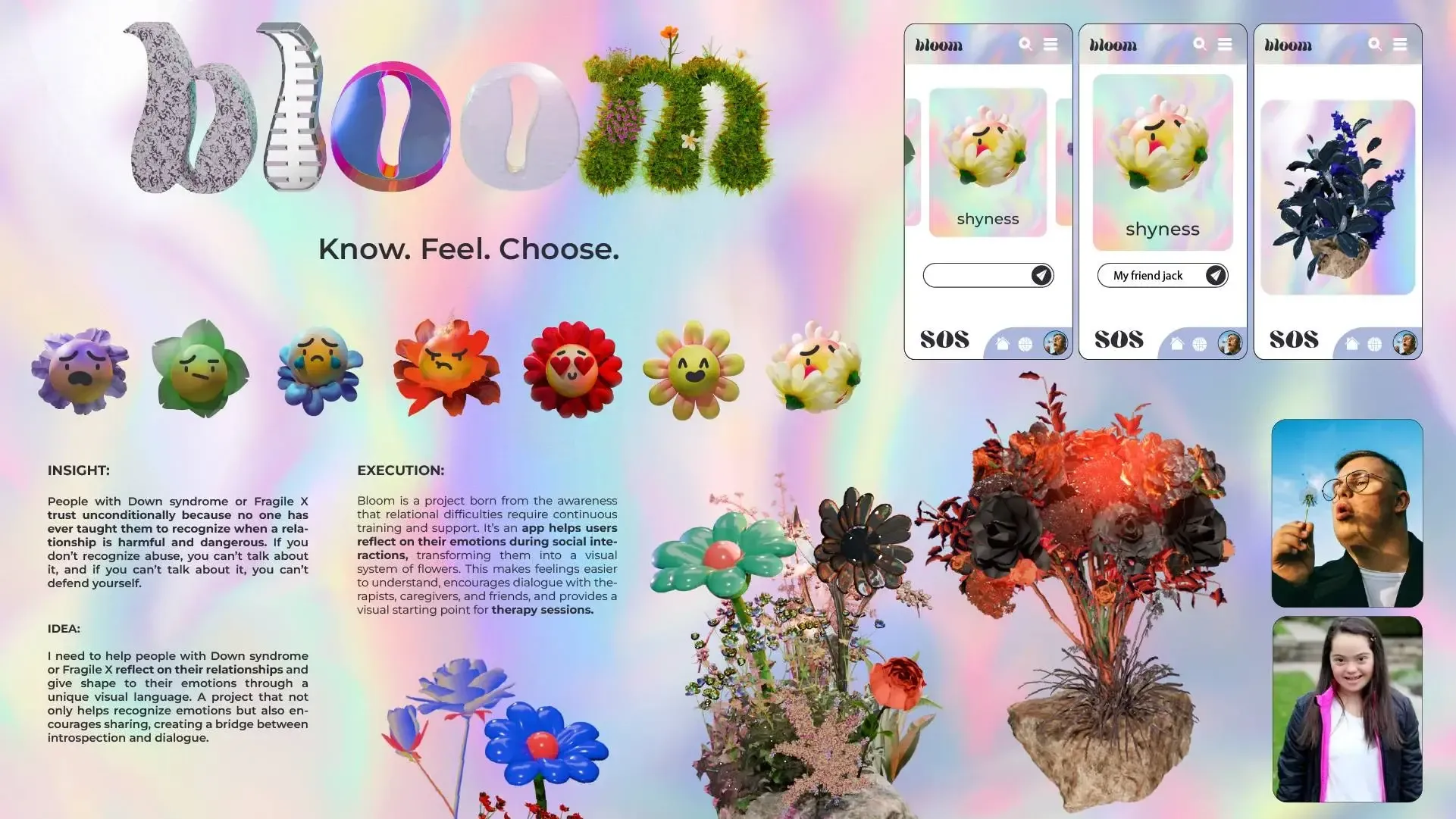
BLOOM addresses the emotional experiences of people with Down syndrome through a communication framework grounded in listening, participation and ethical collaboration, using visual language to illuminate often-overlooked perspectives.
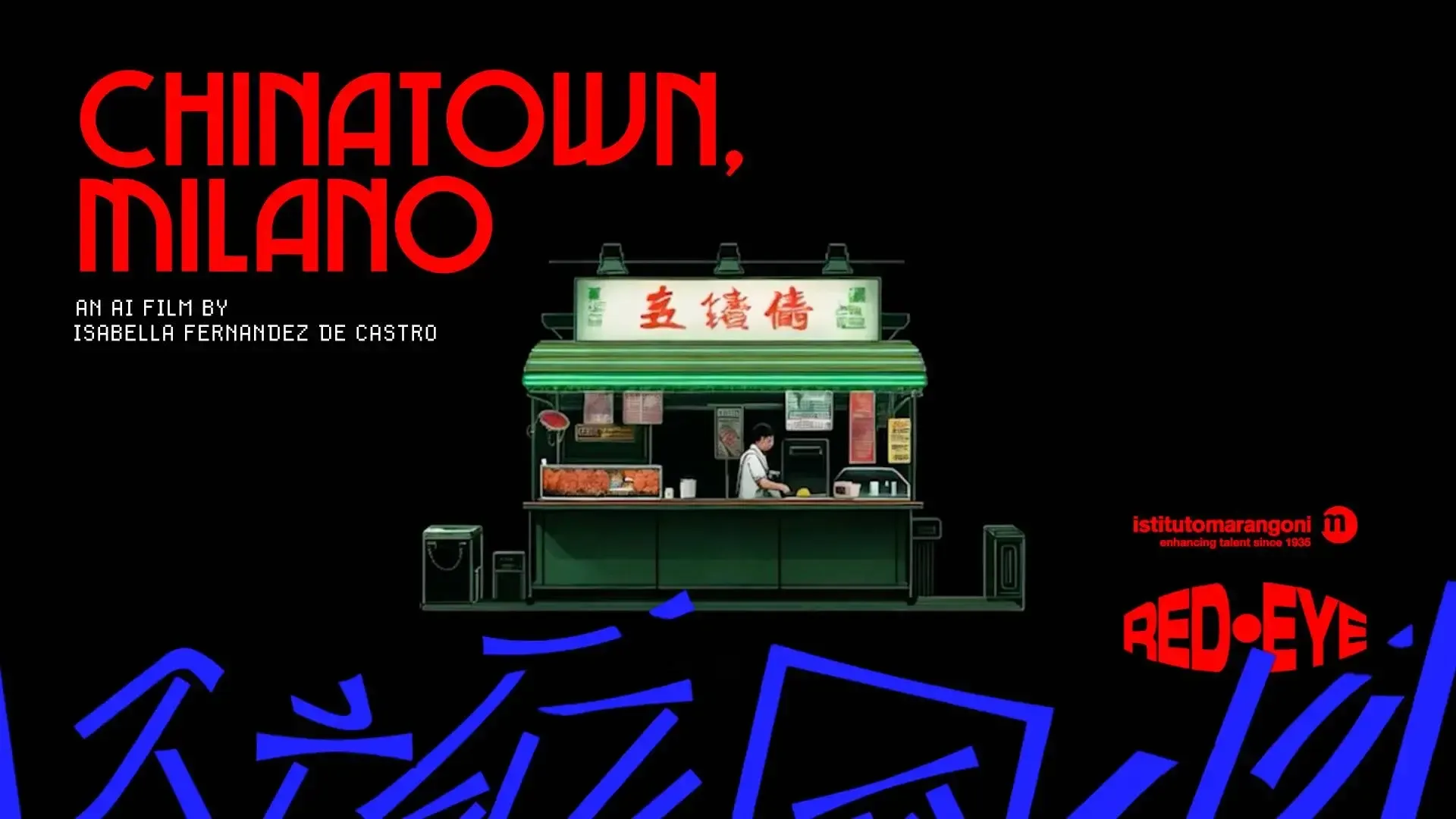
CHINATOWN, MILANO by Isabella Fernandez De Castro is a visual design project that reimagines Milan’s Chinatown through a digitally mediated and surreal lens, exploring how cultural belonging, migration and hybrid identity shape the perception of one of the city’s most layered urban districts. In CHINATOWN, MILANO, Isabella Fernandez De Castro reimagines the city through a digitally mediated, surreal lens, exploring cultural belonging, migration and hybrid identity in the Chinatown district.
Both projects show how visual communication can move beyond aesthetics and become a tool for interpreting contemporary realities.
BE A CIRCLE: Can Design Restore Human Connection in the Digital Age?
At the D&AD New Blood Awards 2025, the focus shifts even more toward communication. Stefano Rivera, a third-year Visual Design student, received a Wood Pencil for BE A CIRCLE—a project created for Christopher Ward that imagines a world more connected to human interaction, encouraging Gen Z audiences to engage with physical spaces and shared experiences rather than endless scrolling.
Visualizza questo post su Instagram
The project envisions signal-free Circle Zones in city squares to encourage analogue connection, while park portals recreate pre-digital environments through live performances from different eras. Circular posters, meanwhile, point to the absurdity of constant online presence.