
Hao Miaomiao — Sonic Geometry
Fashion Design & Innovation
Sonic Geometry transforms sound into wearable visual systems, using spectrograms, frequency, rhythm and generative experimentation to develop repeatable prints connecting scientific imaging, digital design, fashion application and creative industry practice.
SONIC GEOMETRY — SOUND DATA BECOMES WEARABLE PATTERNS THROUGH AI DESIGN
Sonic Geometry explores how sound can be translated into a wearable print language. Hao Miaomiao treats frequency, rhythm, amplitude and distortion as visual parameters, developing a collection in which sonic information becomes density, repetition, contrast, fragmentation and movement.
From Research to Visual Language
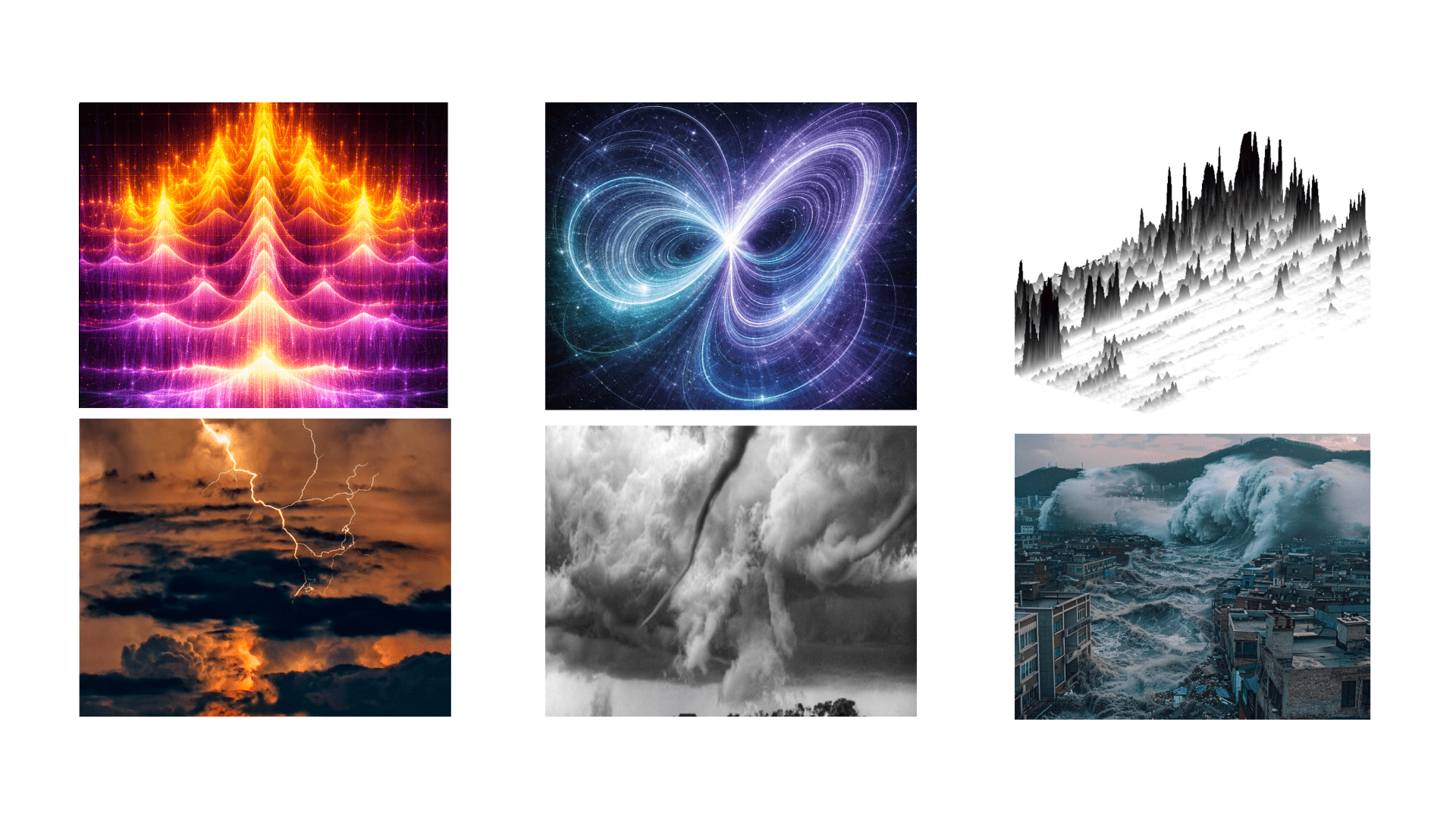
The project draws on music visual culture, scientific imaging and data-visualisation systems. Spectrograms, wavelet scalograms, chromagrams, phase-space attractors, reaction-diffusion patterns and Perlin-noise fields provide different methods for interpreting the structure of sound. These systems are then connected with natural soundscapes including earthquakes, volcanic eruptions, thunderstorms, tornadoes, whale song and birdsong. Each phenomenon generates a specific visual vocabulary: fault lines become fractured surfaces, volcanic energy becomes vertical expansion, dunes become flowing contours, and whale song becomes a sequence of spiral forms resembling underwater galaxies.
Discover the Course
Discover the Fashion Design & Innovation course and other Istituto Marangoni programmes exploring the intersection of technology, creative research and contemporary fashion.
AI as a Creative Design System
AI supports comparison, translation and visual iteration. The student uses prompting to connect acoustic properties with colour, texture, geometry and repeat behaviour, while testing different platforms for specific stages of the workflow. Firefly is identified as useful for cleaner graphic results, while Nano Banana is used to evaluate print scale and placement on three-dimensional garments. The system therefore combines conceptual prompting with technical assessment, requiring the student to evaluate clarity, continuity, visual hierarchy and suitability for textile production.
From Digital Print to Fashion Application
The project moves from generated imagery to standardised modules, repeated swatches and garment visualisations. Each print is tested as a surface rather than presented as an isolated digital artwork. Jackets, scarves, dresses, shirts and outerwear demonstrate how changes in scale and placement influence the perception of the pattern. By connecting sound analysis, generative visualisation and fashion application, Sonic Geometry shows how AI can support cross-disciplinary research while preserving the student’s role as creative director, editor and designer of the final system.