
What if the future of fashion accessories is no longer about ornament

From wearable sculptures to biomaterials, emerging designers imagine the future of fashion accessories through craft, technology and repair
Fashion accessories are no longer mere ornaments. A new generation of designers entering the luxury industry is rethinking bags, shoes and leather goods as wearable objects defined by pillars such as interaction, sustainability, modularity and emotional experience. Sculptural silhouettes and responsive mechanisms, along with biomaterials and repairable constructions, are reshaping the future of these pieces. In a nutshell, what were once considered decorations are now becoming systems designed to evolve with the body and endure beyond seasonal consumption.
This pioneering approach stood out during the Innovative Accessory Challenge launched by Istituto Marangoni Firenze in collaboration with Sara Sozzani Maino and with Tod’s Group as special partner. Presented in Milan before an international jury of fashion professionals—including Paul Andrew, Giuliano Calza, Edward Buchanan, Nicolò Beretta, Niccolò Pasqualetti, Anna Dello Russo, Massimo Bonini and Carolina Pelizza, Head of Women’s Leather Goods at Tod’s—the projects explored how emerging designers are combining craftsmanship with fashion technology and material innovation to push forward the role of accessories today.
Emma Sissa’s PREDATORIA imagines accessories as living architectures, where floral sensuality, mechanical tension and repairable construction merge into objects designed to attach, transform and endure. Courtesy of the author. The jury’s role was twofold: to assess the strength of the concepts and to judge how convincingly those ideas were brought to life as tangible objects. As shoe designer and creative director Nicolò Beretta observed during the final presentation, “Ideas are the core, but execution plays a huge role: I’d say up to 70%.” Fellow juror Niccolò Pasqualetti echoed this point, emphasising the importance of balance: “You need a strong personal vision, but also a sense of reality. It works when something is being fulfilled, whether it’s a need for creativity or a different way of using an object.”
Looking across the student projects, each stemmed from a different starting point—be it the human form, structural design, a gesture or the material itself. This diversity led to a wide range of ideas, yet a shared mindset emerged throughout: fashion accessories now function as interactive structures, narrative devices that engage people, and lasting objects designed to carry enduring value.
Sculptural Fashion Accessories Built for Repair and Longevity
Among the many notable projects, one that stands out is PREDATORIA, The Grafted Bloom – L’Innesto Floreale by Emma Sissa. Its aesthetic is precise: pink and floral, with a romantic flair in its shape, yet governed by an inner logic that is anything but merely decorative.
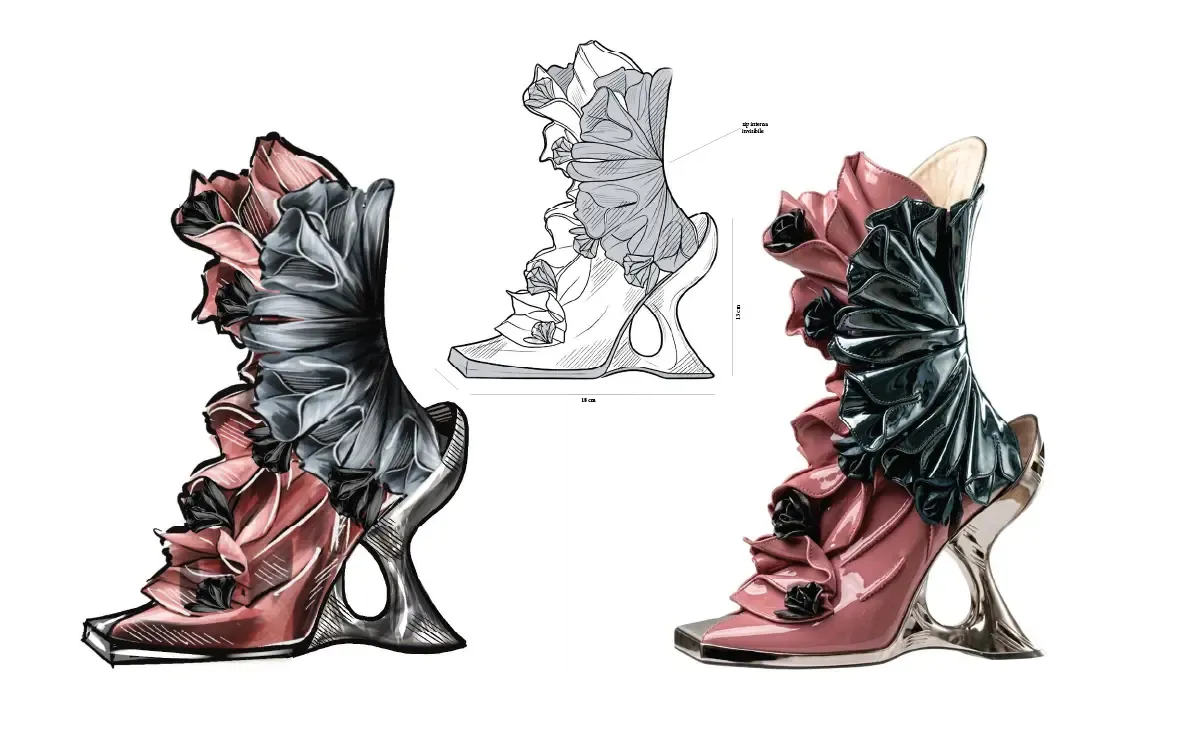
Emma Sissa’s sculptural boot turns floral romance into a mechanism of attachment, where leather petals and a stainless-steel cage heel suggest beauty engineered to endure. Courtesy of the author. Here, shoes and bags are conceived as structures that do not simply rest on the body, but attach to it, evoking carnivorous plants more than traditional ornaments. Petal-like forms conceal mechanisms; openings contract and close; leather and metal are fused into rigid constructions capable of transformation.
What is most striking, however, is the project’s technical sophistication. The entire project revolves around longevity: a boot with a sculptural leather upper and a stainless-steel cage heel engineered to last; a shoe that changes configuration through a concealed button; a bag designed to be dismantled into separate components so that each part can be repaired, recovered or reassembled where needed. While it certainly embraces an aesthetic of sustainability, on closer reflection, it feels even more intentional: a structure designed not to become waste.
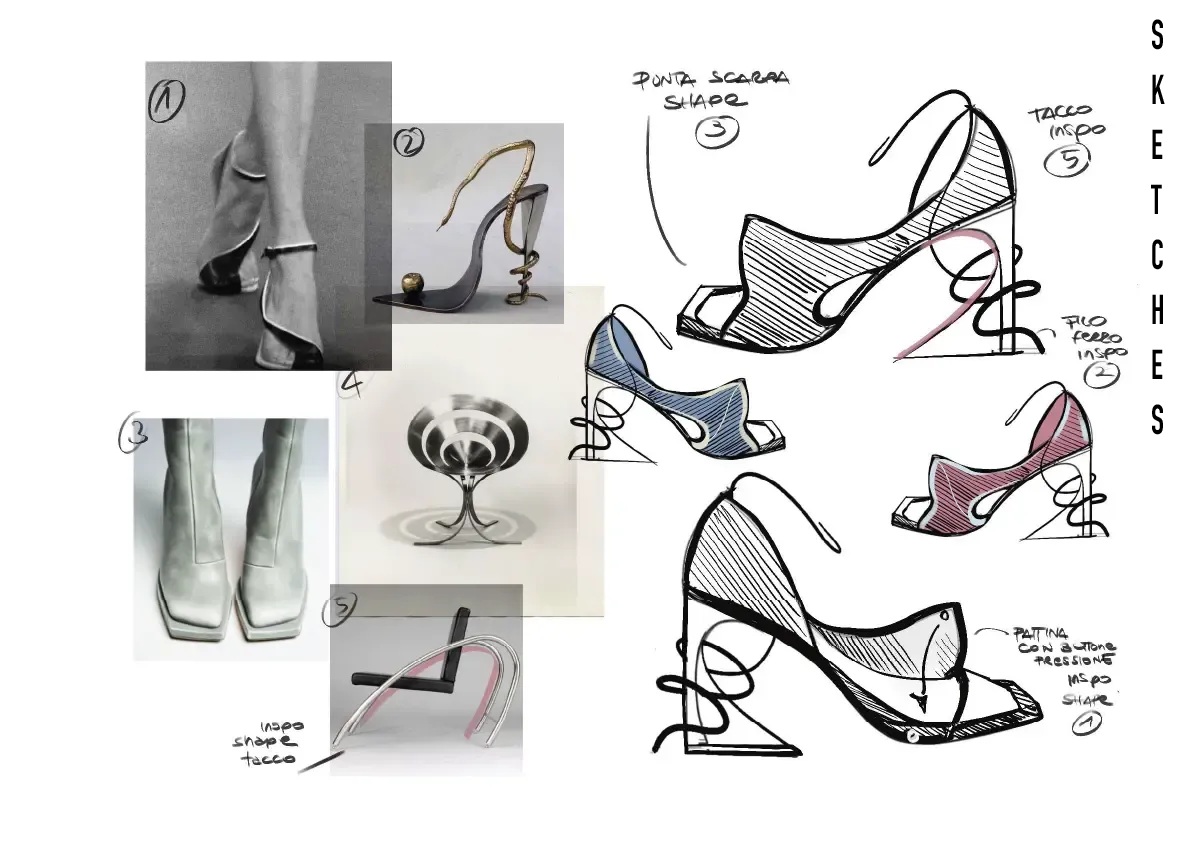
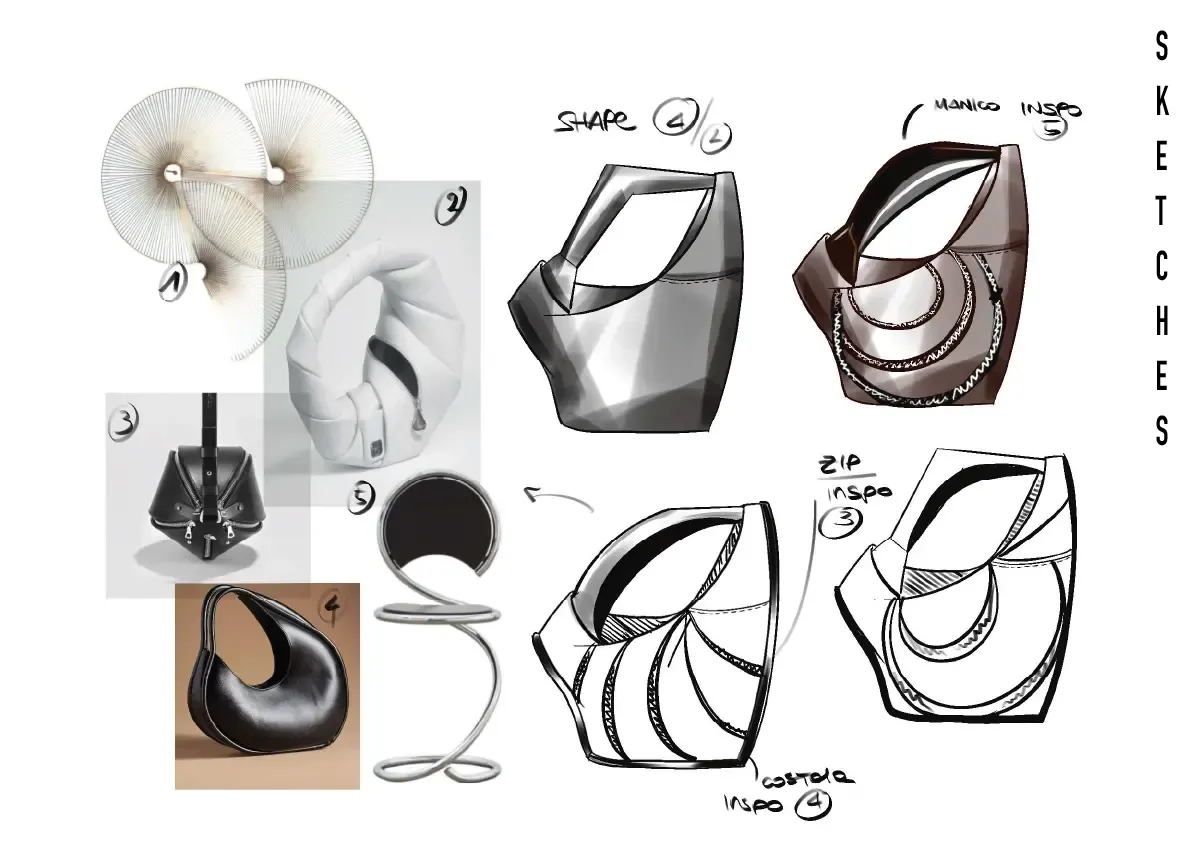
Behind the organic silhouette, Sissa’s sketches reveal a sharper logic of construction, repair and transformation, closer to a living system than a decorative accessory. Courtesy of the author.
Biomaterials and the Rise of Experimental Fashion Accessories
Anatomy of Excess by Manuele Gratteri unfolds in three acts—Genesis, Discipline, Vanitas—each marked by a distinct material approach expressed through hats and headpieces.

Manuele Gratteri’s headpieces move through desire, control and decay, treating the body as a site where biomaterials, restraint and excess begin to blur. Courtesy of the author. In Genesis, real sprouts grow through felt and raffia, with petals and apple slices sealed beneath translucent biomaterial layers. “I wanted to work on desire from its origin, something that is still raw, not yet shaped into a product,” Gratteri explains. In Discipline, foam expands within sheer stockings, compressed and held in place, with a book embedded into the construction and nets pulling the surface inward. Vanitas marks a final shift: burned felt, mould, and clusters of black stones radically alter the texture, making it heavier and less controlled, as if the material itself were giving in.

“The project follows a cycle, starting from desire, moving through control, and eventually reaching excess,” adds the designer.
As the winner of the Innovative Accessory Challenge, Manuele Gratteri will receive a full scholarship for the Master’s in Fashion Design & Accessories at Istituto Marangoni Firenze. Additionally, his project will be produced, prototyped, and showcased during the school’s 10th anniversary celebrations.
Can Fashion Accessories Become Interactive Objects?
With Onnisciente, emerging accessories designer Nicola Molin began with a gesture: touch an invisible sensor, and the bag opens, expands, and reveals its contents. “I wanted to create something that gives an emotion. Today, buying a bag is almost a ritual; I wanted to add a gesture that could surprise.”
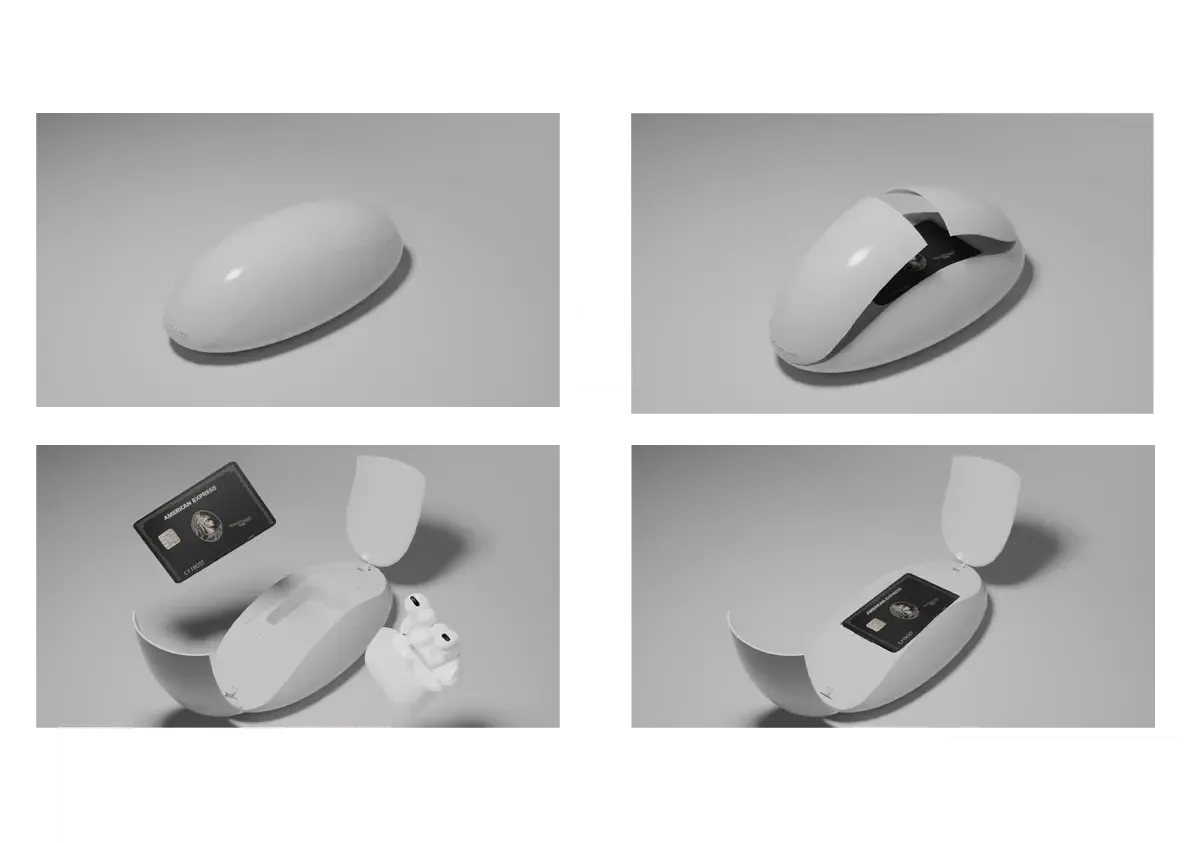
Nicola Molin’s bag turns opening into a ritual gesture, using hidden technology to make the accessory feel less like an object to carry than a small emotional mechanism. Courtesy of the author. Across the capsule, the mechanism takes different forms: a glossy, strass-covered piece that opens gently from the top; a more minimal, cosmetic-inspired object that splits open unexpectedly; a petal-like structure that unfolds outward, turning the bag into something akin to a kinetic sculpture.
Even smaller pieces, like the wallet, act as micro-containers, opening like tiny treasure boxes in the hand. The shapes remain controlled, rounded, and almost familiar. “I didn’t want to create something completely futuristic. I was more interested in evolving what already exists, keeping it clean but adding a new experience,” says Molin.
During the Innovative Accessory Challenge, Anna Dello Russo highlighted this very balance: “That kind of approach, especially coming from such a strong analogue past, is very innovative. Today, it is about closing the books and really looking ahead.”
Where Craftsmanship Meets Fashion Technology
Interwoven Futures by shoe designer Puying Liu explores the integration between leather weaving and 3D-printed TPU, not layered, but built together, held in tension against each other. “I wanted to explore the potential between traditional structures and new technologies,” explains Liu. “You have a pre-made shell, and then you insert the material; it becomes a dialogue between the two.”
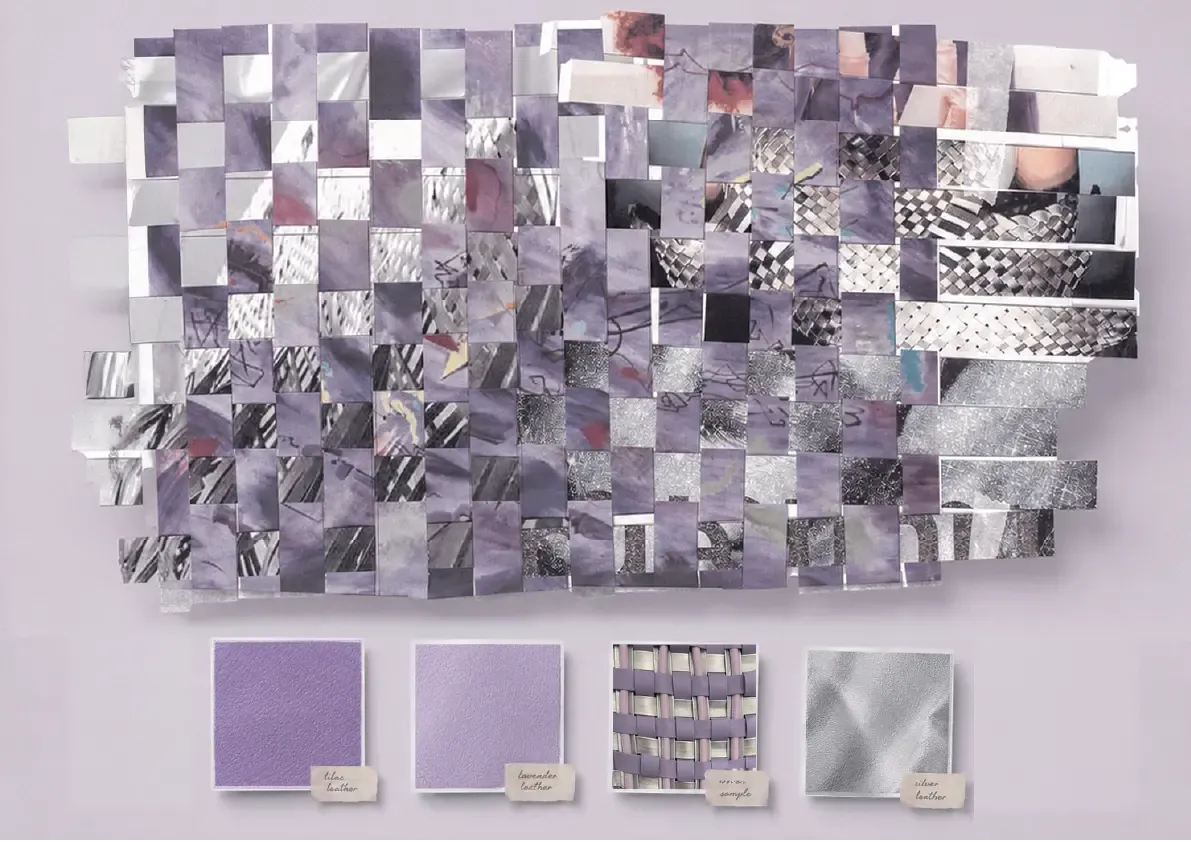
A material board where leather, TPU and metallic surfaces begin to behave less like separate samples than fragments of the same constructed language. Courtesy of author. One shoe features an upper woven into a flexible printed frame, while a mule pairs soft leather with a rigid metal heel. Elsewhere, a corset belt tightens and adapts to the body while leaving its structure exposed. Each object appears to have been conceived from the inside out.
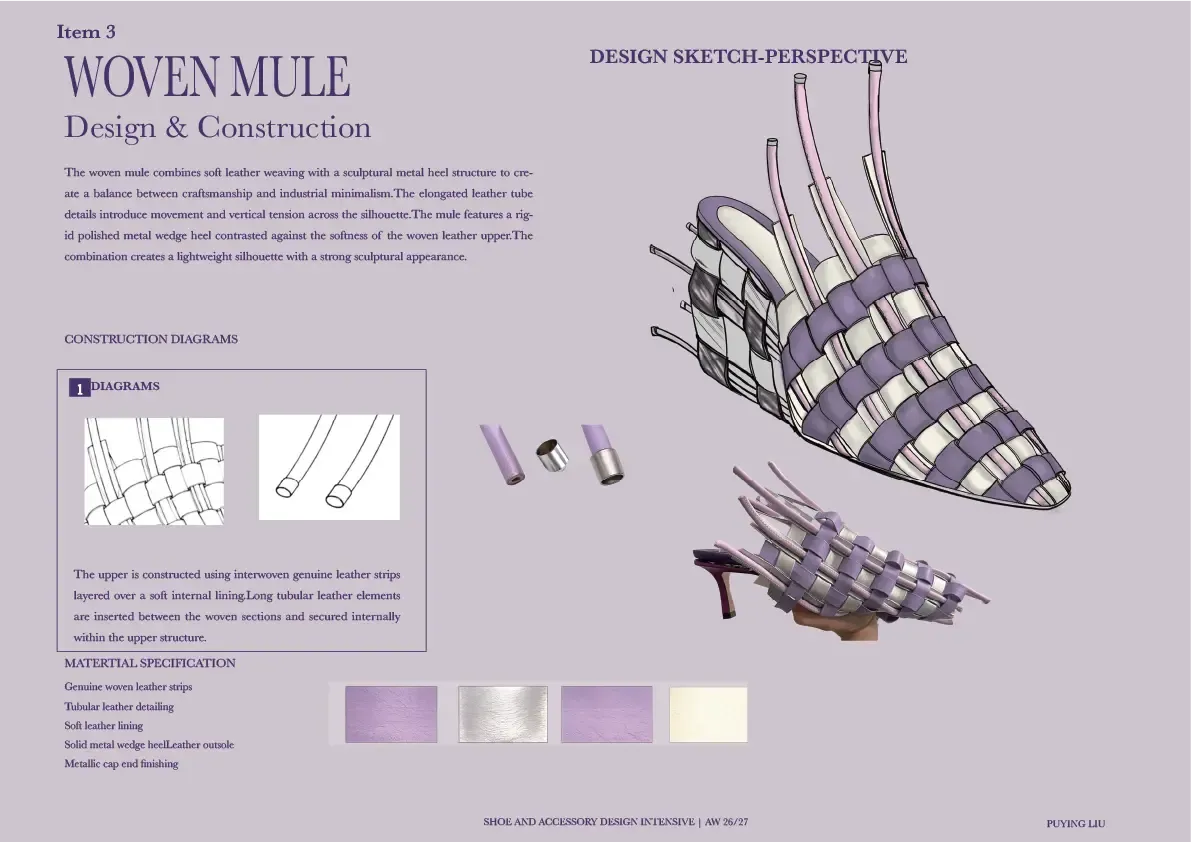
Puying Liu’s mule turns weaving into an exposed system, holding soft leather and rigid structure in a visible dialogue between craft and digital construction. Courtesy of the author. Underlying the project is an idea of innovation that is less concerned with spectacle and more focused on construction. Even the process itself resists simplification: translating weaving into digital models requires working against the system through constant adjustments, failed attempts and reconstruction. “The computer does not understand how fabric flows,” concludes Puying Liu.
What Emerging Designers Reveal About the Future of Fashion Accessories
Looking at the student projects as a whole, Sara Sozzani Maino points to a generation that feels both open and grounded.
“What is interesting about these designers is how freely they think,” notes Sara Sozzani Maino. “They are clearly looking at the future and at technology, while still understanding the importance of craftsmanship and keeping certain skills alive—things that remain essential for the industry.”
Lucrezia Spina
Editor