

How GucciCore transformed Demna’s irony-driven fashion language into a new vision of glamour, seduction and desire
Few designers defined fashion’s irony era as decisively as Demna. At Balenciaga, sarcasm, provocation and internet-fuelled spectacle became embedded into the language of luxury itself, turning runways into performances of commentary and social critique. As self-awareness replaced seduction and cynicism overtook fantasy, clothes seemed designed to generate discourse rather than desire. This shift made GucciCore feel unexpectedly significant during Cruise 2027. Beneath the celebrity overload and Times Square chaos, Demna’s fourth statement for Gucci suggested a move away from irony and back toward glamour, aspiration, confidence and sexiness—still gritty and charged with urban tension, but no longer detached from allure.
During the Cruise 2027 shows, GucciCore’s massive Times Square takeover brought a moment when everything clicked into place. Fifty glowing screens across Manhattan, fake Gucci campaigns plastered everywhere, paparazzi chaos, Kim Kardashian in full luxury mode, Mariah Carey radiating pure diva energy, Paris Hilton walking the runway with dark hair, Cindy Crawford closing the show as if the supermodel era had never ended: the entire production transformed the traditional runway into a cinematic show staged on a monumental scale. Few designers understand spectacle the way Demna does.
Why GucciCore Marks Demna’s Break From Fashion Irony
Many dismissed GucciCore as yet another exercise in fashion controversy, criticising Demna’s sardonic blend of critique and sarcasm for shifting from an authentic creative sensibility to a deliberate branding strategy—not only for the creative director himself, but also for the Kering houses that recruit him, first Balenciaga and now Gucci.
That perception is inaccurate. The collection felt immediately different from the Balenciaga formula that made Demna one of the most talked-about designers of the past decade. Gone were oversized meme hoodies, aggressively satirical shapes, ugly-core provocations, and deliberately disturbing silhouettes designed to break the internet. Instead, the focus landed on identity and different identities.
The press release presents GucciCore as “the fourth chapter in Demna’s character-study approach, bringing together the visual languages of La Famiglia, Generation Gucci and Primavera into one cohesive collection. At its centre is a permanent wardrobe built around pragmatic, wearable and unmistakably Gucci pieces.” Demna himself described GucciCore as a “basic wardrobe of essential pieces”—the perfect peacoat, the classic trench, the pencil skirt, the business suit, the crisp shirt—filtered through Italian glamour and elegance.
For a designer whose career was built on disruption, the shift is significant. At Balenciaga, irony—often abrasive and intentionally mischievous—became embedded in the language of luxury itself; at Gucci, however, the objective appears both different and more direct. Especially in New York, the collection was staged to rebuild a visual universe instantly recognisable as Gucci: seductive, cinematic, hyper-visible, confident and aspirational. This is likely exactly what Kering needs right now.
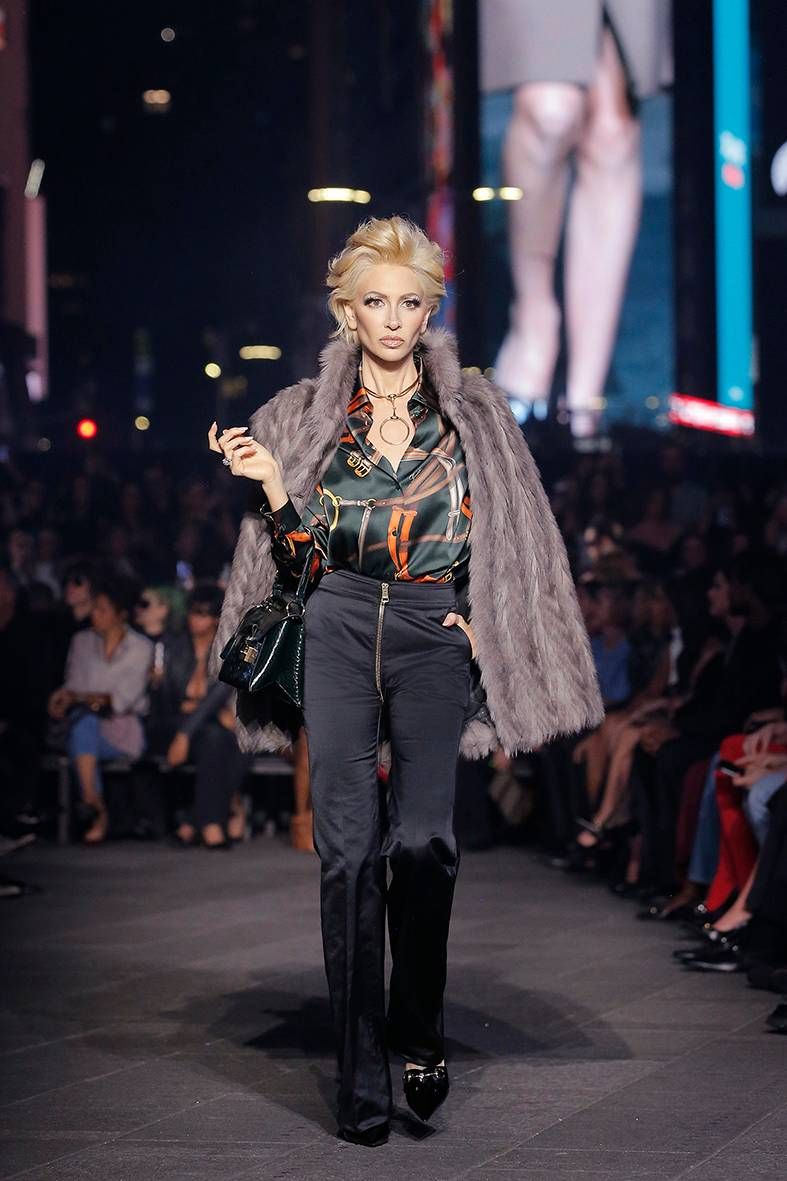
Between diva spectacle and urban tension, GucciCore turns Times Square into a stage for desire re-entering luxury with cinematic confidence. Courtesy Gucci.
Inside the Times Square Spectacle That Turned Gucci Into Urban Cinema
The choice of location reinforced the message. After unveiling his first Gucci official show inside Milan’s Palazzo delle Scintille, surrounded by neoclassical statuary and old-world solemnity, Demna moved Cruise 2027 into the intensity of New York.
Times Square became part of the set design, engulfed by giant screens projecting both real and fictional Gucci advertisements—Gucci Gym, Gucci Pets, Gucci Acqua, Gucci Life—blurring luxury branding with consumer fantasy and pop satire.
Demna spoke about wanting Gucci placed “at the centre of the metropolis,” and the idea translated visually with precision. The atmosphere recalled Robert Longo’s Men in the Cities series: sharply tailored figures suspended in states of urban anxiety and nervous energy, their bodies twisted mid-motion as though caught between control, collapse, and performance. That same contrast ran through the collection itself, as corporate tailoring collided with undone glamour and rigid silhouettes were softened by nightlife sensuality and glossy excess.

Fur, leather and oversized sunglasses recast Tom Ford-era sensuality through Demna’s colder grammar of power dressing. Courtesy Gucci
The Return of “Sexy Gucci” and Fashion’s New Appetite for Glamour
The references to Tom Ford’s Gucci era were impossible to miss. Sharp tailoring, ultra-sexual silhouettes, fur coats draped over shoulders, lacquered fabrics and that unmistakable “rich and dangerous” energy all pointed back to Gucci’s late-1990s and early-2000s peak. Online, fashion communities immediately started discussing the return of “sexy Gucci.”
The difference is that Demna isn’t indulging in the straightforward Tom Ford revivalism that has become a default strategy for many designers. The Ford-era glamour is now filtered through a colder, more controlled lens, stripped of disco hedonism and recast as luxury power dressing.
That tension is what made GucciCore compelling: it suggested a designer recognising that audiences no longer crave relentless satire from fashion. Glamour, fantasy and overt desirability are pulling attention back toward the centre of luxury.
Why Celebrity Virality Alone Cannot Fix Gucci’s Luxury Crisis
The celebrity presence naturally amplified the spectacle. Kim Kardashian, Mariah Carey, Lindsay Lohan, Shawn Mendes, Paris Hilton, Tom Brady and Lewis Hamilton—the guest list seemed almost unreal.
Paris Hilton’s brunette runway appearance spread across social media within minutes, while Cindy Crawford’s finale became one of the most replayed moments of the night. Even so, celebrity hype alone cannot solve Gucci’s larger challenges.
The real issue is much bigger: Gucci remains the financial core and the economic engine of Kering, and the brand’s slowdown over recent years has weighed heavily on the group’s overall performance. That reality gives Demna’s appointment a significance well beyond aesthetics or online virality. He has to sell clothes.
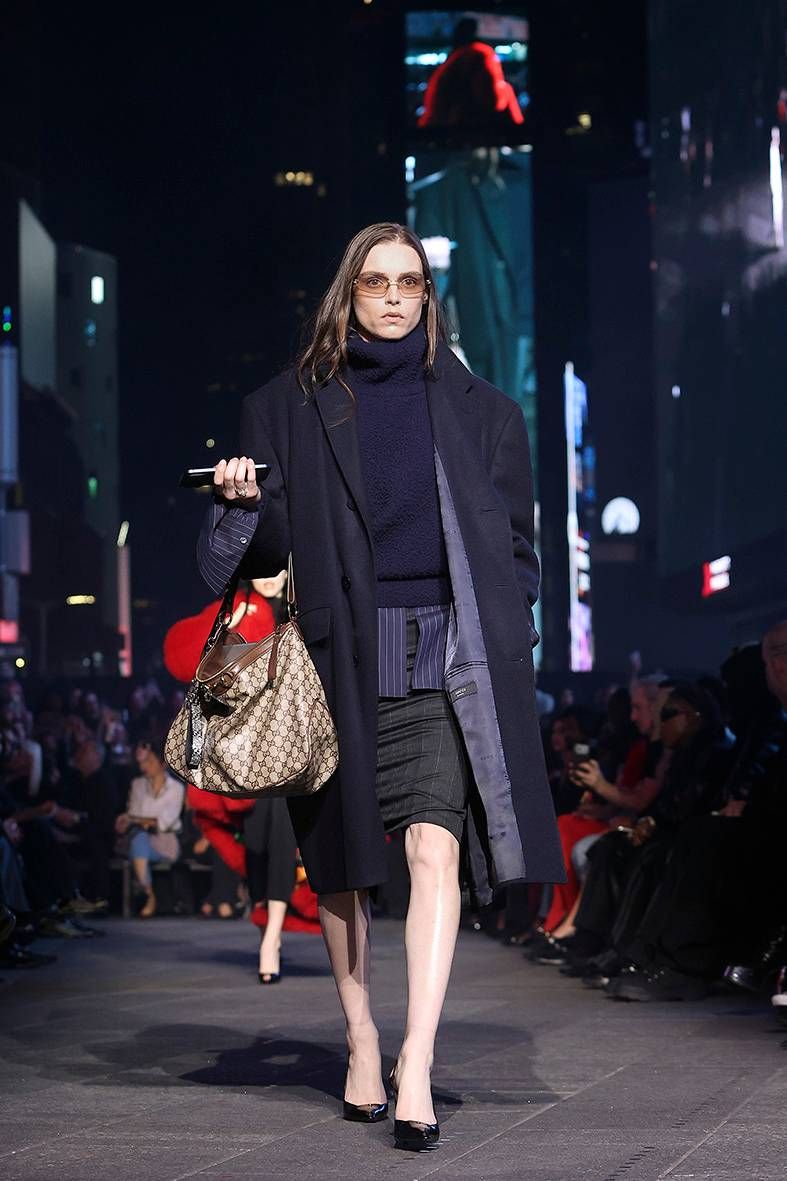
Corporate tailoring slips into nightlife energy, where Gucci’s wardrobe of essentials becomes less basic than charged with metropolitan anxiety. Courtesy Gucci.
Fashion Audiences No Longer Want Detachment From Luxury
Demna understood the industry’s realignment and post-irony moment before most. What makes GucciCore interesting is how mature the collection felt compared with Demna’s earlier work. Even Reddit discussions noted the difference, describing the show as “softer” and more refined than Balenciaga while still clearly tied to Demna’s visual language. And that may be one of the smartest moves possible in 2026.
Fashion audiences seem exhausted by constant provocation. Quiet luxury has peaked, streetwear has lost much of its urgency, and consumers are gravitating back toward glamour, fantasy, and recognisable luxury codes. That’s why GucciCore worked on an emotional level. The collection did not push desperately for shock value; it focused on making Gucci feel magnetic again, and that strategy resonated immediately.
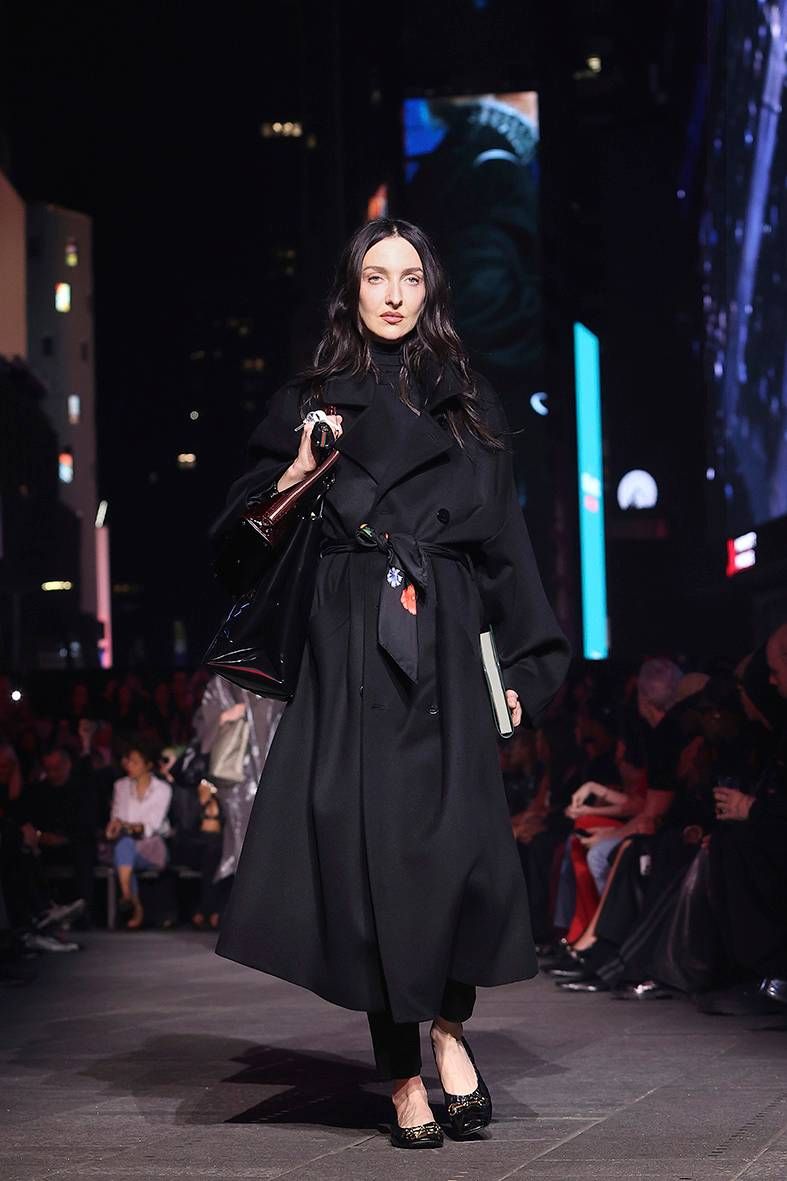
The black coat becomes a portable architecture of seduction, austere on the surface and unmistakably Gucci in its appetite for drama. Courtesy Gucci.
Demna’s Real Challenge Is Making Gucci Feel Desirable Again
Creatively, the so-called “Demna cure” already appears to be working. Gucci feels culturally alive again, the conversation is back, fashion media cannot stop dissecting the show, celebrity buzz has fully returned, and, perhaps most importantly, people seem curious about Gucci rather than fixated on its past.
The financial results will take longer to emerge. A viral Times Square takeover can reignite fascination overnight, but rebuilding a luxury empire is a far longer process.
Still, one thing already feels clear: Demna did not come to Gucci to recreate Balenciaga 2.0. He arrived to restore desire—and ultimately, that is how his success will be measured.
Angelo Ruggeri
Journalist and Tutor for Styling, Business and Design Course and Master’s Programmes, Milan