
Why Azzedine Alaïa’s method and archive still challenge the fashion system

Azzedine Alaïa’s archive and method remain central to today’s fashion system, and to how such knowledge is passed on
Most conversations about Azzedine Alaïa still orbit the runway: the sculpted silhouettes, the body-conscious design, the mythology of the Tunisian-born designer living and working in the Marais. Yet the essence of his legacy resides elsewhere: in the discipline and study of a couturier whose garments were shaped directly on the mannequin and perfected by hand—sometimes over years—as well as in the value he placed on friendship and his exacting commitment to craft.
At Istituto Marangoni Milano, Carla Sozzani, Founder and President of the Fondation Azzedine Alaïa, and its Director, Olivier Saillard, turned the focus from image to process, offering a direct, human perspective on Alaïa himself. Rather than rehearsing the usual rhetoric that surrounds influential designers, they examined how Alaïa’s technique, working rituals, the almost familial structure of his studio and his instinct to collect continue to inform the Fondation Azzedine Alaïa in Paris, which today preserves and activates an extensive fashion archive dedicated to his work and collection.
What emerged was a reflection on the role of that archive and on its function in conservation, research and education within a digital era. The discussion placed Azzedine Alaïa within a broader cultural lineage, suggesting that his practice remains relevant not because of its image, but because of its method. It is a way of working that continues to inform contemporary debates around authorship and the material intelligence of clothes—knowledge that must be experienced materially and carried forward through evolving forms of documentation and access.
Carla Sozzani and the Rise of Azzedine Alaïa in 1980s Paris
Carla Sozzani looked back to 1980, when she first met Azzedine Alaïa. As the founding editor-in-chief of Italian Elle, she had been hearing whispers about a Tunisian-born designer in Paris, whose leather garments editorial teams struggled to frame—pieces that seemed “too strong” and too unconventional for the prevailing fashion narrative. With hindsight, it’s clear that they anticipated a shift in how the body would be dressed and understood: Alaïa was simply ahead of his time.
Curiosity led her to seek him out. The affinity between them, she recalls, required no explanation: just a natural connection. From that moment on, they remained closely linked, personally or professionally.
Azzedine Alaïa made her a dress on the spot and drew her into a milieu that functioned as a porous household: Alaïa’s circle wasn’t a formal team but rather a gathering of people who came, stayed, helped, and talked—sharing meals as frequently as fittings. Those who knew him and speak of “family” describe a structure sustained by loyalty and daily presence: the way Alaïa organised his world.
What a Studio Anecdote Reveals About Alaïa’s Character
Olivier Saillard’s earliest memory of Azzedine Alaïa is disarmingly simple. During a studio meeting, a bird flew in through an open window. Instead of ignoring it, Alaïa paused his work and spent close to an hour guiding the bird back outside, resuming only once it had safely left.
The anecdote points to a temperament marked by attentiveness and resolve—qualities that shaped Alaïa’s approach to fashion design. He was patient, even stubborn, especially when he cared about something. And this attitude carried over into his work: whatever held his focus received his full concentration.
How Alaïa Worked Within—and Against—the Fashion Calendar
The conversation with Carla Sozzani and Olivier Saillard repeatedly returned to Alaïa’s relationship with time. While the industry was already governed by delivery schedules, he followed his own rhythm—he worked slowly, by hand, adjusting and refining. He didn’t plan collections through sketches; instead, he developed garments directly on the mannequin by draping, in a process closer to couture technique than to conventional ready-to-wear.
As he did not rely on preparatory sketches, form emerged through the manipulation of fabric and an understanding of volume and tension honed over years of practice. According to Saillard, this method aligns him with designers such as Cristóbal Balenciaga and Madeleine Vionnet, whose work was grounded in three-dimensional construction and a deep knowledge of the body.
Sozzani recalled the black jacket that occupied him for nine years; he kept refining it until it reached the balance he sought. In Azzedine Alaïa’s studio, the creative process carried more weight than the external rhythm of the market.
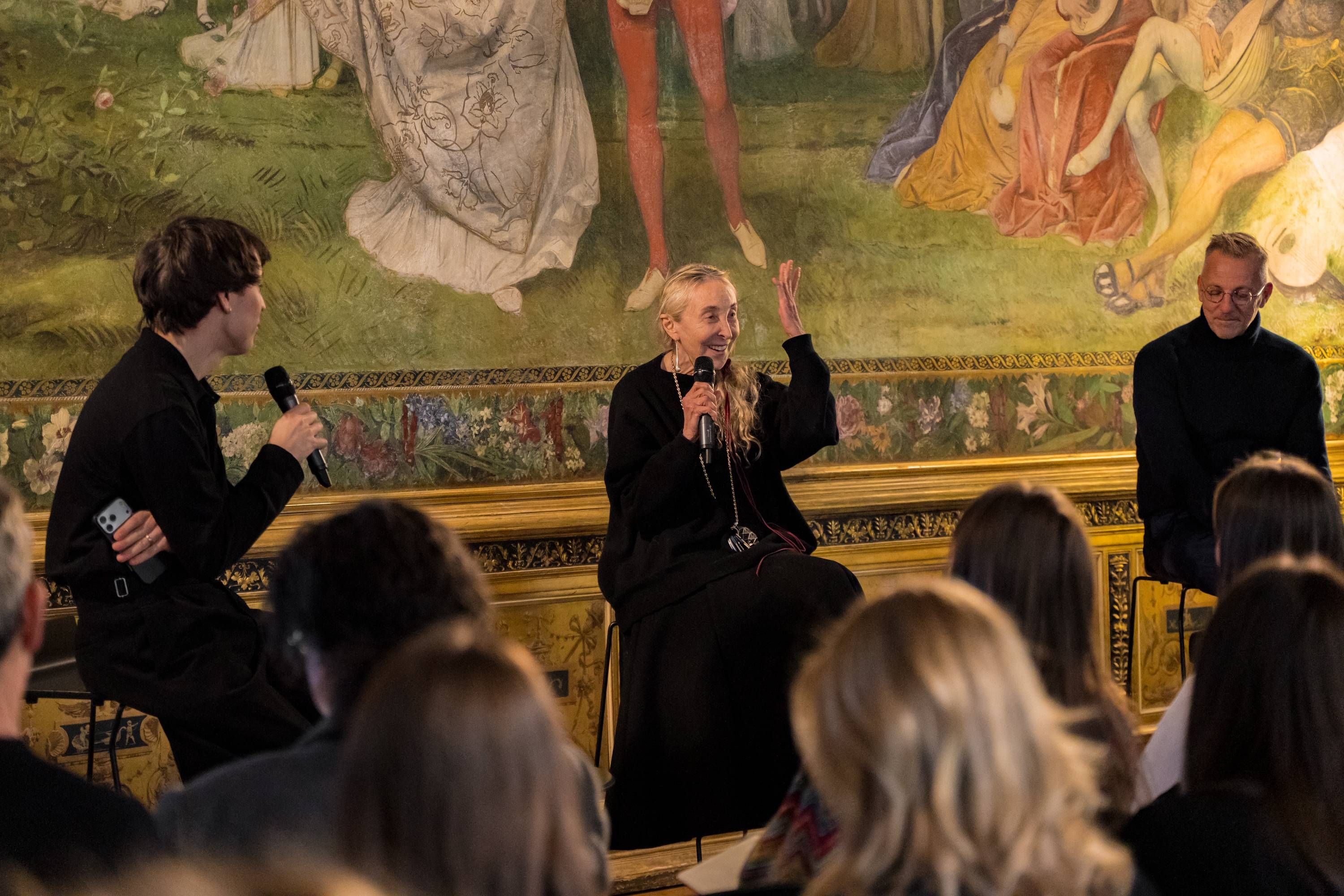
During the talk at Istituto Marangoni Milano, Olivier Saillard and Carla Sozzani discuss Alaïa’s method, exploring how archival research and direct study of garments remain essential for future fashion designers. The Fondation Azzedine Alaïa and the Scope of Its Archive
Alaïa’s home and atelier were housed in the same building in the Marais, an arrondissement renowned for its cultural vitality. Yet inside, the atmosphere felt calm—almost like a courtyard house. Doors were always open, people flowed in and out, and meals happened whenever someone sat down at the table. Everything was informal, warm, and always lively.
That address is now home to the Fondation Azzedine Alaïa, which preserves an extensive fashion archive. It comprises over 22,000 pieces created by Azzedine Alaïa himself between 1964 and 2017, mapping the evolution of his practice from early experiments to the silhouettes that defined his legacy. Alongside these works is his personal collection of roughly 15,000 garments assembled over decades—a trove that features major names such as Cristóbal Balenciaga and Christian Dior, as well as lesser-known designers. Alaïa collected relentlessly, sometimes acquiring multiples of the same piece; it was only after his passing that the team grasped how vast the collection truly was. For him, collecting was part of learning.
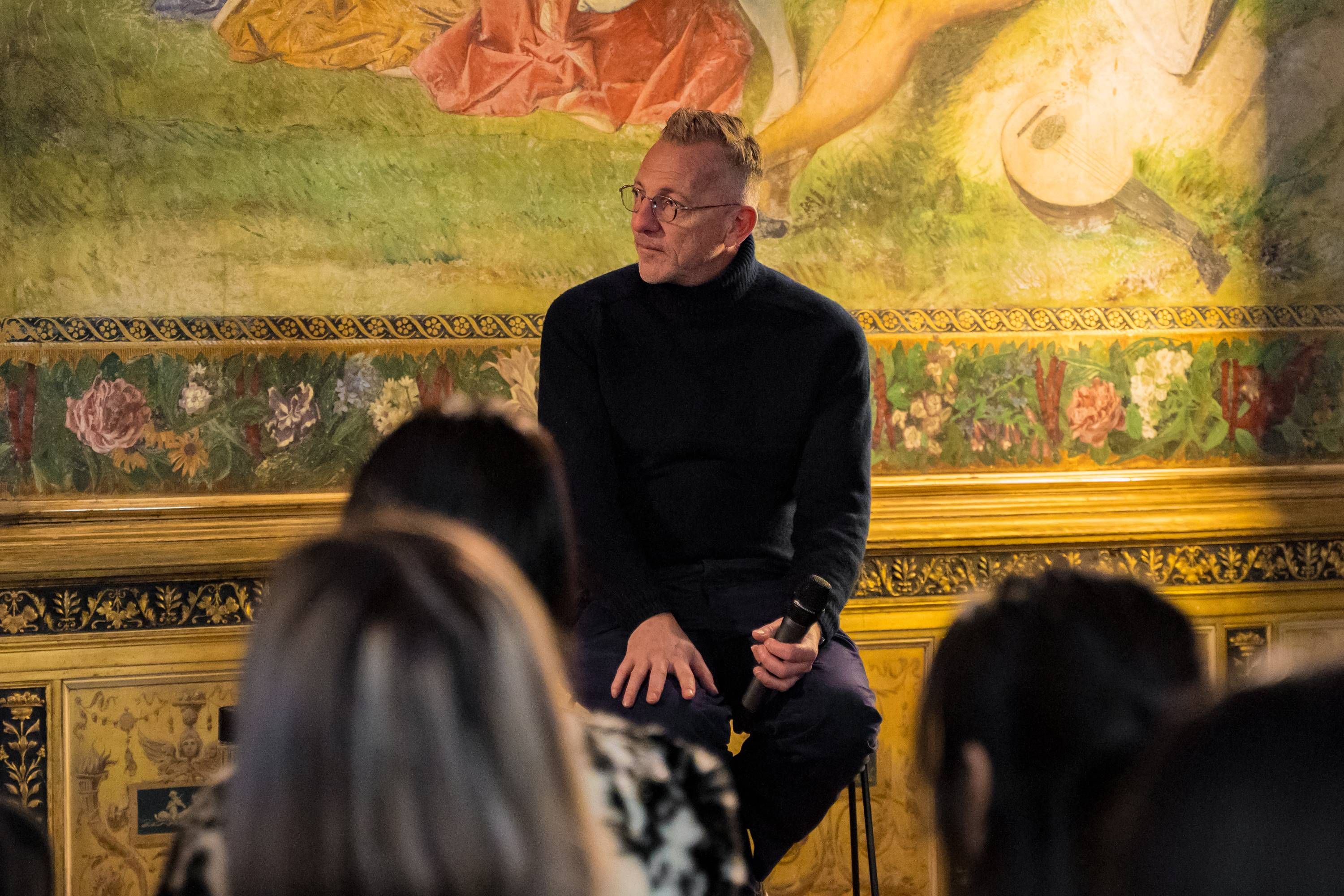
Olivier Saillard reflects on Azzedine Alaïa’s legacy, emphasising discipline, craft and the role of fashion archives as spaces where technique, memory and material knowledge continue shaping contemporary design practice.
What Is at Stake for Fashion Archives in the Digital Era?
Questions around the future of the Fondation Azzedine Alaïa extend to the broader debate on fashion archives in the digital age. As we live in a rapidly changing present, there is a growing fear of losing significant parts of our past, which makes the creation of an archive feel especially urgent. At the same time, digitisation has become essential for cataloguing and scholarly access, particularly as institutions reach out to international audiences—but garments themselves resist full translation into image files and metadata.
While digitising the collection may seem like the ideal solution, a screen cannot convey the density of a knit, the engineering of a seam, how a piece actually hangs on the body, or how a bias-cut dress responds to movement. For fashion students and established designers alike, this kind of information is the field’s core knowledge. Archiving, in this context, involves maintaining conditions that keep material intelligence accessible and understandable.
The foundation’s approach reflects this understanding. Technology supports research and preservation, but it does not replace the physical encounter through which construction can be examined and fully appreciated. For this reason, the foundation’s exhibitions, projects and initiatives aim not to make everything available as flat, digital images, but to ensure that the archive remains useful, comprehensible and connected to lived knowledge.
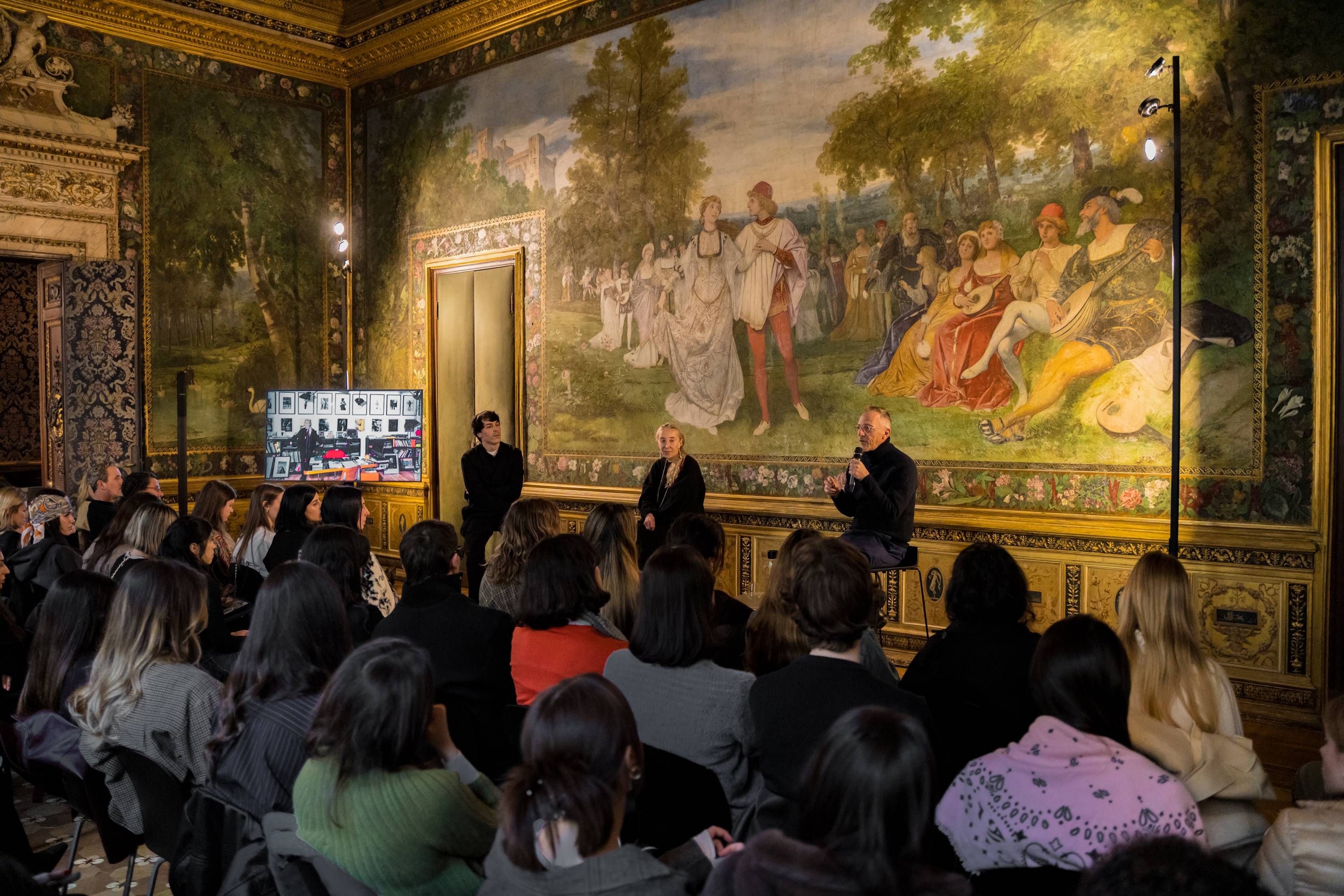
Students gather at Istituto Marangoni Milano to examine the legacy of Azzedine Alaïa, where conversation around archives, craftsmanship and time reveals alternative rhythms for today’s accelerated fashion system.
Why the Fondation Azzedine Alaïa Exhibits Without Glass
One element that surprised many students was the Fondation Azzedine Alaïa’s decision to avoid vitrines: there is no glass between the garment and the viewer. This doesn’t mean people can touch everything freely; it simply means the clothes are shown in the space as they are. This makes the construction details easier to observe and enables closer visual study, especially for emerging designers learning about volume and pattern-making.
Olivier Saillard even mentioned an exhibition devoted to a single garment, structured to encourage prolonged observation. While many displays compete for attention, this kind of focused presentation invites a different pace of engagement and foregrounds the analytical side of fashion curation.
Beyond the Image: Azzedine Alaïa’s Relevance in Today’s Fashion System
The discussion concluded with a reflection on fashion communication. Today’s system generates an unprecedented volume of imagery across digital platforms, reinforcing brand visibility, yet not always with depth. Photography alone does not secure longevity.
Carla Sozzani emphasised that communication acquires meaning when anchored in technique, research, and time invested in development. Azzedine Alaïa’s work demonstrates how construction underpins aesthetic impact: the interior of a garment—its seams, reinforcements and structure—determines what the audience ultimately sees on the outside.
By revisiting Alaïa’s practice, the talk at Istituto Marangoni Milano offered a portrait of the designer while also illuminating a model of fashion grounded in study and continuity: elements that remain instructive for an industry navigating speed, visibility, and the challenges of preserving its own history.
Lucrezia Spina
Editor, Milano