
Can an olive oil bottle become a design object worth keeping?
From paper wings to Swarovski crystals: Marco Bonaldo on why he treats olive oil bottles as a playground for fashion and design
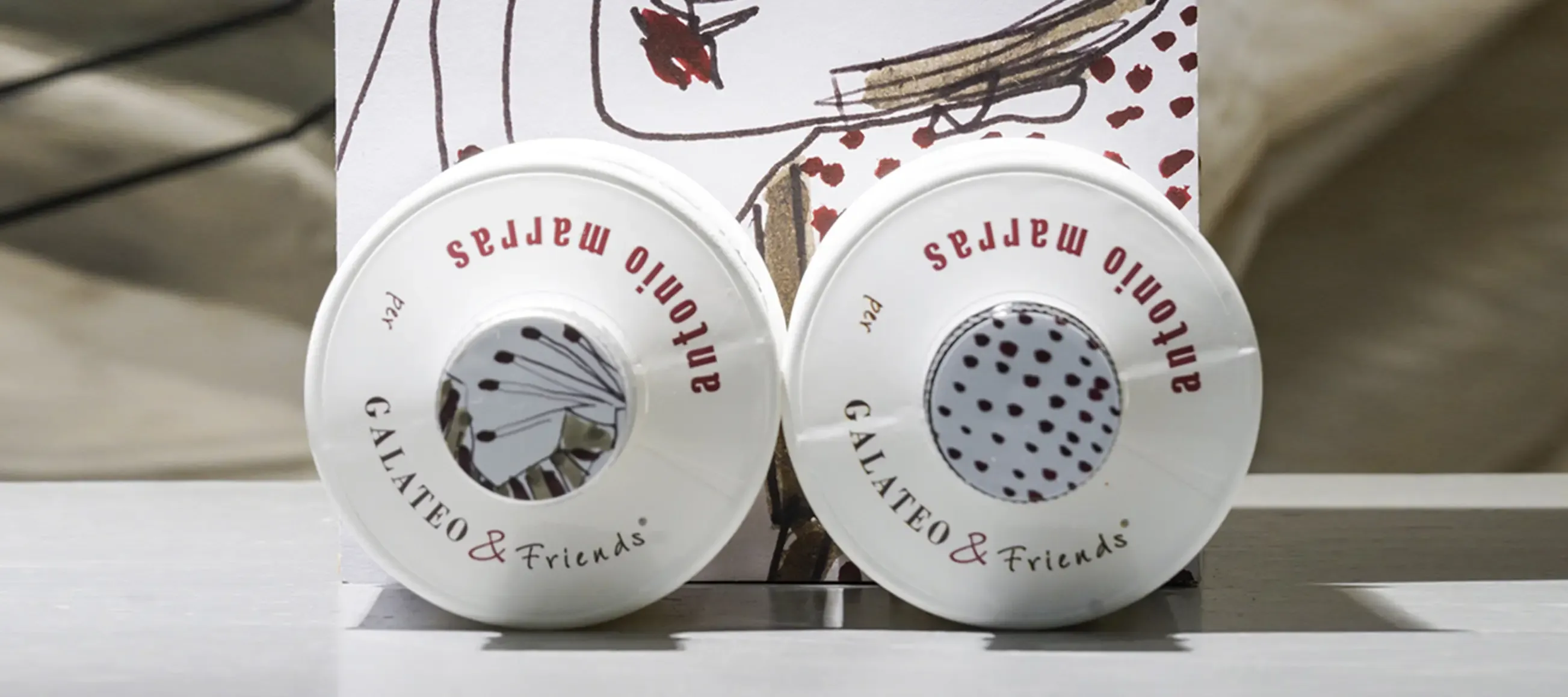
Why put angel wings on an olive oil bottle? And why add Swarovski crystals to its packaging? For Marco Bonaldo, founder of olive oil brand Galateo & Friends, the reasoning is clear. From his base in Taggia, Liguria, Bonaldo has spent years challenging the notion that a product so steeped in Italian tradition should always look traditional. His bottles have evolved into a fusion of fashion, design, and food, sometimes resembling collectable objects more than ordinary kitchenware, while still protecting the oil and remaining practical for everyday use.
In this interview, Bonaldo discusses Galateo & Friends’ collaborations, how a familiar product can become an unexpected design challenge, what happens when fashion designers enter the world of food, and why the next generation of creatives should look beyond the boundaries of their own disciplines.
Bonaldo urges young designers to rethink the whole olive oil experience, from how people perceive and use it to how they might store and repurpose the bottle. The idea is less far-fetched than it sounds: The Guardian has noted the growing appeal of premium olive oils as gifts and eye-catching bottles designed for display, reporting a 515% year-on-year rise in olive oil sales at an online retailer of independent brands.
Visualizza questo post su Instagram
Olive Oil Bottle Design: From Kitchen Staple to Design Object
“Why should olive oil, with its extraordinary history and connection to Italian culture, always be presented in the same way?” That was Bonaldo’s starting point. “With Galateo & Friends, I wanted to break out of that mould and bring olive oil into a world of aesthetics, experimentation and design culture,” he explains.
“I drew inspiration from what some French luxury houses were already doing with spirits and champagne about thirty years ago. I didn’t want olive oil to be just another everyday condiment: I wanted it to be the true star of the table.” – Marco Bonaldo, founder of Galateo & Friends
This vision became the company’s motto, “Il buono racchiuso nel bello,” or “Goodness enclosed in beauty.” But Bonaldo’s ambition was never merely to make olive oil look more luxurious.
“I wanted to create something that wasn’t just good olive oil, but also an object capable of stirring emotions and connecting with the worlds of fashion, art, and lifestyle.”
Visualizza questo post su Instagram
What Happens When Fashion Designers Take on Olive Oil Packaging?
Over the years, Galateo & Friends has developed a series of creative collaborations known as Signatures, inviting designers and fashion creatives to reinterpret its products. For Marco Bonaldo, these partnerships start with people, not just big names.
“Every Signature collaboration begins with a meeting of minds. We’re not simply looking for a name or a signature to place on a bottle. We’re looking for someone with a vision, a language of their own, and something authentic to say through our product,” he says.
The designers involved are often friends of the brand, and Bonaldo believes that giving them the freedom to express their personalities is essential.
“We try to give creativity plenty of room to breathe. If we invite a designer to collaborate, it’s because we want them to contribute something unique. Of course, we must respect certain aspects, from the bottle’s functionality to the product’s recognisability, not to mention the technical and production requirements.” – Marco Bonaldo
“Our bottles are going to be sold and used all over the world,” he points out.
Some collaborations have produced particularly imaginative results. French designer Jacqueline Morabito created a bottle inspired by the idea of olive oil as a guardian angel watching over the table, complete with delicate paper wings. Another project incorporated Swarovski crystals into a capsule collection, adding some jewellery-inspired glamour to food packaging.
How Do Designers Balance Aesthetics and Functionality in Product Design?
Behind these playful experiments lies a practical challenge. A bottle can look extraordinary, but it still has a job to do, especially when it contains food. “A bottle of olive oil can be absolutely beautiful, but it must still contain and protect a food product, be practical to use, and meet strict technical and, above all, regulatory requirements,” adds Bonaldo.
“Designers can’t just focus on how an oil bottle looks. They must consider materials, shapes, weight, closures, product preservation, and production processes. These constraints are real, but they’re also what make the project so exciting.” – Marco Bonaldo
For the founder and owner of the luxury food company specialising in Taggiasca extra virgin olive oil, the aim is to balance imagination and feasibility. Design should surprise people, but it must also function in everyday life. Ideally, it should give an object a life beyond its original purpose.
“I like to think that a bottle can live on, becoming part of someone’s home, their table and their personal style,” he states. “When an object’s shape becomes recognisable and desirable, the product gains a whole new dimension. And that’s when, in my opinion, you can really make your mark.”
He notes that the distinctive shape of the Galateo & Friends bottle has remained recognisable for 25 years, even without its label. It’s a reminder that design can become an essential part of a brand’s identity, just as it does in fashion or furniture design.
Visualizza questo post su Instagram
What Makes a Young Designer Stand Out to Brands?
For Bonaldo, the fluid boundaries between fashion, food, hospitality and lifestyle are opening new opportunities for young designers willing to explore unfamiliar territory.
“Young designers don’t have to imagine their future in a single industry. They can bring their own creative language into food, fashion, hospitality, or other fields.” – Marco Bonaldo
For the entrepreneur, those connections were very rare when he founded Galateo & Friends. “Back then, we were often described as real pioneers,” he recalls.
When it comes to working with young creatives, he values curiosity, personality, and the ability to question established conventions.
“I’m interested in people who aren’t satisfied with the first solution and who dare to question things that seem already settled. Technical skills are essential, but I believe what really makes the difference is the ability to see possibilities where others see nothing but habits.” – Marco Bonaldo
The Olive Oil Design Brief: Rethink How We Use, Store and Reuse It
So what brief would Bonaldo set for a group of design students? “I wouldn’t want them to stop at designing a beautiful bottle. I’d want them to rethink the entire experience of the product: how people perceive it, use it, store it and, why not, reuse it,” he says.
And what would really impress him? He knows exactly what: “A project that completely catches me off guard. Something I’d never thought of, something that would make me see our own product from a new perspective.”
“What would really surprise me isn’t necessarily the most spectacular object, but a project in which an original idea becomes a concrete, intelligent, and achievable solution.” – Marco Bonaldo
He also believes that this exchange should work both ways, with brands remaining open to input from younger generations. “That’s part of our role: not just producing and selling objects, but creating opportunities to exchange ideas with the next wave of creatives, letting them influence us and giving both the contents and the container a new life,” he concludes. He invites young designers to look at familiar objects with fresh eyes, reminding them that an unexpected creative opportunity can start with something as ordinary as a bottle of olive oil.