

Fashion and decay shape Dirty Looks at the Barbican, examining imperfection and resistance through Chalayan, Adrover and other radical designers
Dirty Looks at the Barbican: Fashion Against the Myth of Perfection
With only a few days left before it closes on 25 January, Dirty Looks: Desire and Decay in Fashion brings a set of questions back into the conversation around luxury and creativity: the aesthetics of mud, challenges to Western ideals of beauty and perfection, and the rebellious, romantic, regenerative potential embedded in dirt and decay.
Presented at the Barbican Art Gallery in London, eight years after its last large-scale fashion exhibition, Dirty Looks gathers more than a hundred works from the past fifty years. The exhibition spans the practices of over sixty established fashion houses and emerging designers from Europe, Asia, Africa and the Americas, tracing a shared yet fragmented lineage of resistance within fashion’s visual and material language.
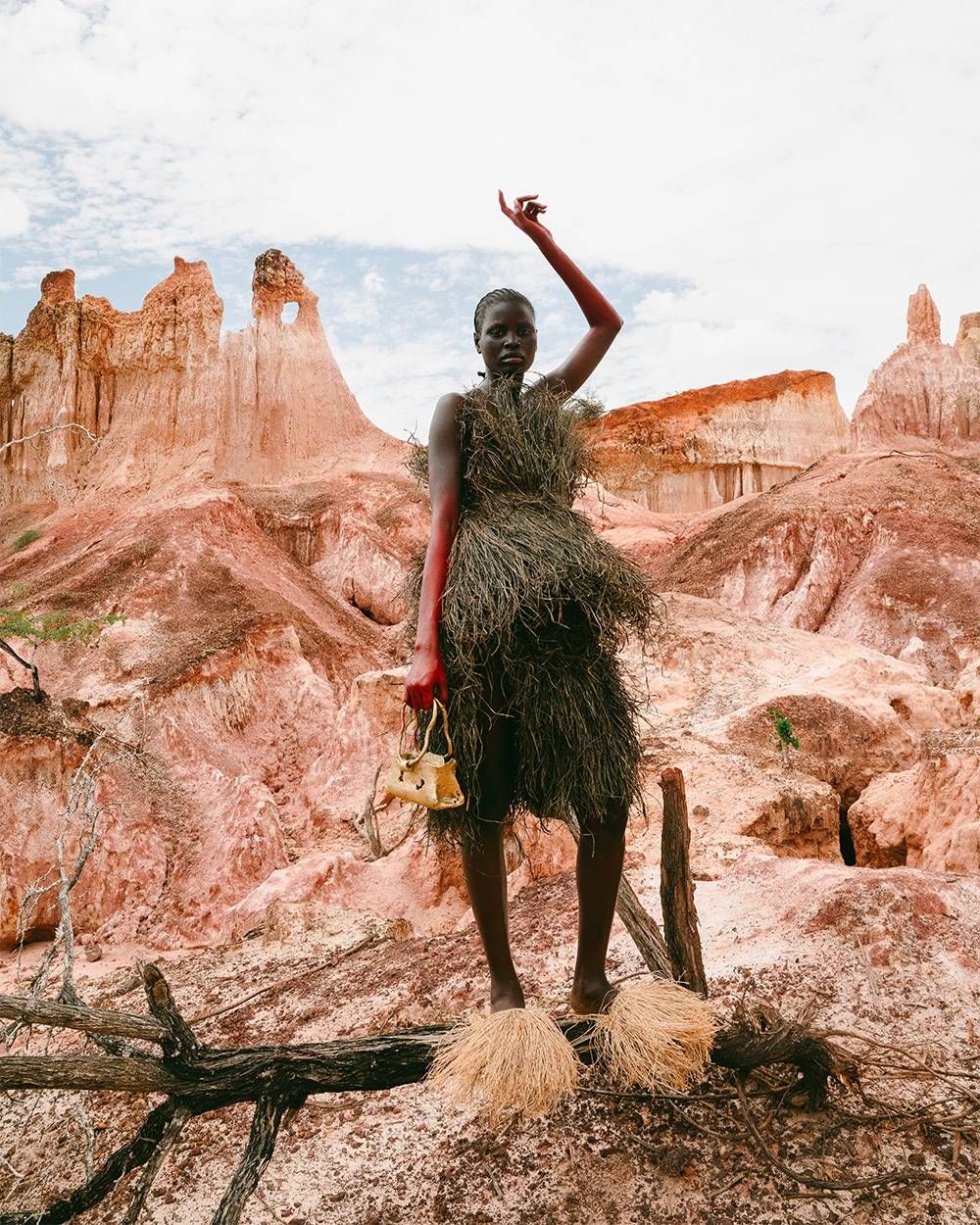
IAMISIGO, handwoven raffia-cotton blend look dyed with coffee and mud, Shadows, Spring/Summer 2024. Photograph by Fred Odede. Courtesy of IAMISIGO.
Why Fashion Keeps Returning to Dirt, Decay and Imperfection
By putting past and present in conversation, the exhibition raises a crucial question: what does all this say about the future of fashion? And why does it matter to keep tracing fashion’s fascination with dirt, wear and decomposition across couture, experimental craft and performative installations?
The answer is more complex than it might initially appear. Even though “dirty looks” have been part of fashion and its most radical designers since the 1980s, they still act as a rupture—a critique with the power to unsettle. In fact, their critical force appears to have regained urgency.
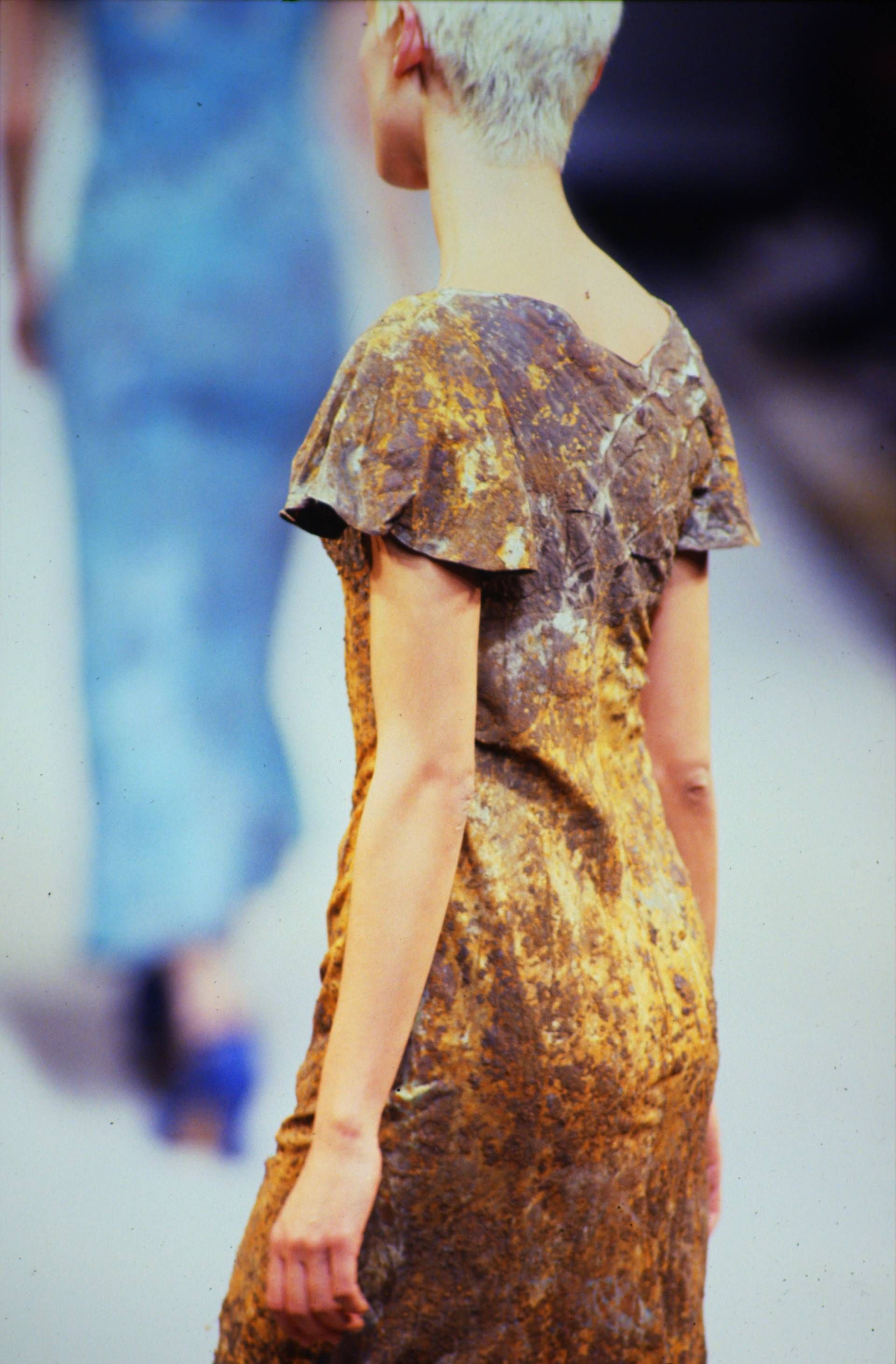
Hussein Chalayan, Temporary Interference, Spring/Summer 1995. Courtesy of Niall McInerney/Bloomsbury/Launchmetrics/Spotlight.
Are Dirty Aesthetics Still Radical in Contemporary Fashion?
Emerging as a subversive challenge to entrenched ideas of luxury, class and refinement, these creations have consistently lingered at the edges of fashion rather than its centre. They never went mainstream—nor were they meant to. Yet as fashion evolved and absorbed new forms of visual dissent, the disruptive power of “dirty aesthetics” gradually softened.
Today, as many luxury brands retreat into safer, more conservative territory—embracing quiet luxury, risk aversion and a hollow neutrality to offset declining revenues—this lineage acquires renewed relevance. We’re prompted to reconsider the journey of “dirty aesthetics”: from their early appearance as acts of transgression to their evolution into forms of craft that question global consumption, and redefine what modernity, beauty and luxury could mean.
Advancing the idea that fashion’s critical force emerges where ideals of perfection start to crumble, the Barbican exhibition treats clothing as a porous entity—one that absorbs soil, moisture, time and labour, and in doing so resists the pressure for constant, immaculate renewal that has once again come to govern much of the industry.
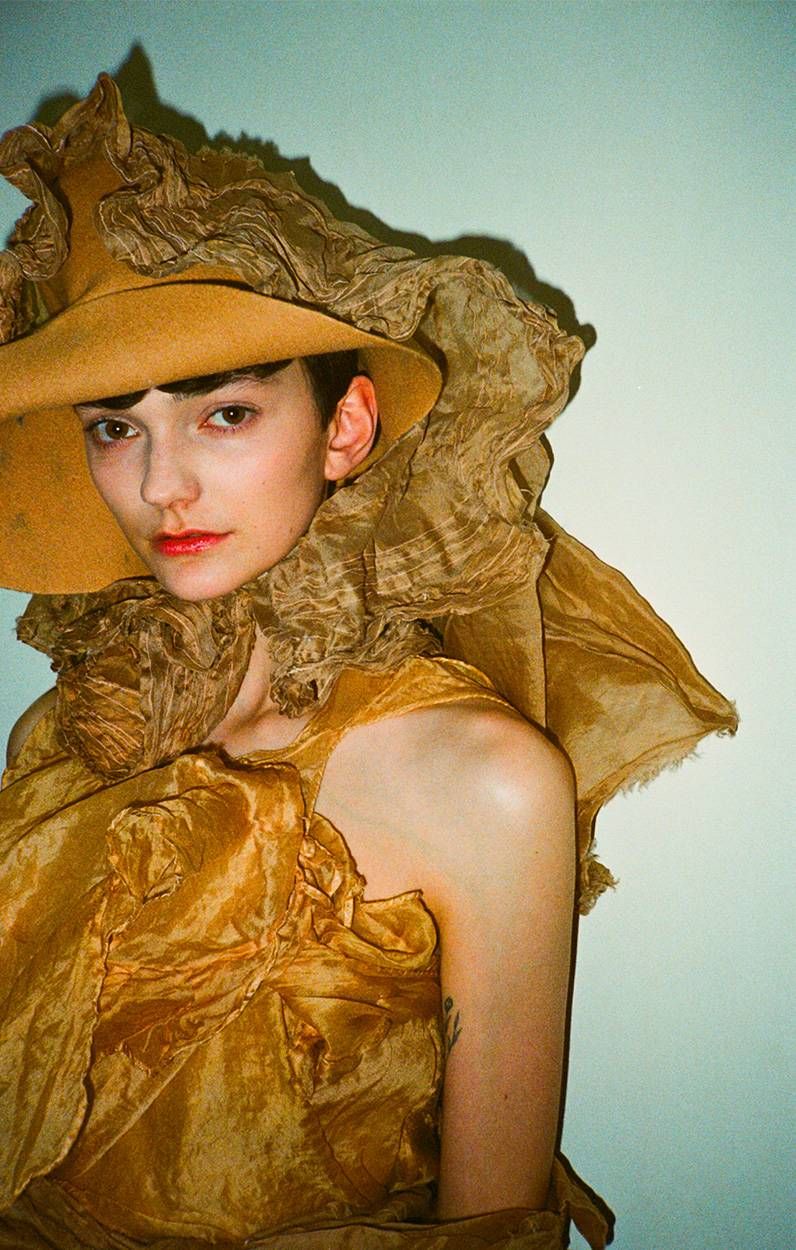
Paolo Carzana, Spring/Summer 2025, How to Attract Mosquitoes. Headwear and creative consulting by Nasir Mazhar. Styling and creative consulting by Patricia Villirillo. Photograph by Joseph Rigby. Courtesy of Paolo Carzana.
From Westwood to Margiela: Radical Designers of Dirty Looks
This expanded vision unfolds through a deliberately diverse constellation of designers and fashion houses, where historical radicalism and contemporary experimentation coexist as equals. Foundational figures like Vivienne Westwood and Malcolm McLaren appear alongside Maison Margiela, Miguel Adrover, and Japanese designers Issey Miyake, Rei Kawakubo and Yohji Yamamoto—whose work challenged Western ideals of beauty and refinement from the late twentieth century onward. The exhibition brings together practices by Helmut Lang, Jean Paul Gaultier, Alexander McQueen and Rick Owens, all of whom have used erosion, distress and material disobedience as tools for critique.
These trailblazers are placed in dialogue with more recent voices, including Marine Serre, Robert Wun, Paolo Carzana, Dilara Findikoglu, Solitude Studios and SR Studio L.A. C.A. by Sterling Ruby, whose work engages reuse, contamination and degradation as ethical and political statements.
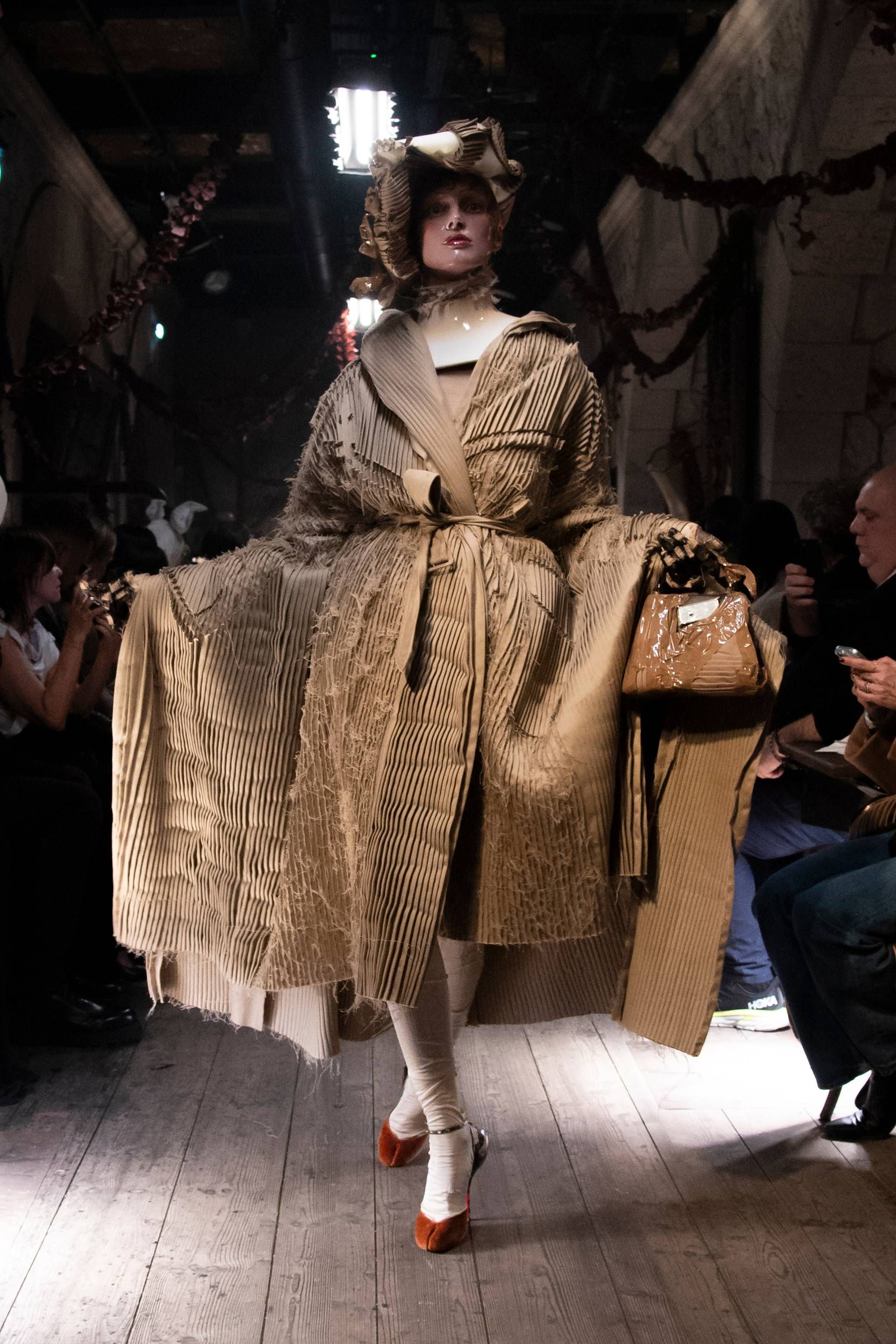
Maison Margiela, Artisanal Spring/Summer 2024. © Catwalkpictures
Hussein Chalayan and Fashion as Future Archaeology
Few designers have explored “dirty aesthetics” as rigorously as Hussein Chalayan. For his 1993 graduate collection, The Tangent Flows, he famously buried garments underground with iron filings for months, allowing rust and oxidation to become part of the creative process.
The resulting pieces are what Chalayan calls “future archaeology”: garments conceived with an awareness of their own eventual disappearance, blurring the lines between creation, decay and return to the earth. Fashion here gives up on the idea of durability, instead embracing its connection with time and entropy.
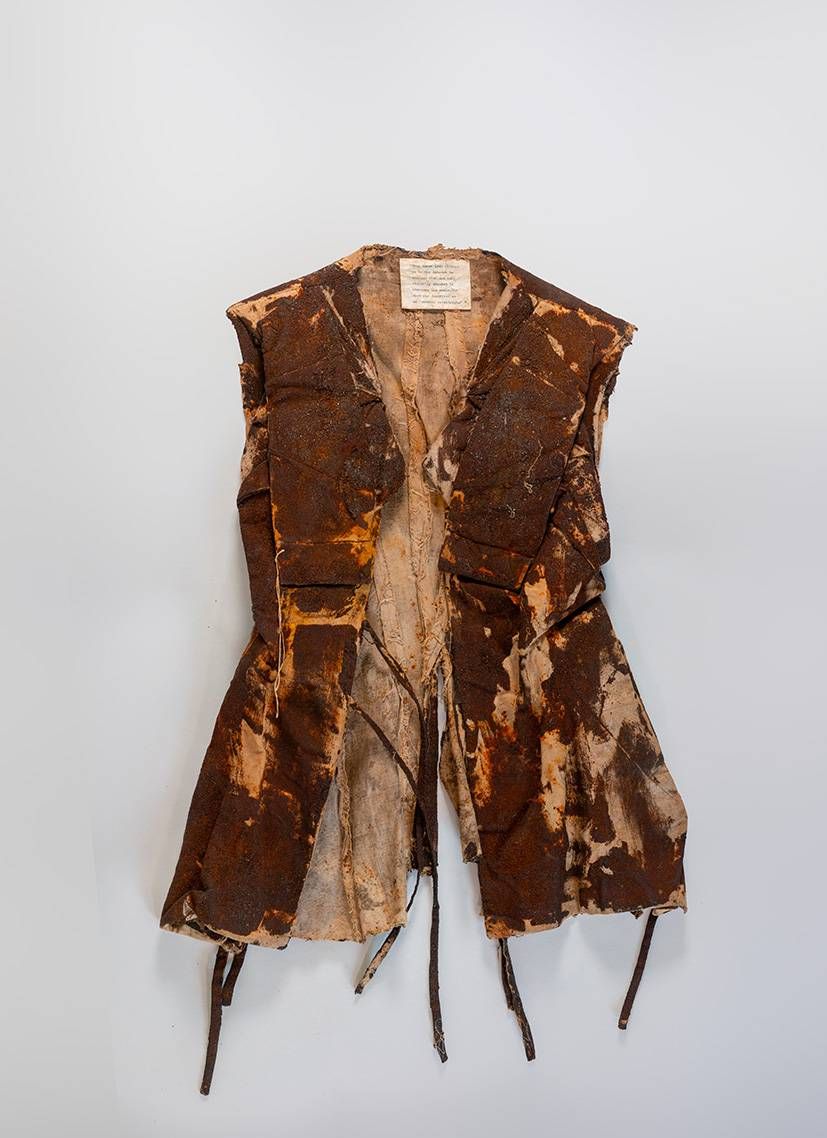
Hussein Chalayan, The Tangent Flows, 1993. Photograph by Ellen Sampson.
From Miguel Adrover to Solitude Studios: Ethics, Reuse and Bogcore
This tension between fashion and decay also runs through Miguel Adrover’s work, as seen in looks from Out Of My Mind (Autumn/Winter 2012). Adrover’s practice has consistently confronted fashion’s excess and obsession with authorship, opting for reworked, distressed and politically charged garments that highlight reuse and material fatigue. In Dirty Looks, his creations serve as an ethical statement—rejecting novelty in favour of garments that proudly bear the marks of their previous lives.
Equally significant is Solitude Studios, whose work is closely associated with what has come to be known as “bogcore”. Drawing on the historical use of Danish bogs for ritual offerings and preservation, the studio submerges textiles in peat-rich wetlands, allowing microorganisms and minerals to alter the fabric. The bog acts as both a dye bath and a digestive system, partially consuming the cloth and leaving behind deep, earthy tones. Rather than just simulating decay, these garments actually experience it, placing fashion within ecological cycles that predate and outlast human production.
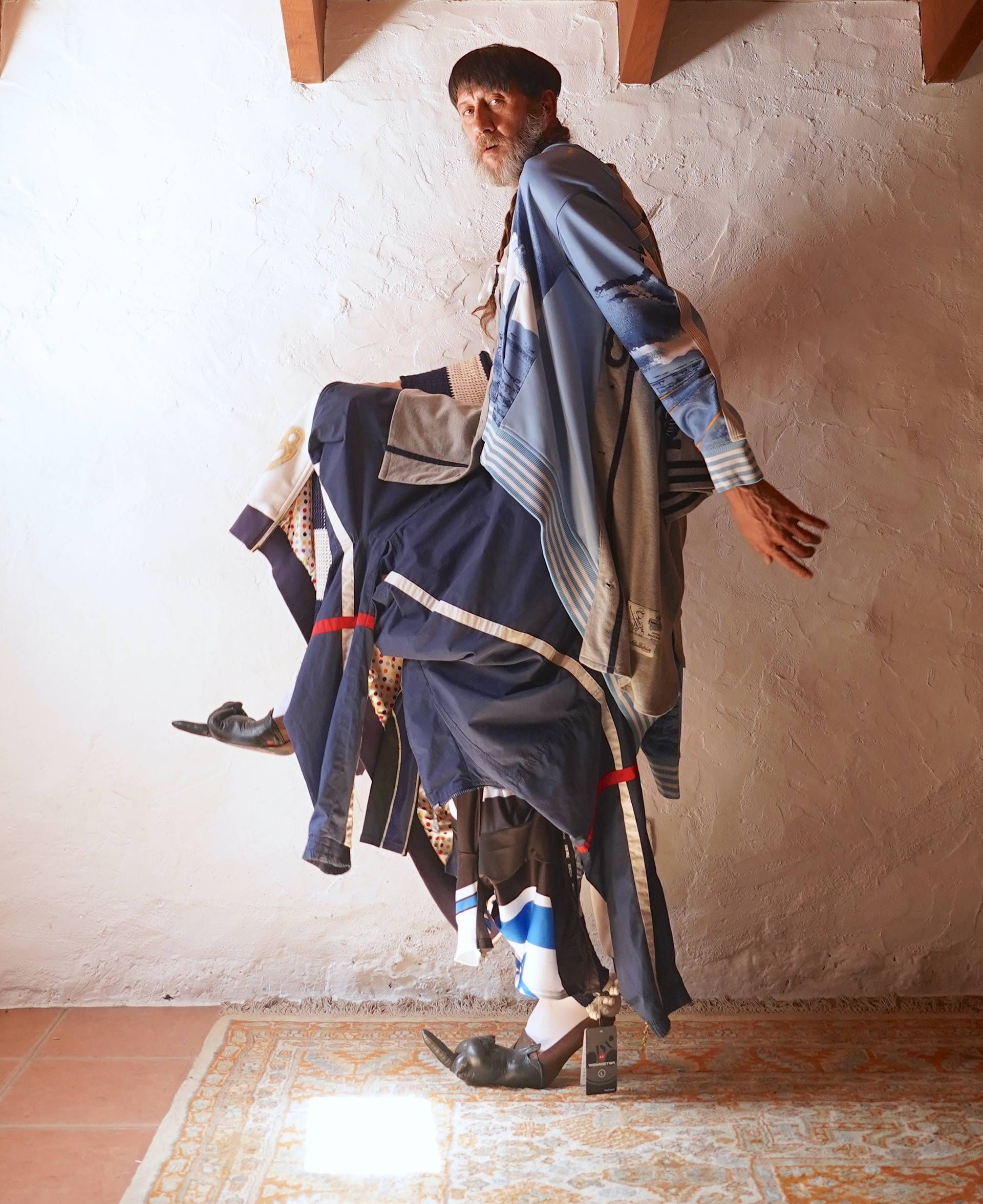
Miguel Adrover wears a look from Out Of My Mind, his Autumn/Winter 2012 collection.
Learning to See Fashion Differently: A Student’s Encounter With Dirty Looks
Together, these practices sketch a vision of fashion rooted in rebellion, vulnerability, impermanence and material honesty. As the global fashion calendar gears up for another round of controlled spectacle and polished excess, Dirty Looks insists on an alternative lineage—one where clothes are allowed to age, deteriorate and remember.
To see how this approach resonates with those still finding their place in fashion, this essay turns to the reflections of London-based student Giulia Ascolani, who recently experienced the exhibition—and with it, a vision of fashion stripped of its usual protective gloss.
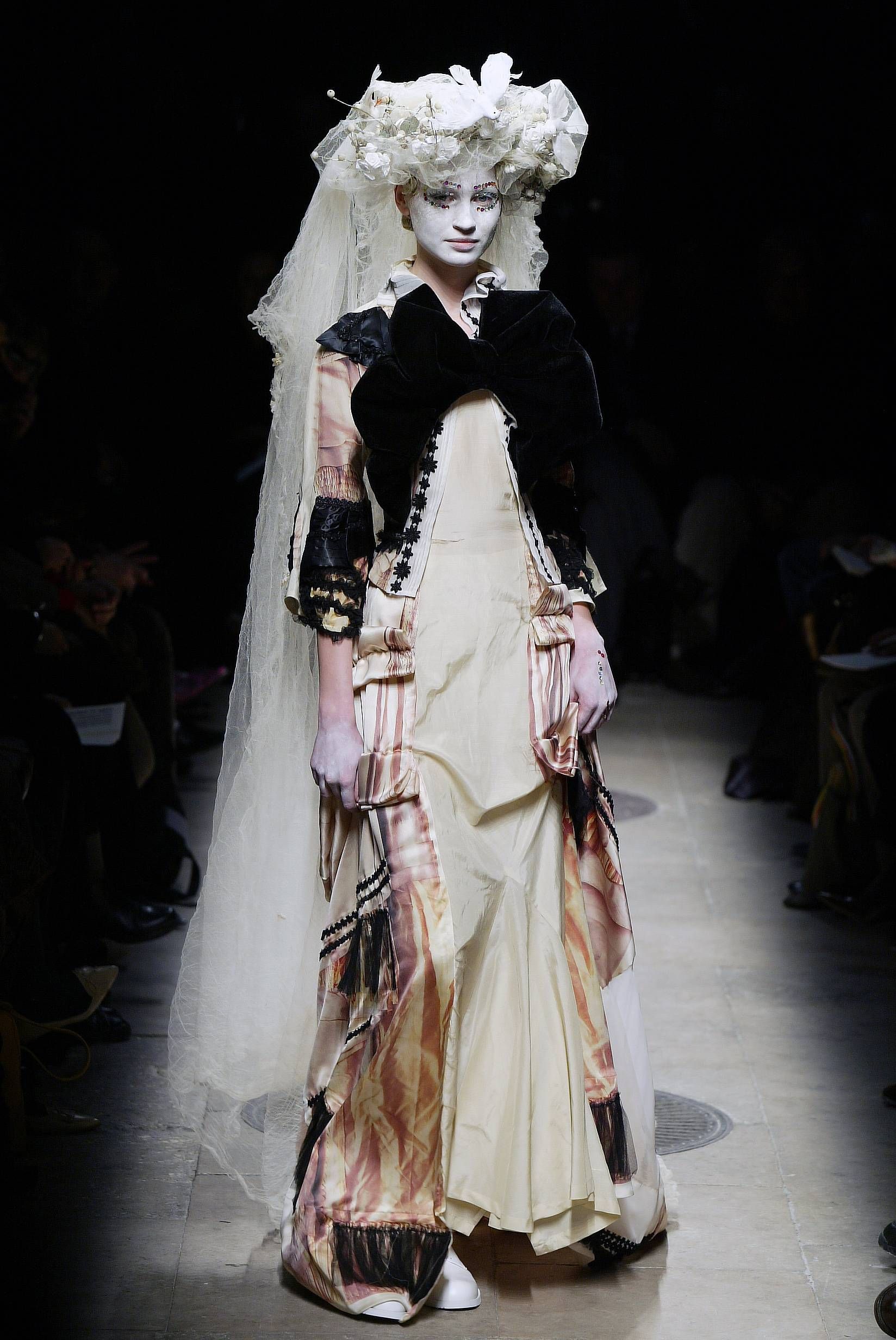
Comme des Garçons, Autumn/Winter 2005, Broken Bride ©Catwalkpictures.
How did it feel to encounter fashion through the lens of dirt and decay?
I never expected fashion could look like this. Walking into Dirty Looks, we left behind the polished surfaces and perfect seams we usually associate with fashion and entered a world where clothing is allowed to crumble, crease, and carry its own memory. The garments felt somewhere between relic and experiment—pieces that have lived, weathered, or been transformed by unusual processes.
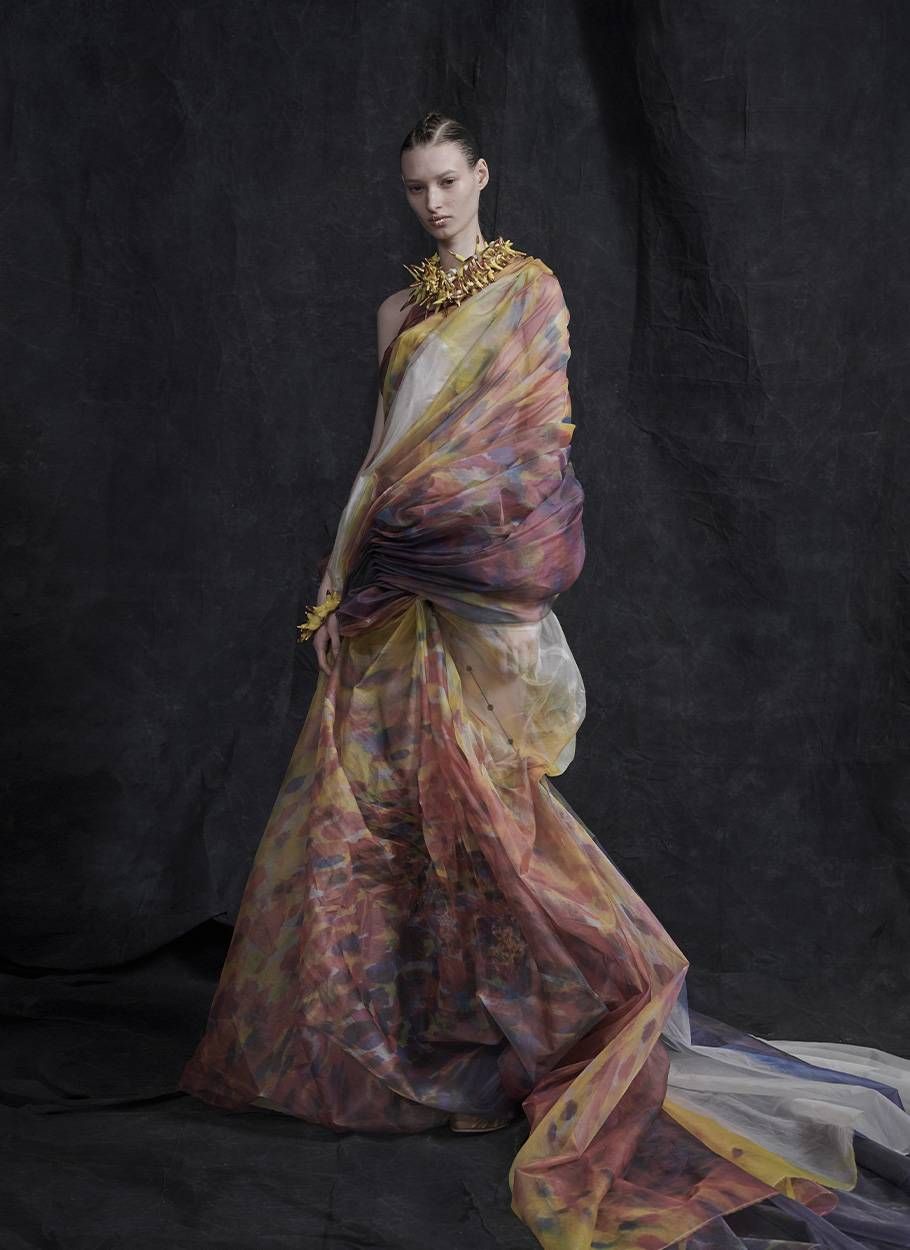
Yuima Nakazato, Couture Spring/Summer 2023 INHERIT. Photograph by Morgan O’Donovan.
What did Dirty Looks change in the way you see fashion today?
As Fashion Business students, we are used to working with high-fashion brands and visiting showrooms where everything looks perfect. Here, though, the clothes were displayed in states of distress and imperfection. Dresses appeared softened by time, their colours muted as if they’d whispered their stories into the fabric. Some garments looked like they’d been dug from the earth; others seemed shaped by natural forces rather than by designers’ hands. Textures shifted from rough to delicate, from stiff to almost ghostlike, giving each piece a quiet emotional weight.
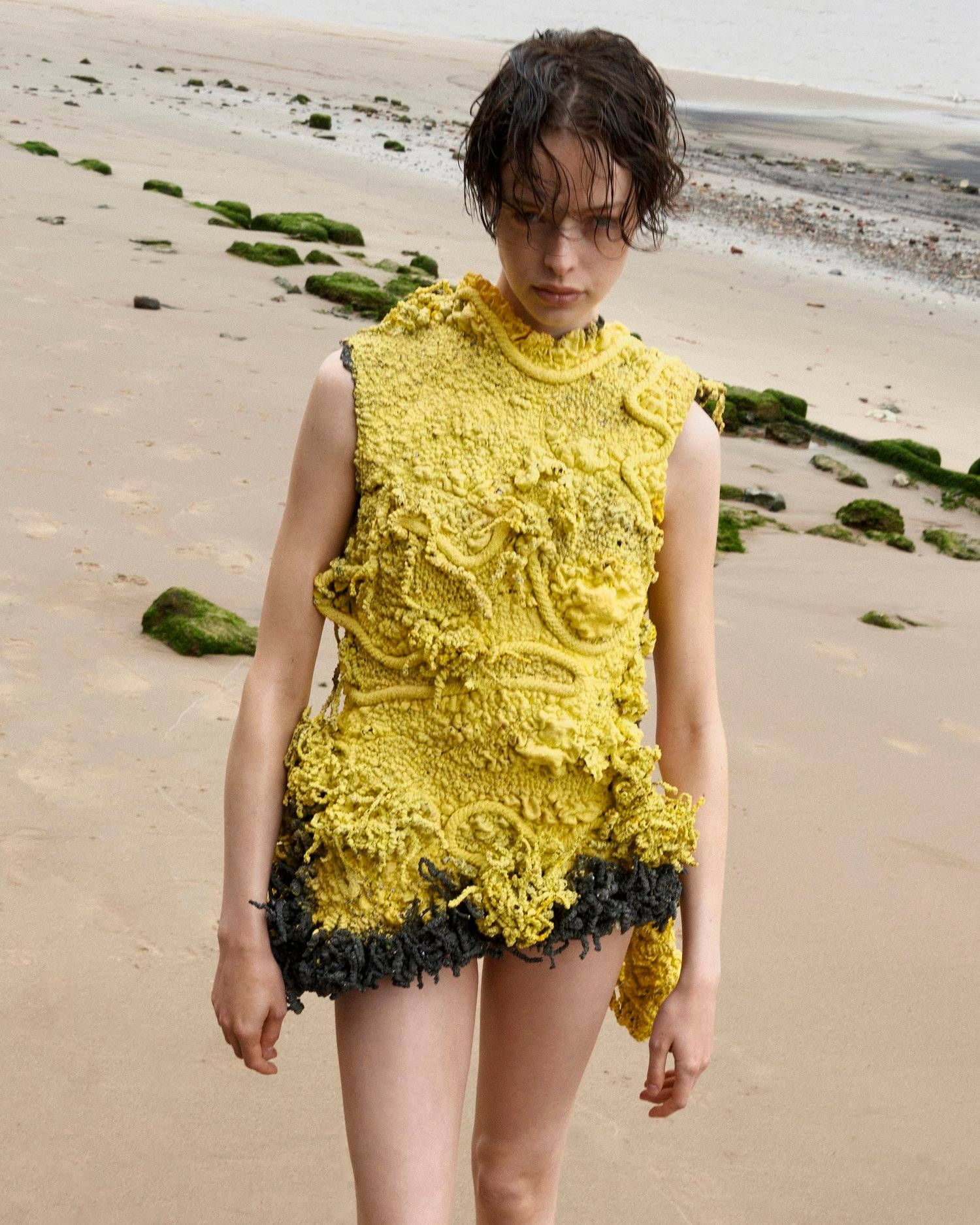
Piero D’Angelo, Physarum Lab, 2019. Photograph by Ladislav Kyllar.
Do “dirty looks” function as a trend, or as a deeper cultural critique?
The exhibition celebrates imperfection not as an aesthetic trend, but as an honest state of being. Instead of hiding wear and decay, Dirty Looks brings trends forward, allowing frayed hems, stretched fibres, and uneven tones to become part of the narrative. The result is both unsettling and strangely elegant—a reminder that fashion, like people, is often most compelling when it refuses to be smoothed out.
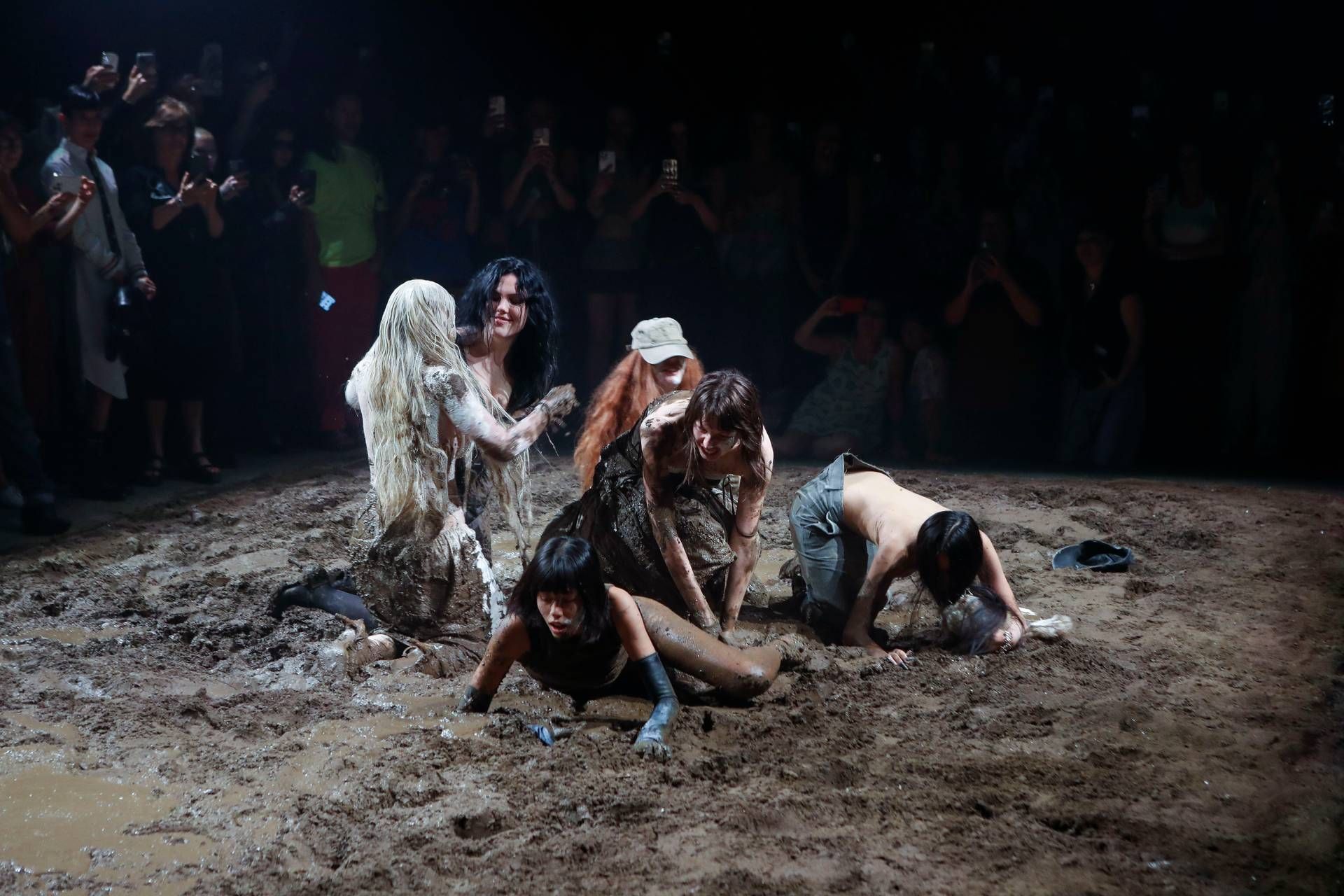
Models mud wrestling at Elena Velez’s Spring/Summer 2024 presentation, The Longhouse. Photo by Jonas Gustavsson for The Washington Post via Getty Images.
Which material or detail stayed with you the most, and why?
Walking through the gallery, we found ourselves slowing down, drawn to the smallest details: a faint crease at the shoulder, the softened edge of a skirt, the subtle collapse of fabric that once held its shape. Each piece felt almost human. Their imperfections weren’t flaws but fingerprints—traces of where they’d been and what they’d survived.
What does the dialogue between iconic designers and emerging voices reveal about fashion now?
From the start, it was clear: the exhibition isn’t asking to admire conventional beauty, but to recognise it in the fragile, the weathered, and the unguarded. Seeing those legendary designers made everything click—the subversive punk of Vivienne Westwood, the eclecticism of Maison Margiela, and the Japanese trio of Issey Miyake, Rei Kawakubo and Yohji Yamamoto, all introducing the dual aesthetic of beauty and perfection, ultimately challenged by the fragile creations of Hussein Chalayan. Next to them, contemporary designers like Paolo Carzana and Robert Wun continue this perspective— not just as a trend, but as a genuine necessity. The Barbican’s concrete walls amplify this feeling, holding the garments in a space where roughness feels honest, and transformation feels inevitable.
Silvia De Vecchi & Giulia Ascolani
Librarian, and Fashion Business student, London