

Mona Hatoum world map installation at the Cisterna at Fondazione Prada uses red glass spheres to depict a borderless, unstable geography shaped by power and movement. Courtesy of Fondazione Prada BACK EXHIBITION
Feb 04, 2026
Mona Hatoum at Fondazione Prada: An exhibition for an age of uncertainty
Mona Hatoum at Fondazione Prada transforms the Cisterna into a charged environment of fragility and tension, reflecting the uncertainty of our time
Until November 9, 2026, Fondazione Prada in Milan presents a major exhibition by Mona Hatoum. With Over, Under and In Between, the artist transforms the iconic Cisterna building into an environment charged with fragility, tension and poetic unease.
Far from a conventional exhibition, the project unfolds as a site-specific encounter with the uncertainty of our time, and stands out as one of Fondazione Prada’s most significant exhibitions this year.
Why the Cisterna at Fondazione Prada Is Central to Mona Hatoum’s Exhibition
The Cisterna is a powerful setting. Once home to industrial silos and alcohol tanks, it retains a strong sense of containment, pressure and transformation.
Mona Hatoum does not neutralise this history; instead, she works with it. Her three independent yet interconnected installations engage directly with the architecture, treating the building not as a passive backdrop but as an active participant in the exhibition. The result is a dialogue between art, space, and the visitor that feels visceral and unavoidable.
At the heart of the project are three recurring motifs in Hatoum’s practice: the spider web, the map and the grid. These familiar forms, in this context, become markers of instability, vulnerability and risk. Together, they structure a spatial sequence that reflects the precariousness of contemporary life.
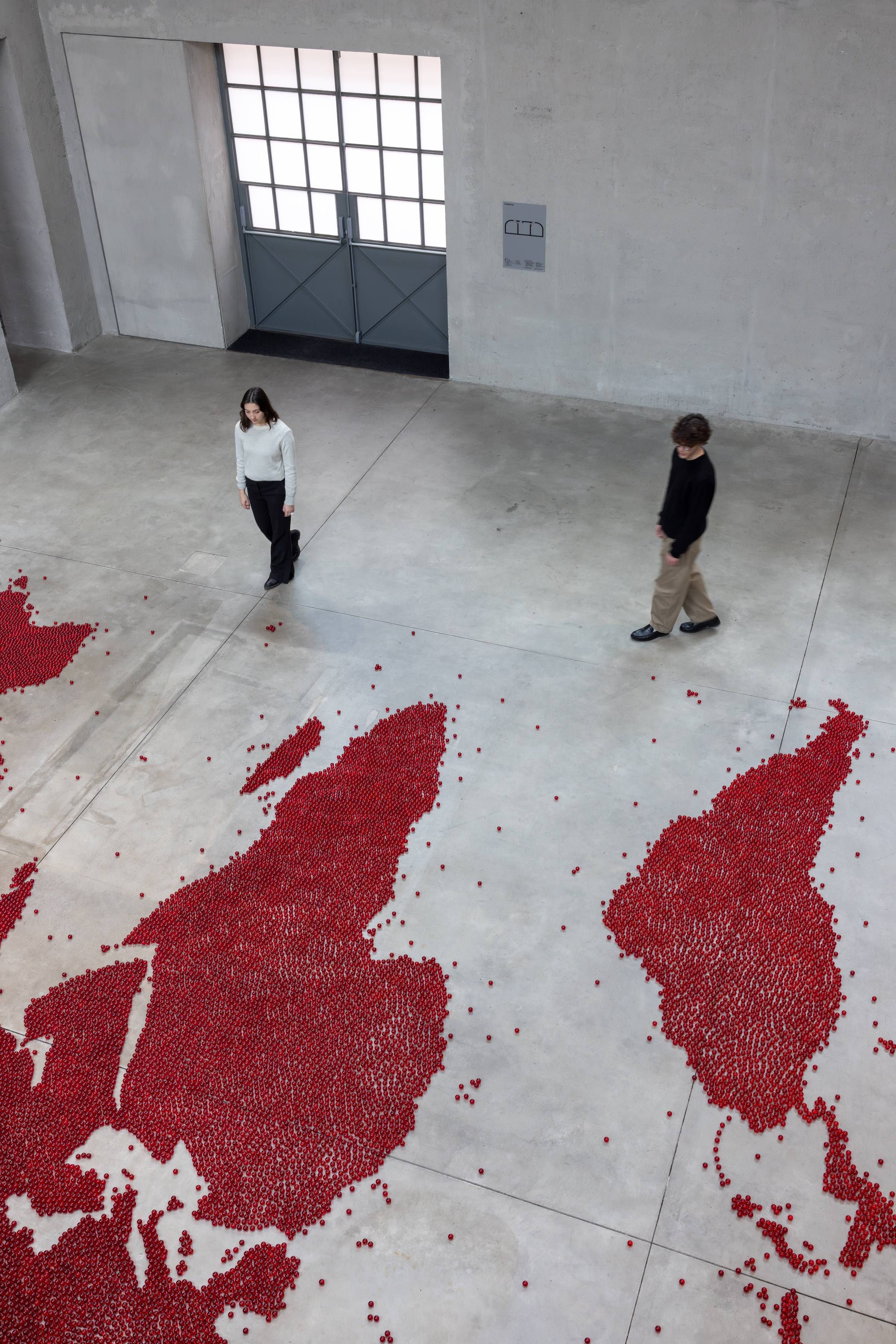
Mona Hatoum installation at the Cisterna, Fondazione Prada, transforms industrial space into a visceral map of vulnerability, movement and spatial tension within contemporary life. Courtesy of Fondazione Prada
The Spider Web in Mona Hatoum’s Work: Meaning, Metaphor and Risk
Over, Under and In Between begins immediately upon entering the Cisterna. Suspended overhead is a large spider web composed of hand-blown transparent glass spheres connected by fine threads. Positioned just above the visitor, it heightens awareness of scale, gravity and exposure.
Mona Hatoum has long used the spider web as a metaphor for entrapment, neglect, family ties and invisible systems of connection. Here, however, it expands into something almost cosmic. The glass spheres evoke dewdrops—luminous and ephemeral—while also conjuring a celestial constellation.
The work oscillates between attraction and threat. Is it a trap? A shelter? A universe held together by invisible forces?
As Hatoum observes, the installation speaks to the interconnectedness of all things. Standing beneath it, visitors are placed in a space charged with both awe and anxiety—a reflection of the emotional register of our era.
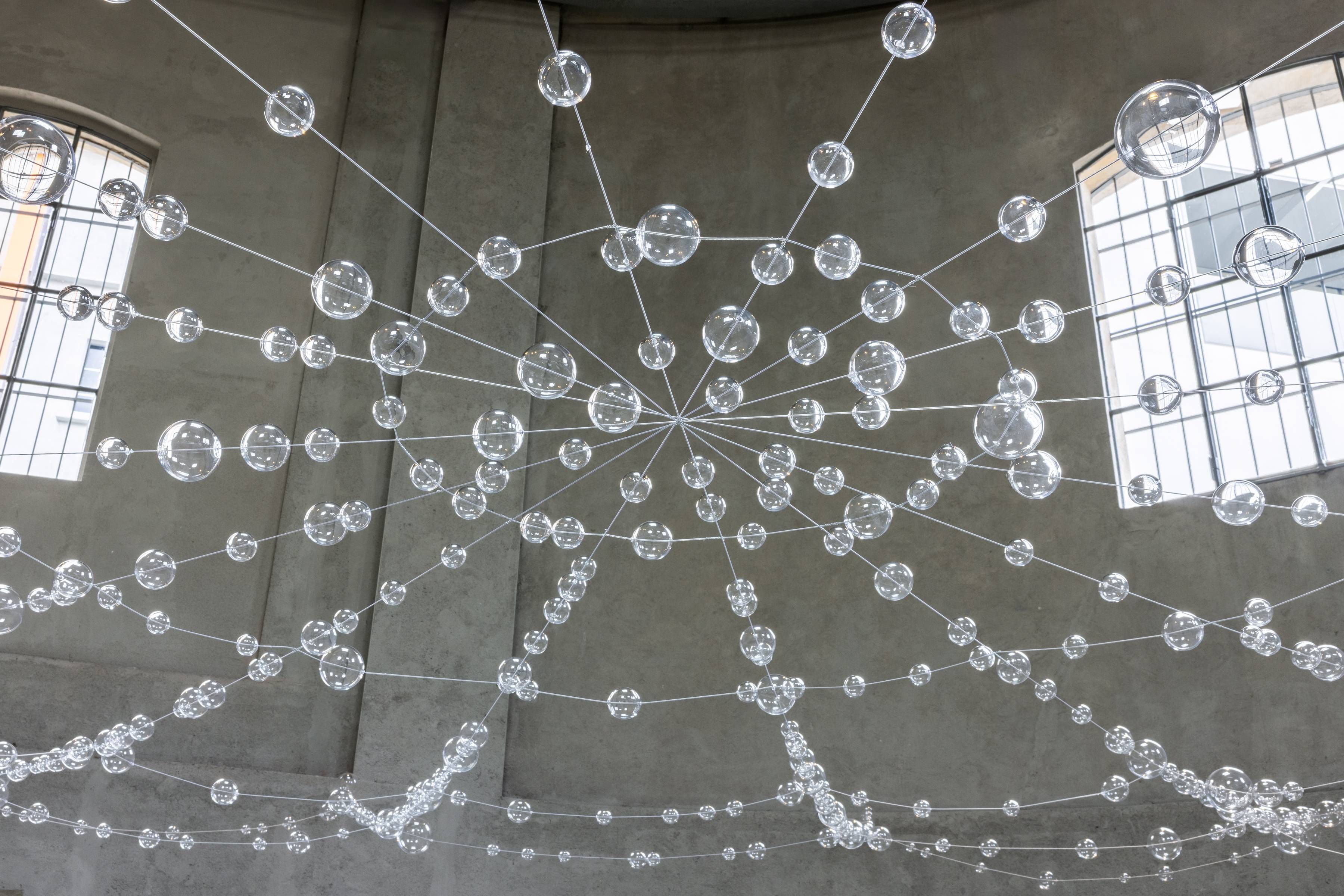
Mona Hatoum spider web installation at the Cisterna at Fondazione Prada suspends glass spheres overhead, evoking interconnectedness, fragility and cosmic tension between attraction and risk. Courtesy of Fondazione Prada
Mona Hatoum’s Borderless World Map and the Politics of Representation
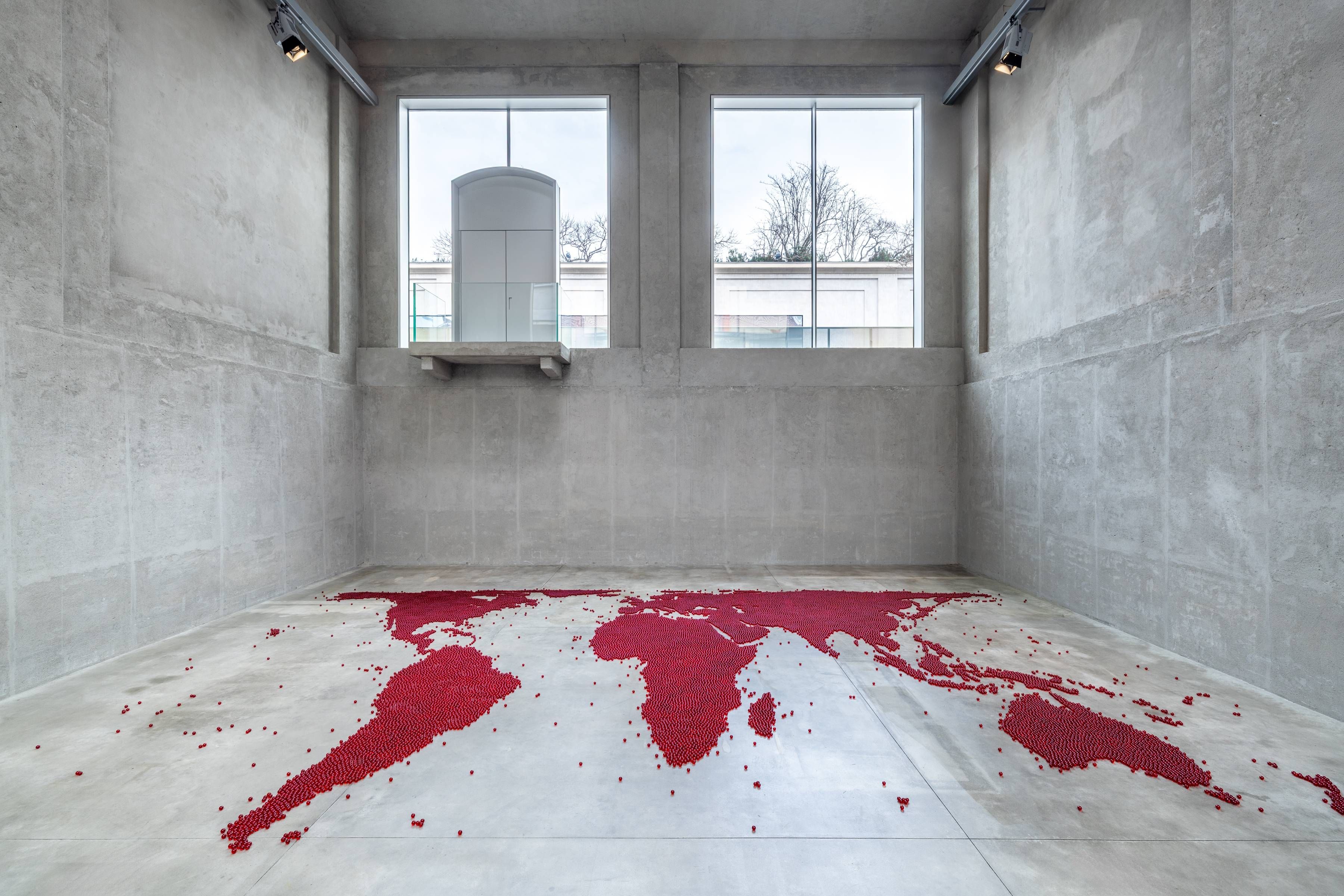
In the central hall, the experience shifts from overhead suspension to ground-level instability. More than 30,000 translucent red glass spheres cover the concrete floor, arranged to form a world map. Only the outlines of the continents are visible; political borders are absent.
Importantly, the spheres are not fixed. The map exists as an “open and undefined territory,” vulnerable to external forces and visitors alike. The work becomes a metaphor for a world in constant flux, shaped by movements, pressures, and imbalances beyond any stable framework.
Mona Hatoum’s use of the Gall-Peters projection, rather than the traditional Mercator map, is a deliberate choice. Historically, cartography has reflected systems of power, often distorting the scale of different regions—shrinking the Global South while enlarging the Global North.
By adopting an alternative projection, the artist challenges inherited ways of seeing the world and reminds us that representation is never innocent.
As architect and theorist Theo Deutinger notes, a map can be understood as the Earth’s skin, peeled off and flattened. In this installation, that surface is exposed—beautiful, glowing, and precarious.
All of a Quiver: Why Mona Hatoum Turns Minimalism into Instability
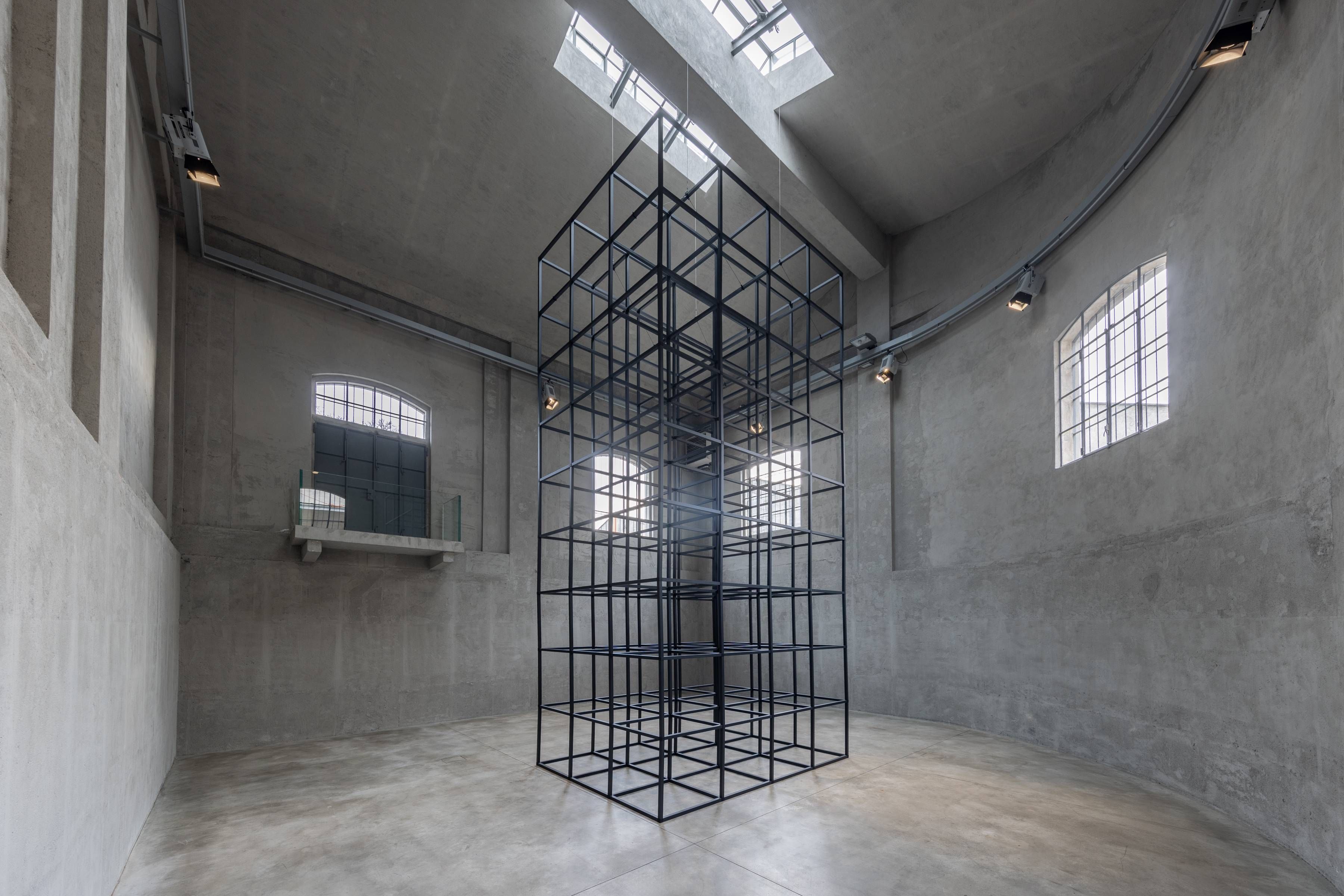
The final room features perhaps the exhibition’s most physically intense work: All of a Quiver, a kinetic installation consisting of a suspended metal grid built from nine stacked levels of open cubes. Minimal in appearance, the structure delivers a powerful physical and psychological impact.
Hanging from the ceiling, the structure slowly oscillates, zig-zagging downward as if on the verge of collapse. Metallic creaks and clinks accompany its movement, amplifying the sense of tension. The work feels almost animate, caught in a continuous cycle of movement and adjustment—like a body trembling, resisting gravity, failing and rebuilding itself in an endless loop.
Here, Mona Hatoum reworks the formal language of minimalism—grids, cubes, repetition—by introducing instability, sound and discomfort. The work evokes claustrophobia and anxiety, yet also hints at resilience. It exists in a liminal space between construction and breakdown, suspension and fall, strength and fragility.
As Lebanese architect Lina Ghotmeh has written, this kind of oscillation suggests that remaining upright does not mean overcoming instability, but learning to exist within it.
Why Over, Under and In Between Defines Mona Hatoum’s Relevance Today
Mona Hatoum’s Over, Under and In Between resonates because it mirrors the emotional conditions of our time. Rather than illustrating political, environmental or social instability, Hatoum translates these dynamics into spatial and bodily experience.
This latest exhibition at Fondazione Prada unfolds through movement, sound and physical proximity. The suspended web, shifting map and oscillating grid all point to a world where certainty has eroded, yet interdependence remains.
Fondazione Prada has consistently positioned itself as a site for challenging contemporary art. With Mona Hatoum’s project, the Cisterna becomes a space where instability is not resolved but examined—and where awareness takes precedence over reassurance.
If there’s one exhibition in 2026 that truly captures what it feels like to live “over, under and in between,” this is it.
Angelo Ruggeri
Journalist and Tutor for Styling, Business and Design Course and Master’s Programmes, Milan
You might be interested in...
School
MILANO FASHION Course
Programme
undergraduate-BA (Hons) Degrees · 3-Year courses · Bachelor of Arts