

The Chamber of the Possible
From Folios Nº7, the third entry in Maze35’s new series featuring articles, writings and essays from Moleskine Foundation’s cultural publication
Folios is the cultural publication of Moleskine Foundation showcasing the theme of creativity for social change through the stories of the Creativity Pioneers around the world that are part of Creativity Pioneers Fund. Through its new editorial column featuring a selection of articles from the latest, seventh edition of the publication, Maze35 presents its third installment.

Original illustration by Ibrahim Rayintakath, commissioned exclusively for Folios No. 7, the cultural publication of the Moleskine Foundation.
I will not be addressing liminality as an identifiable physical space, but as a process. The laboratory in which an autonomous consciousness is built, a crucial stage in mental and personal evolution. In other words, the intimate, in the sense of the psyche, is what is at stake here. How does a person evolve and what are the consequences, or at least the conditions, of this evolution?
The issue at play is that state between two states where the personality is shaped. Liminality is a kind of limbo, a purgatory that can only represent a transitional state, like the evolution from larva to butterfly. This in-between state could represent the chamber of the possible. We might feel a kind of floating, like a state of weightlessness during which we lose control of things; a state of social puberty for the still undetermined individual.
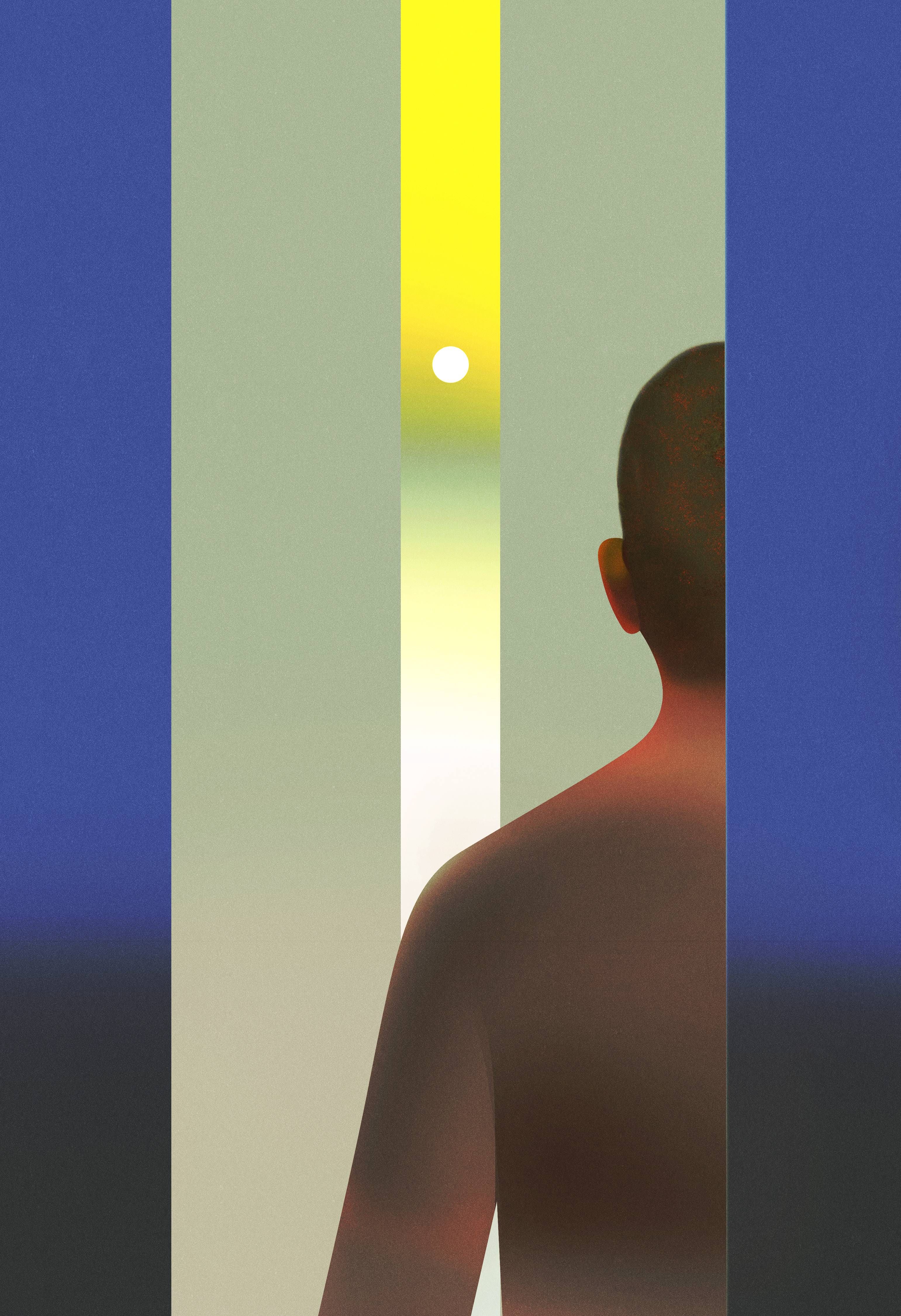
Original illustration by Ibrahim Rayintakath, commissioned exclusively for Folios No. 7, the cultural publication of the Moleskine Foundation.
The liminal space is the place of doubt within which a rising “I” gazes suspiciously at everything around it, including itself.
Deprived of its certitudes, it no longer has any other way of being in harmony than to accept the violence of the phenomenon of which it has been both the object and the subject.
Descartes thought he had resolved the question of the separation of body and mind in his “I think therefore I am”, but perhaps he was a little too radical in this assertion, which eliminates the body as a fundamental element in the creation of autonomous thought. The liminal space, by operating a kind of sensory deprivation, constrains the subject-agent to activate tools other than those of reason.
The sensations that develop and to which the subject is exposed are as important as the synthesis that occurs at a later stage. It is at the end of this process that individuation intervenes, namely the full and complete awareness of being unique and accepting one’s singularity not as a weakness or a lack, but as a vital force.
The path to individuation is a painful process. It is not a matter of separation, but of integration. As Leibniz points out, in a kind of tautology, there are no two similar beings:
“for if it is true that we cannot obtain marks which perfectly distinguish an individual from any other possible individual, there are nevertheless marks which distinguish him or her from the individuals we usually meet”.
The individuals mentioned by Leibniz can be complete strangers, of course, but I am thinking mainly of relatives, family and social units with whom identification is strong.
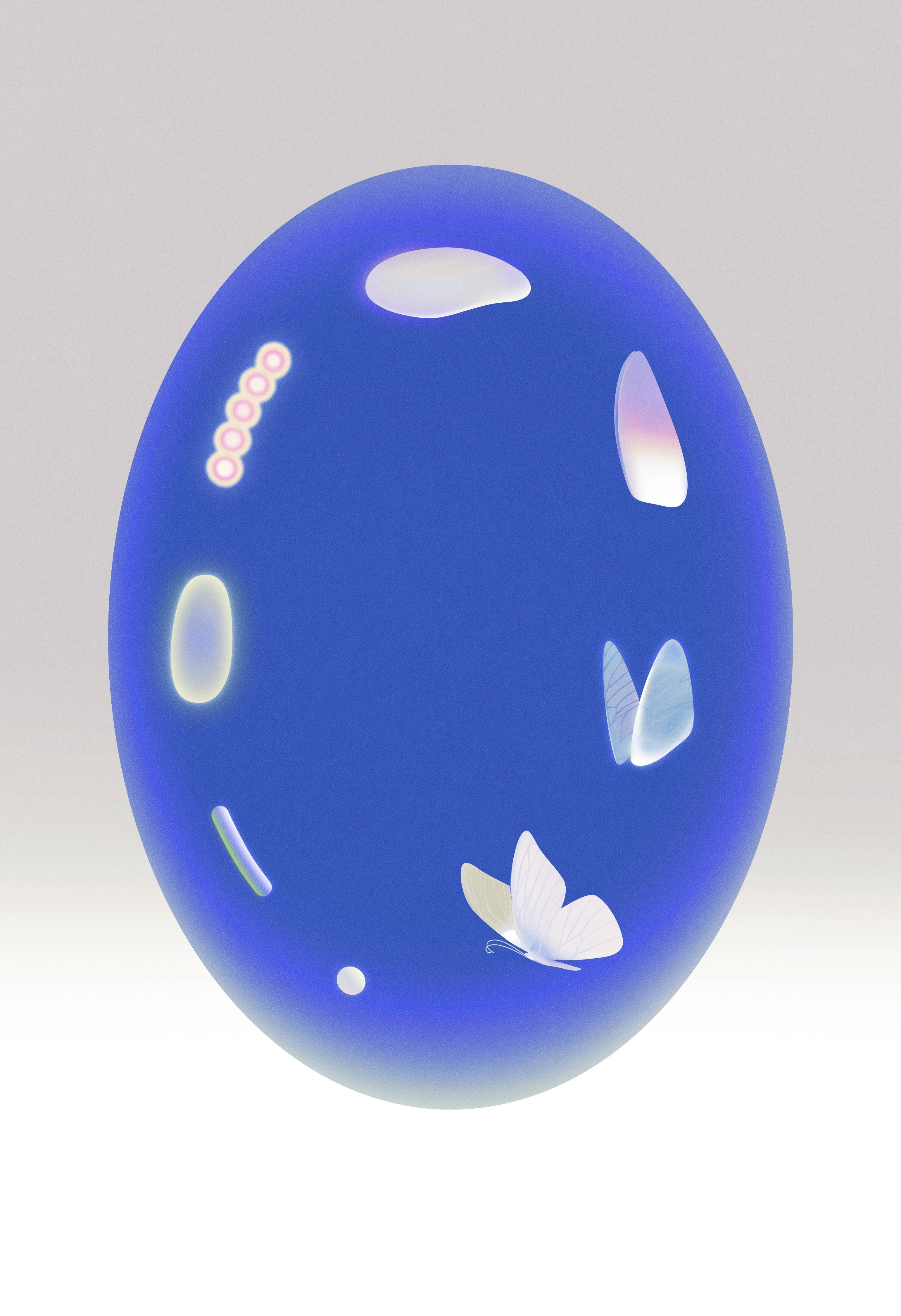
Original illustration by Ibrahim Rayintakath, commissioned exclusively for Folios No. 7, the cultural publication of the Moleskine Foundation. The ethnologist Arnold van Gennep, for example, distinguishes three stages in the unfolding of a rite of passage: the preliminary (the unelucidated phase, where the raw material has not yet been confronted with a contradictory reality; it is the space of unproven certainties), the liminal, and the post-liminal (which is a moment of accession to maturity).
The liminal phase of the ritual is the one that interests us here.
This is the antechamber in which the subject must abandon his or her past life (the social group, the assigned role, etc.) and enter solitude, in other words a space where he or she is confronted with himself or herself and must face the emptiness of determination. It’s up to the individual to forge new points of reference, to activate new, previously unknown impulses that will transform him/her from a passive to an active being.
The relationship with the world is recomposed. The evidence that constitutes the preliminary state is shattered. The comfort zone, if such a thing exists, disappears. Liminality represents this transitional stage, characterised by its indeterminacy.
It is in this meaning that the word passage takes on its full importance; it expresses a transitory moment, the temporality of which undoubtedly varies according to the subject concerned, a moving phenomenon that leads to a transformation.
Transformation, within the liminal space, takes place on two levels: one is internal, that is personal and mysterious, blind, while the other, external, is concerned with the way others look at us and the way we look at others. Both are necessarily linked, in so far as the way we perceive ourselves influences the way we will be perceived, and vice versa.
The liminal space unfolds with its own autonomy and confronts us with questions to which we do not always know how to respond: how do we get rid of the ornaments of established truths and agreed societal rules? How do we achieve the critical distance that alone can enable us to question what we have until now considered axiomatic?
The operation is troubling and painful. The liminal space is a passage. A crossroads whose architecture determines the different possible pathways. So the rituals of passage most often take place in non-places that escape ordinary temporality. This non-lieu is essential because it creates the conditions for a loss of control and landmarks.
Arthur Schopenhauer insists on the tight relationship that every individual has with the space in which he or she evolves, which he or she modifies at the same time as he or she is modified by it: “But in fact – the subject – has his/her root in the world; as an individual, he/she is part of it; his/her knowledge alone makes possible the representation of the whole world; but this very knowledge has as a necessary condition the existence of a body, whose modifications are, as we have seen, the starting point of the understanding for the intuition of this world”.
The body, therefore, not as a carnal envelope, but as a concept and a tool of knowledge. The body as a personal fiction, necessary and indispensable to the elaboration of this collective fiction that Schopenhauer names the world.
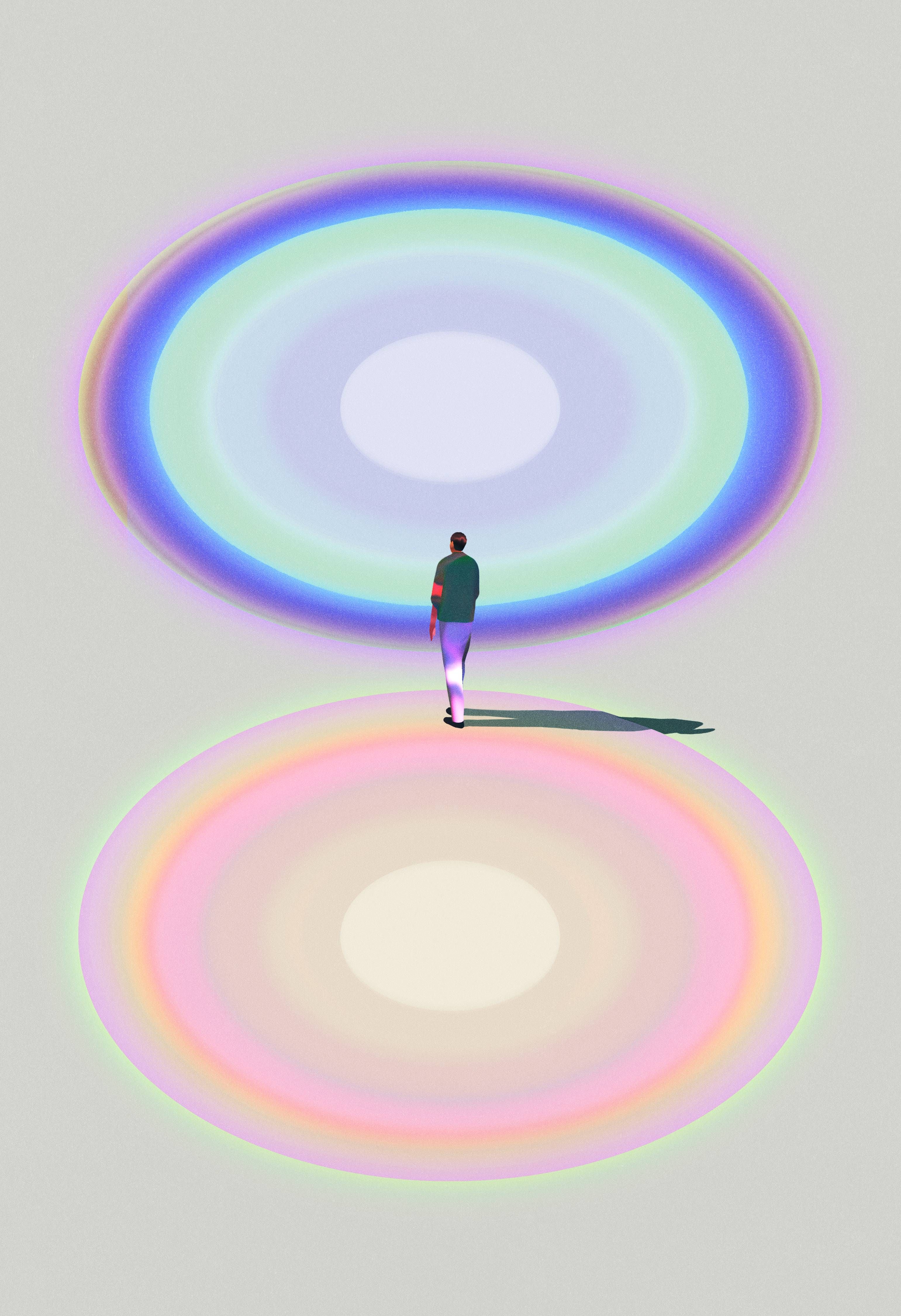
Original illustration by Ibrahim Rayintakath, commissioned exclusively for Folios No. 7, the cultural publication of the Moleskine Foundation.
What is this intuition if not, through the world, a revelation of ourselves? Firstly, by becoming aware of the world of which we are both part and whole, and secondly, by defining ourselves outside that world, alongside that world, we become capable of embodying dasein, that is, our being-in-the-world, which participates in a process of individuation. Van Gennep, referring to this side, evokes the notion of “lisièrement”.
I like the notion of lisièrement, which implies an outcropping, a non-frontal proximity. We are, like Dante in the introduction to his Comedy, on the edge of an obscure forest about which we know nothing.
We are going to be confronted with knowledge, in the sense of an experience, that is necessarily transformative. It is, in a way, a wake-up call, an awakening. In other words, an awakening to self-awareness. Like the child attracted by what Kierkegaard called the call of silence. A bit like an adult deprived of his cognitive faculties waking up from a coma. The body is a sponge, a recording device that collects data without being able to decipher all its functions.
The liminal space therefore acts as an incubator, or, to use a photographic metaphor, a revealer.
First there is, as we have seen, the awakening to an awareness of the world and of one’s own physicality as distinct from that of the group, and then the questioning and uncertainty provoked by this kind of epiphany.
We have to bring ourselves up to date, because each stage of the transformation carries its own shadowy areas, as Jacques Derrida points out: “But this awakening itself has no meaning without the yes. Belief and doubt are but two dialectically linked moments in thought, each as necessary as the other. In Cartesian dualism, putting doubt to sleep is not simply a passion of the soul, and therefore an action of the body. It is the very breath of thought, a rhythmic phase of thought, a necessary period of thought”.
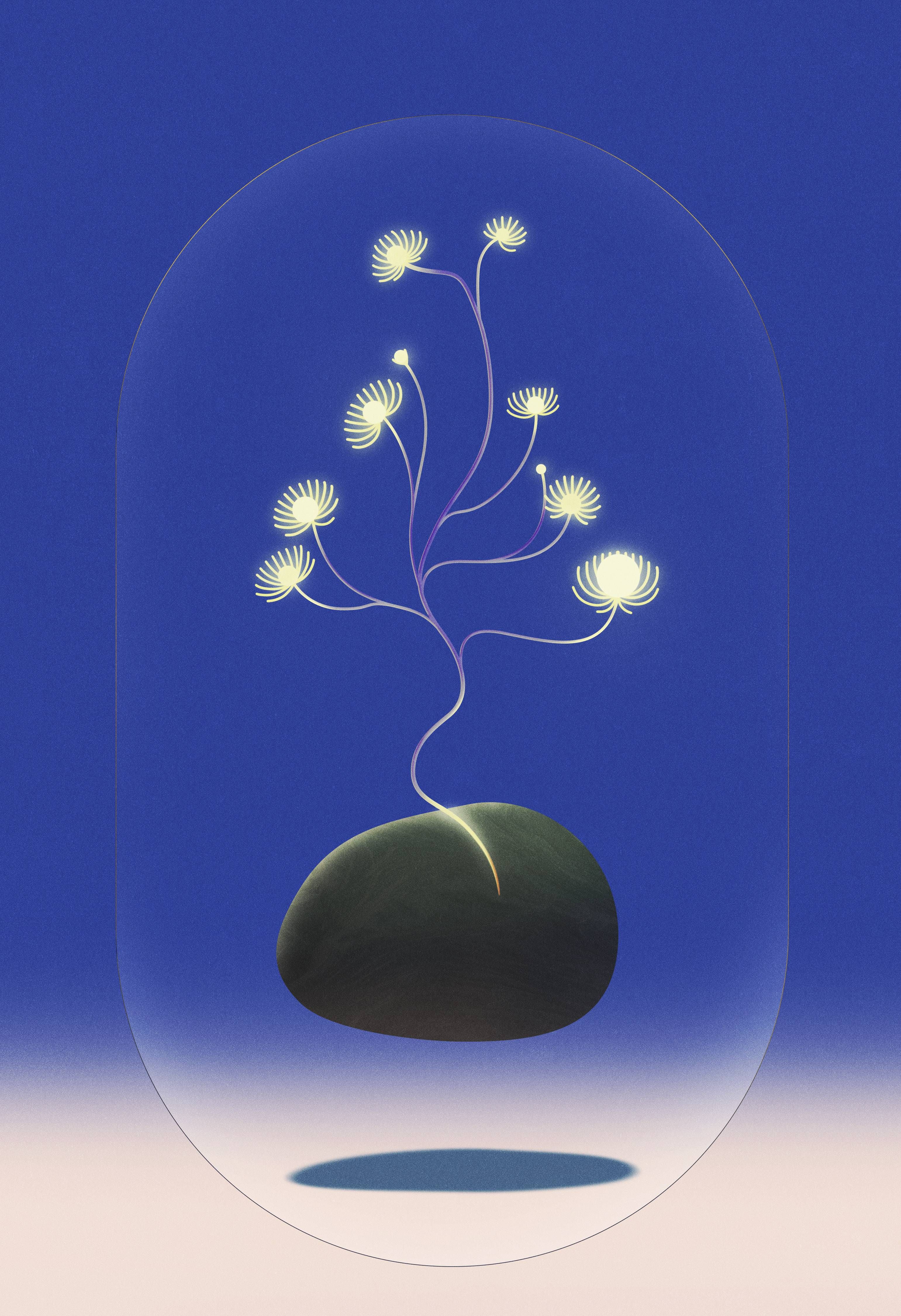
Original illustration by Ibrahim Rayintakath, commissioned exclusively for Folios No. 7, the cultural publication of the Moleskine Foundation.
The rhythmic phase of thought, which, according to Derrida, puts doubt to sleep, is perhaps that moment during which, as in music, we are able to impose an original tempo on our own persona.
Carl Gustav Jung, who took up the principle of individuation developed by Leibniz and Schopenhauer, applied it to the field of analysis in order to study the evolution of the psyche.
Whereas Leibniz opposed the individual to the species, Jung focused on the definition of the individual, drawing on the notion of transcendence explored by Schopenhauer.
For him, individuation is the culmination of a process (Jung drew a parallel with the phases of alchemical transformation) of self-awareness and self-assertion. Among others, it’s the passage to maturity. It’s a form of reconciliation with oneself, a reunification of disparate, sometimes contradictory, parts. It’s a process of repairing and harmonising the conscious and the unconscious.
This whole alchemical operation, which brings us closer to ourselves, takes place in the liminal space which, with a nod to Socrates and his “know thyself”, acts as a maternity unit or, to be more precise, a delivery room. In fact, Socrates said that he could “make minds give birth to the thoughts they already contained, without knowing it or being aware of it” (in Theætetus). The term “maieutics” comes from ancient Greek and means “the art of giving birth”.
Liminality is the art of giving birth to oneself.
Simon Njami
Writer, contemporary art curator, critic, and advisor to the Moleskine Foundation









 COLLAB & PARTNERSHIPS Is storytelling the X-factor to stand out in the luxury perfume boom? 17/04/2024
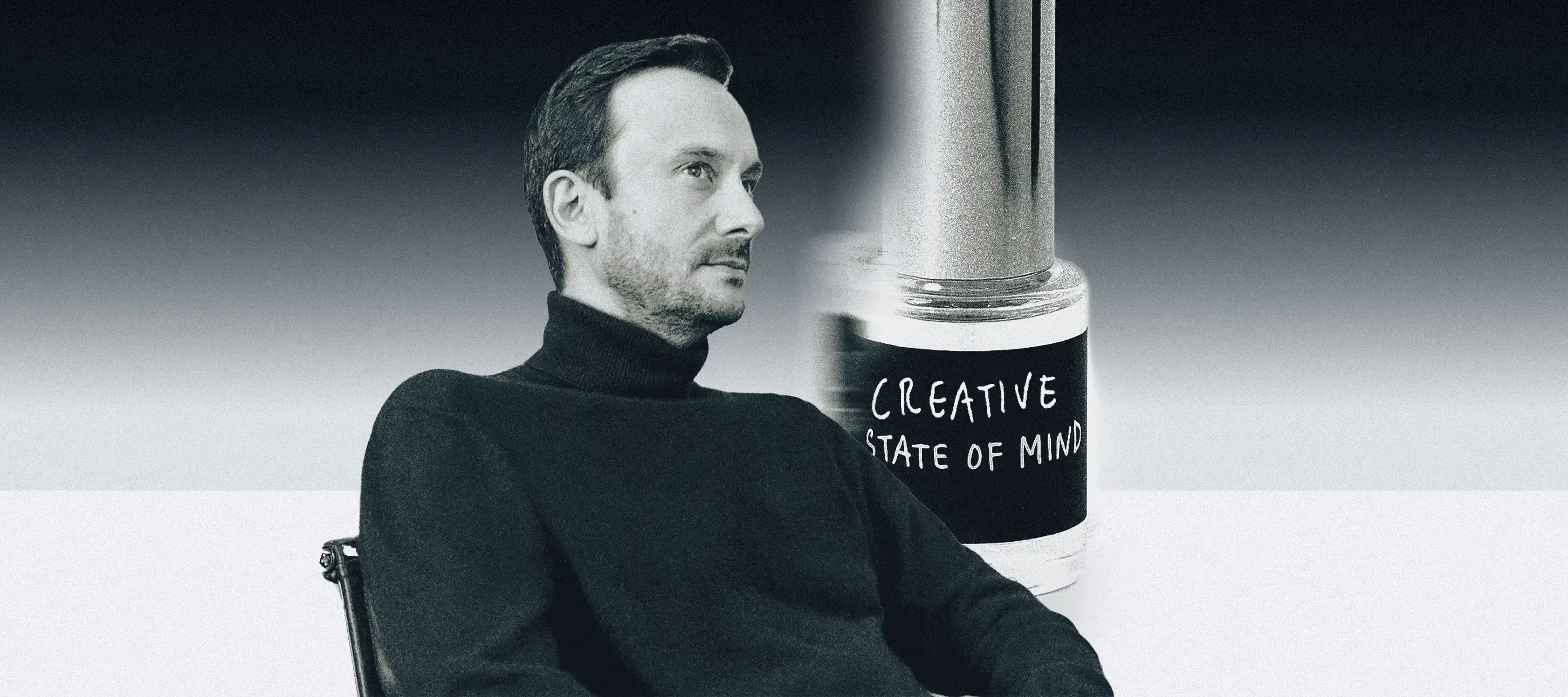 COLLAB & PARTNERSHIPS Pierre Gueros reveals what’s behind the Istituto Marangoni 90th anniversary perfume 15/10/2025
  COLLAB & PARTNERSHIPS How to design a logo for a real client: The Casa Italia Embassy project 04/03/2026
 COLLAB & PARTNERSHIPS What if the new gen of fashion designers leads the evolution of fragrances? 22/11/2023
 .jpg)

.jpg)
