
What is Venerdì Pomeriggio? Vivetta Ponti on starting again without losing herself
Vivetta Ponti discusses starting again in fashion with Venerdì Pomeriggio, micro-capsules, deadstock, Made in Italy and a different fashion calendar
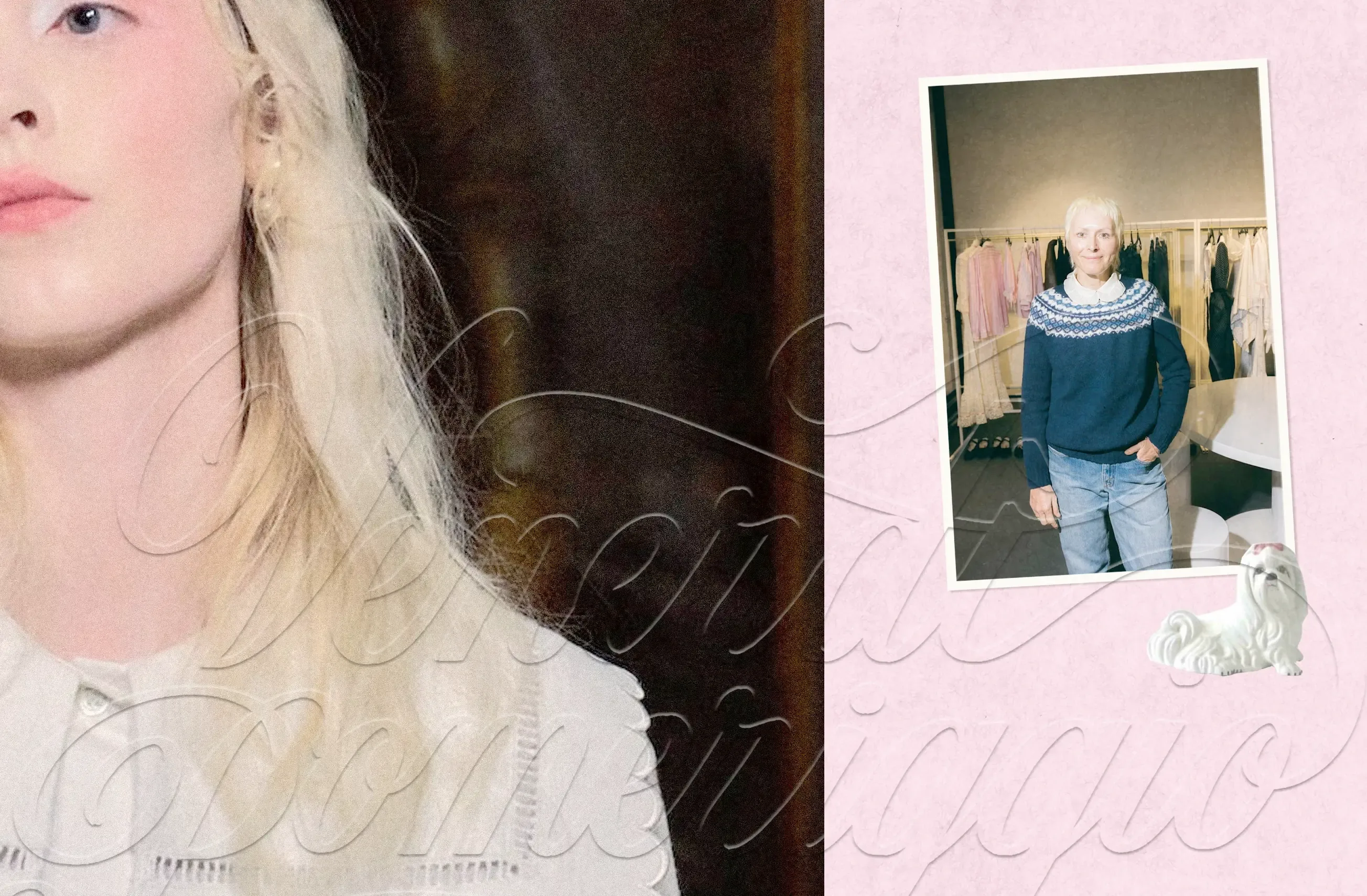
What does a designer do when her name has already become a fashion identity? Vivetta Ponti’s answer is Venerdì Pomeriggio. Carolina Lecce was looking for a graduation dress when she found herself asking Ponti—creator of the Vivetta label and its iconic visual language—how to start again without losing her unique signature. Lecce, an alumna of Istituto Marangoni London’s Fashion Promotion, Communication and Digital Media course, speaks with Ponti, founder of Venerdì Pomeriggio, about micro-capsules, direct sales, deadstock fabrics sourced in Prato, production in Florence and Puglia, and the decision to keep each piece below £400. Together, they consider how a designer can change pace, step outside the traditional fashion calendar, and make clothes without diluting a strong point of view.
It’s early August, and I’m searching for a dress for my graduation in London. I stumble across a Vogue Italia article about Venerdì Pomeriggio, the new brand founded by Vivetta Ponti. During a video call with my mother, I share how meaningful it would be to wear something designed by Vivetta on my big day. By happy coincidence, sitting beside my mother is the very aunt who first introduced me to Vivetta’s work years ago, telling me about her shirts with embroidered hands as collars, complete with red-lacquered nails. She connects me with the designer to discuss delivery times. From there, with the kind of boldness that occasionally serves me well, I ask Vivetta whether she’d also be willing to speak with me about her new project.
And that’s how I find myself interviewing Vivetta Ponti.
Visualizza questo post su Instagram
What Does Starting Again Mean in Fashion? Vivetta Ponti’s Answer
The first thing I ask her is whether starting again feels frightening. Not from zero, exactly, but from somewhere more complicated. How does it feel to begin anew after building a recognisable creative universe, after years of collections, shows and expectations, and a brand that carried your own name? Her answer is not dramatic. It is calm, and more revealing.
“Venerdì Pomeriggio represents who I am today. It reflects my needs now, my rhythm, and the way I want to work at this stage of my life” – Vivetta Ponti, founder of Venerdì Pomeriggio
That is where the story really begins. Not with the idea of a comeback, but with the decision to change pace.
I’ve known Vivetta’s universe for years, ever since I first began taking fashion seriously. That was the moment I started wondering not just about the established names, but also about the contemporary designers of my own generation—the creators behind the collections I’d later encounter in shows, magazines and editorials. From Alessandro Michele to Pierpaolo Piccioli and Vivetta Ponti, I became fascinated by what makes a designer genuinely recognisable.
Visualizza questo post su Instagram
With Vivetta, the answer has always been in the details: botanical motifs, trompe-l’œil, delicate surrealism and a retro sensibility that never feels nostalgic. Her work possesses a visual language that’s instantly identifiable without becoming predictable.
That’s what makes Venerdì Pomeriggio so compelling. When a designer with such a recognisable language starts again, the question isn’t just what changes. It’s also what endures.
Our conversation never feels particularly formal. It’s fluid, sincere, almost intimate. Even as Vivetta prepares for the upcoming fashion week, she makes space for our exchange. There is a sense that understanding who’s on the other side matters as much as answering the questions themselves.
So when I ask her about Venerdì Pomeriggio, I’m also asking what happens to a creative identity when its structure changes. The name’s English translation, “Friday afternoon”, offers the first clue: it’s more than a poetic image; it suggests a shift in pace. “It is that moment when the week slows down,” she tells me. “The moment when the weekend begins, when you finally have time for yourself.”
Within a fashion system governed by deadlines, seasonal calendars, constant production, and the demand for perpetual novelty, naming a brand Venerdì Pomeriggio feels like a quiet act of resistance. It’s not a rejection of fashion, but a decision to work by a different logic.
Why Is Venerdì Pomeriggio Working Outside the Fashion Calendar?
Venerdì Pomeriggio share the same initials as Vivetta Ponti: VP. The pace, however, changes.
That principle shapes the business itself. Venerdì Pomeriggio is built around micro-capsules, limited quantities and direct sales through its website, without necessarily submitting to the rigid structure of the traditional fashion calendar.
“I don’t want to force a collection just because the calendar asks for it. There has to be the right fabric, the right idea, the right moment” – Vivetta Ponti
This is what sets the project apart from simply launching a new brand. Venerdì Pomeriggio is as much about when and why Vivetta chooses to make something as it is about the finished pieces. It allows her to step outside the market’s automatic cycle while keeping the creative process central.
Visualizza questo post su Instagram
How Is Venerdì Pomeriggio Made in Italy? From Prato to Florence and Puglia
Research begins with materials. When I ask where that process starts, the conversation turns to Tuscany, and particularly Prato.
“The research for fabrics takes place mainly in Tuscany, especially in Prato,” she says. “There is an incredible textile tradition there, and it allows me to work with deadstock, offcuts and fabric remnants that I choose according to my creative instinct.”
Production remains equally rooted in Italy. “The garments are produced in Florence, while the embroidery is made in Puglia,” she continues. The structure is intentionally compact: fabrics are selected based on availability and instinct, quantities remain limited, and production stays close to the places and skills involved.
What I find interesting is that Venerdì Pomeriggio does not romanticise slowness; it gives it a function. A slower pace creates room for research, material choices, and creative instinct to come together. The point is not to withdraw from fashion, but to reconsider how much needs to be produced, and how often.
Can Made-in-Italy Fashion Be Both Special and Affordable? Vivetta Ponti on the £400 Price Point
I ask Vivetta about price because, in fashion, accessibility is often what nobody wants to discuss openly. Pieces from Venerdì Pomeriggio never exceed £400, despite being entirely Made in Italy. It’s a significant choice at a time when fashion, especially independent fashion, can quickly move beyond the reach of the people most interested in it.
Vivetta is unequivocal about the decision.
“Keeping the price point for Venerdì Pomeriggio under £400 was a deliberate choice. I wanted the pieces to feel special, well-researched, almost unique, but still within reach. Today, we see fewer and fewer runway looks on the street, not because desire has disappeared, but because many people simply cannot afford them, even when they work hard. I like to think of this as a more human price” – Vivetta Ponti
I like that expression: a more human price. There is something quietly political about it—not in a manifesto-like sense, but in the practical decision to combine a recognisable creative identity, Italian production, and considered craftsmanship without turning the final garment into something reserved for a highly privileged customer.
At Venerdì Pomeriggio, accessibility isn’t treated as a compromise; it’s built into the project. Price, material, production, and distribution all become part of the same question: how can something remain special without becoming unreachable?
A dress can hold value because of its fabric, cut, embroidery and the way it’s made. It can also hold value because the person who falls in love with it can realistically imagine owning it. That feels like a more contemporary form of luxury: no less desirable, simply less distant.
There is also a social dimension to the brand. Part of the accessories line is developed in collaboration with a social cooperative that supports the employment of people from disadvantaged backgrounds. Importantly, the initiative sits within the project’s structure instead of functioning as an add-on message. It expands the idea of value beyond the garment itself, connecting production to skills, work, and opportunity.
Visualizza questo post su Instagram
Can Young Designers Still Find a Place in Fashion? Vivetta Ponti on Access and Rejection
The last thing I ask Vivetta is how she sees the fashion industry today, particularly for people like me: students, recent graduates, and young creatives attempting to enter a field where success is rarely immediate. The question feels deeply personal.
Graduating in fashion today often means learning that talent, passion, and hard work do not necessarily guarantee a straightforward career path. You apply, wait, hope, face rejection, and try again. Eventually, you might question whether the problem lies within yourself or the system around you.
The feeling is far from unique. A 2025 CIPR study found that 79% of the students and recent graduates surveyed faced barriers to entering the PR sector, mainly due to limited industry connections, practical experience, and difficulties securing paid work. Although the research focuses specifically on PR and communications, the pattern will feel familiar to many people trying to build a career in fashion.
Vivetta’s response is clear-eyed without becoming cynical. Having worked closely with young creatives, she is most concerned about how difficult it has become for talented people to find space within a system that can often feel stagnant.
At the same time, she sees a shift in how younger generations relate to fashion: greater curiosity about independent designers, more interest in craftsmanship, and less reliance on logo as the sole indicator of value.
For Vivetta, part of fashion’s next chapter may belong to smaller independent brands—businesses that can move more freely, produce with greater intention, and build a closer relationship with those who wear their clothes.
Starting Again in Fashion Without Losing Your Identity
That’s why Vivetta’s story has stayed with me. Not because it offers a perfect answer, but because it changes the way I think about the question. Starting again does not necessarily mean going back to square one. It can mean looking at the same industry from a new angle, resetting your priorities, and deciding how you want to move through it.
It is now early September, and I have officially graduated—in my very own carinissimo dress.
This story means something different to me now. It’s no longer just about a designer entering a new chapter; it’s about learning that, in fashion as in life, a path does not have to be linear to make sense. Sometimes you need a different door, different timing, or simply a different way of seeing yourself. And still, somehow, you can begin again without losing who you are.

.gif)

.jpg)
.jpg)