
The FIFA World Cup final has become the New Super Bowl
The FIFA World Cup Final has changed forever. Fashion is the reason. Here’s how the first halftime show transformed football’s biggest night into a global pop culture event
The real winner of the FIFA World Cup Final wasn’t a football team. It was fashion.
The first-ever halftime show transformed football’s showpiece event into something closer to the Super Bowl, where celebrity, music and luxury brands share the spotlight with the game itself. In this essay, Istituto Marangoni London student Carolina Lecce looks beyond the scoreline to explore how the 2026 final became as much a global pop culture spectacle as a football match.
There has always been something magical about the World Cup: the sense of belonging, the collective urge to celebrate, or cry, together, the flags, the noise, the drama, and that national emotion that makes people act as if destiny itself cares about a penalty shootout.
Looking back on the 2026 FIFA World Cup, we will remember many things. As an Italian, I will remember watching without our national team, absent from the tournament once again. I will remember that it’s been twenty years since that unforgettable night in Berlin in 2006, when Italy lifted the trophy for the fourth time. And I will certainly remember the closing ceremony: a final that felt as much like a fashion spectacle as a football match.
I was five years old when my father bundled me into the car after Italy’s World Cup victory and drove through streets alive with flags, horns, and celebrations. I barely understood what was happening, but I’ll never forget the excitement. By the time Italy won the European Championship in 2021, I experienced it with far greater awareness, and definitely more enthusiasm. This time, however, even without Italy on the pitch, I found myself drawn to the tournament for a different reason.
The moments that linger from this World Cup aren’t just sporting; they’re also cultural, fashion, and pop-culture highlights.
From Shakira in Roberto Cavalli to Madonna in Saint Laurent, the 2026 FIFA World Cup final proved that football’s biggest night now belongs to entertainment as much as to sport. By the time the final reached MetLife Stadium in New Jersey, the event seemed to have transformed into something larger than football itself.
Visualizza questo post su Instagram
The First FIFA World Cup Halftime Show Changed the Rules
Hosted in North America, the tournament embraced a distinctly American language of spectacle, culminating in its first-ever halftime show. Honestly, my favourite part wasn’t even the performance itself, but the bewildered reactions online from Europeans watching it unfold, as if someone had suddenly decided that football’s most sacred ritual needed a generous dose of Swarovski crystals and Hollywood glamour.
If the 2026 FIFA World Cup final proved anything, it’s that football’s biggest night no longer belongs exclusively to sport. It now belongs just as much to fashion, music, celebrity, and spectacle. The closing night was, in every sense, a fashion show.
How Luxury Brands Took Over Football’s Biggest Night
Jennifer Hudson Turned the National Anthem into a Fashion Statement
Jennifer Hudson opened the night with the U.S. national anthem in a custom Thom Browne look, styled by Law Roach.
Beyond the spectacle, and beyond that almost awkward silence created by the power of her voice, what I loved most was the stylist’s touch behind the look. Roach rarely misses, and when he’s involved, you can tell. With his clients, he often works in a very literal, yet extremely effective way, always including elements in the outfit that clearly communicate their purpose.
In this case, the corseted back in American colours did exactly that. It was patriotic without becoming costume-like, theatrical without losing elegance. As Roach put it, when one of the most iconic American voices opens the biggest sporting event in the world, fashion has to rise to the moment. And it did, especially with Tiffany & Co. jewellery adding the final layer of shine.
Visualizza questo post su Instagram
Shakira’s Roberto Cavalli Look Brought the World Cup Full Circle
Then came Shakira. At this point, calling her a World Cup performer almost feels reductive. To me, Shakira is the voice of the World Cup. For as long as I can remember, her figure, her voice and her energy have been almost automatically associated with this event.
Seeing her return in a custom Roberto Cavalli by Fausto Puglisi dress, embellished with Swarovski crystals, felt perfectly aligned. The look was bold, colourful, full of movement, and unmistakeably Shakira. It also created a beautiful full-circle moment with her previous Cavalli World Cup look from the Waka Waka era.
The orange tones, the dancers, Burna Boy, the choreography: everything seemed designed to frame her as the Colombian diva who somehow owns this stage every time she steps on it.
Madonna Translated Saint Laurent into Football
Then Madonna arrived. A pop legend in Saint Laurent by Anthony Vaccarello, all soft pink and football references.
The first thing I did was FaceTime my brother, because she was standing next to his two favourite players of all time: Ronaldo and Ronaldinho. I’ve never followed sport with the same devotion as my two older brothers, but growing up around them taught me what certain names mean. Ronaldo: the number 9, the legend. Ronaldinho: always my brother’s favourite, because of the way he played with the ball as if football were a magic trick, not a sport. So I know that seeing them next to Madonna probably gave him the same feeling I had when I saw “Madonna 10” on the back of that baby-pink Saint Laurent teddy jacket. Different obsessions, same emotional damage.
The look worked because it was not just pretty. It was Madonna translated into football language. The Saint Laurent jacket, the sporty attitude, the corset, the sparkle, the sunglasses, the whole theatrical confidence of it all.
Visualizza questo post su Instagram
Independent Designers Found a Global Stage Through BTS
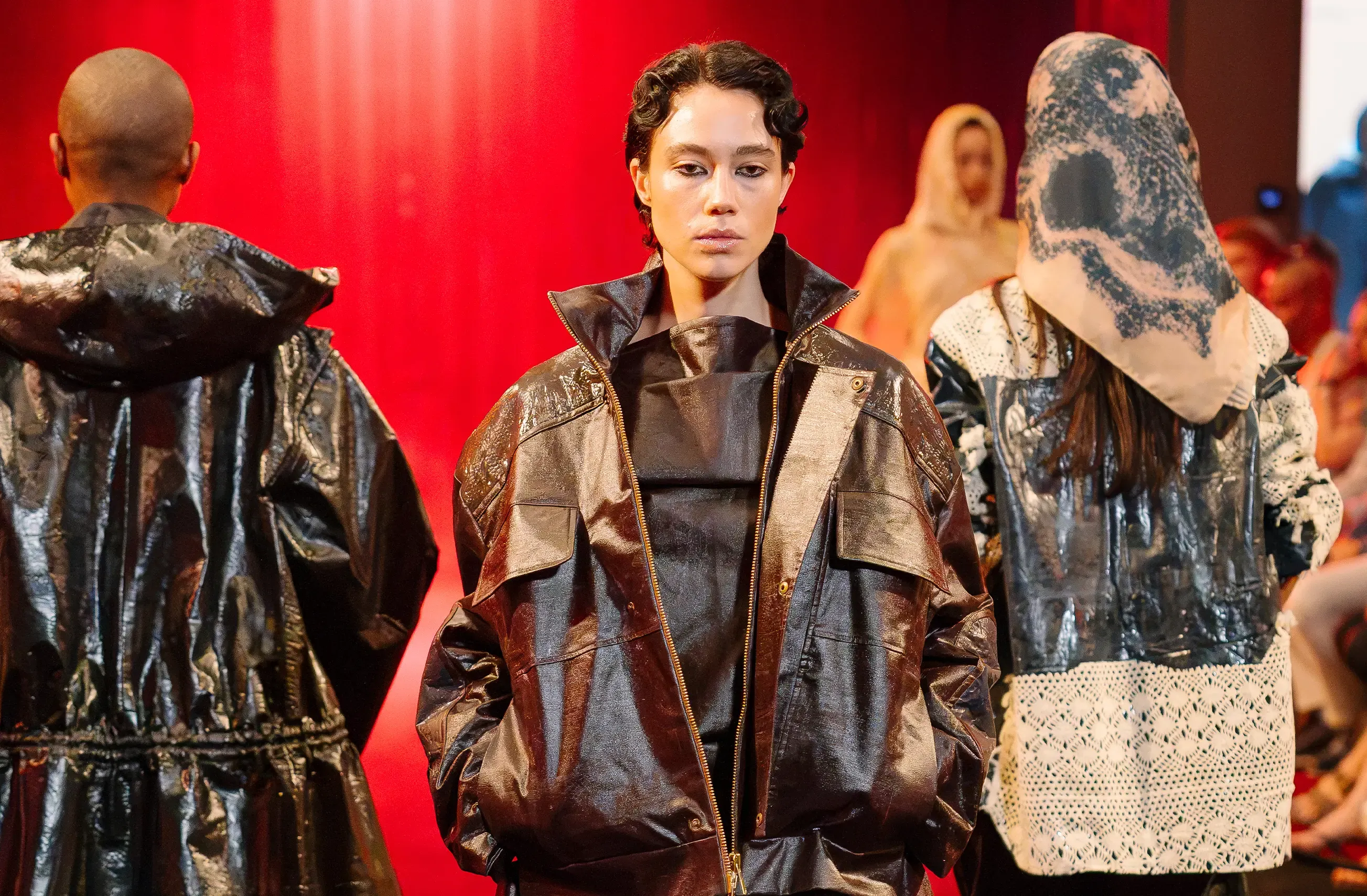
One of my favourite discoveries, though, came from BTS. Finding out that some of their performance looks involved independent London-based designers genuinely excited me. I have lived in London for a year and a half now, and discovering names like Marie Lueder and J E Cai still makes me realise how different this city’s approach to fashion is compared to other fashion capitals.
London fashion can be arrogant, alternative, difficult to explain, and slightly allergic to polish. But when it works, the result is almost breathtaking. The BTS looks had exactly that energy. They felt deconstructed and harmonious at once, like something that shouldn’t work but absolutely does. No wonder social media immediately wanted the jerseys as official merch.
How the FIFA Anthem Became a Fashion Moment
Then came the royal-blue trio: Robbie Williams in Adidas, Nicole Scherzinger in Gaurav Gupta, and Laura Pausini in Balestra, performing Desire, the FIFA anthem. Three completely different personalities, three different concepts, one colour story, and enough crystals to make the stadium feel as if it had its own jewellery sponsor.
Robbie Williams kept it sporty and direct in Adidas, fitting both his style and the setting. Nicole Scherzinger brought a more sculptural, dramatic energy in Gaurav Gupta, turning the stage into something between a performance and a couture silhouette.
Adding another layer of emotion, at least for me as an Italian, was Laura Pausini’s presence. For a few minutes, it felt as if Italy had made it to the World Cup final after all—not as a football team but as a voice, a style, and a cultural presence in front of the world. Pausini is one of the country’s most iconic voices, and her appearance on such a global stage felt like a small moment of national pride. Dressed in Balestra, a historic Italian house embracing a new chapter while celebrating its heritage through all that sparkle and glamour, she brought a distinctly Italian elegance to the occasion.
Visualizza questo post su Instagram
Justin Bieber Proved Personal Brands Belong on Football’s Biggest Stage
And then, maybe my favourite: Justin Bieber. Because the most Justin Bieber thing Justin Bieber could do was perform in SKYLRK, his own label. A full look that felt casual, loose, deconstructed, and entirely in tune with his current image. It wasn’t trying to mimic a traditional global ceremony outfit. It looked like Bieber turning the World Cup stage into part of his own visual universe.
He also generated buzz by wearing his low-top Matter Daddy sneakers around the same time as his SKYLRK pop-ups in New York, which was very smart, very 2026 and very Bieber. It was a performance, a product moment, and a brand statement all at once, which may be exactly what made this World Cup final so captivating.
It wasn’t just a match. It was football, music, fashion, celebrity culture, social media reaction, and brand strategy all colliding in one place. Some critics will say it was too American, too excessive, too far from what football is meant to be. Maybe they are right. But maybe that’s exactly why everyone talked about it.
And perhaps that’s what I’ll remember most—not the scoreline, not even the trophy lift, but the moment football fully embraced its role as a global cultural phenomenon.
Carolina Lecce
Student in Fashion Promotion, Communication and Digital Media, London