
Why do men wear oversized clothes? An emerging designer on masculine vulnerability
Milano Moda Graduate 2026 winner Matilde Bonechi sees oversized menswear as protection, asking what masculinity can make room for
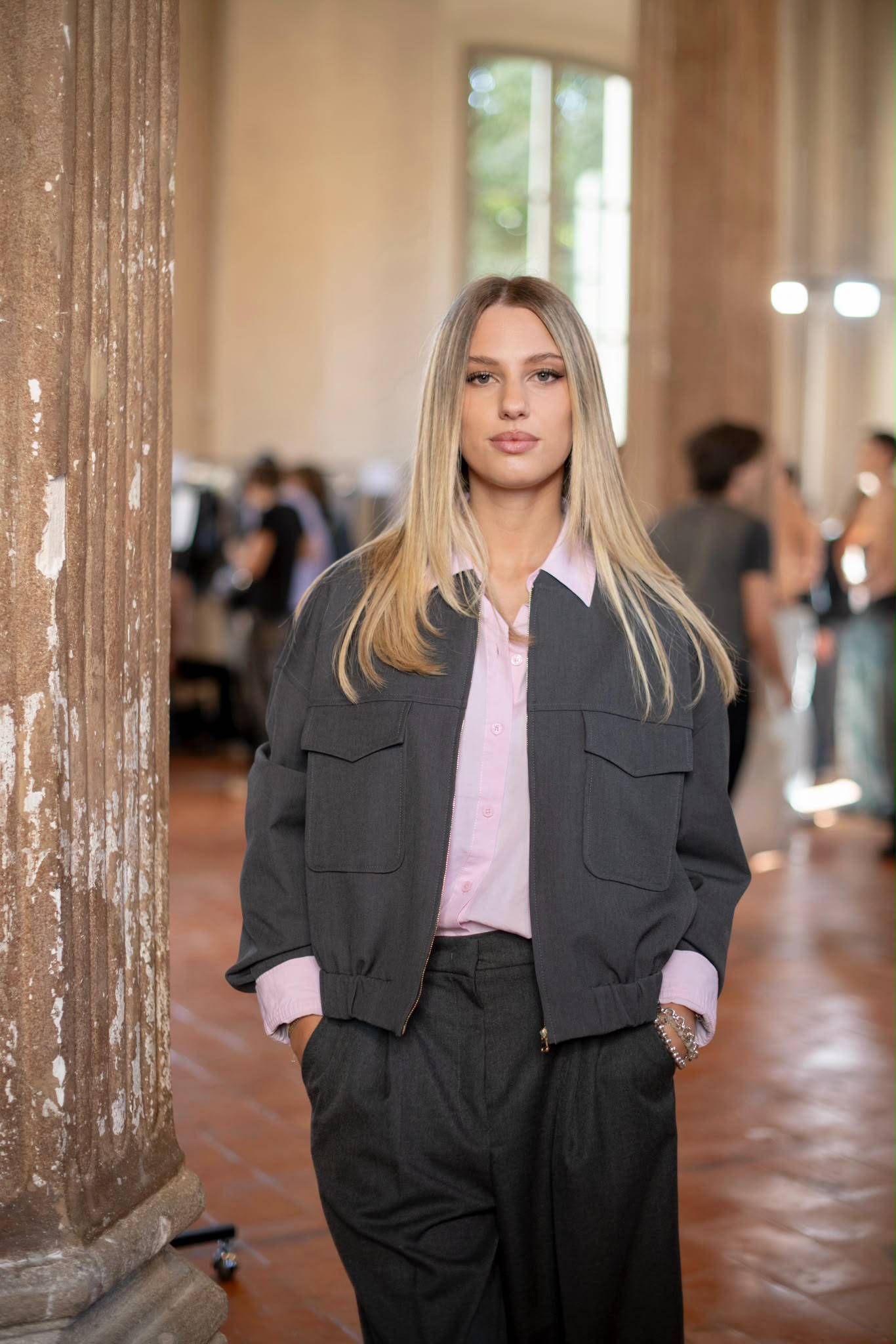
Menswear has long used structure to project authority. Emerging designer Matilde Bonechi, an alumna of Istituto Marangoni Firenze, gives volume a new purpose: shelter. Her collection, which won the CNMI Fashion Award at Milano Moda Graduate 2026, centres on oversized coats and sculptural Aran knitwear. But can a man finally seek protection without being seen as weak?
How Does a Fashion Designer Turn an Idea into a Collection?
Stubbornness might seem an unlikely starting point for a menswear collection, yet for Matilde Bonechi it has become fundamental. The Florence-born designer sees determination as the ability to pursue an idea through unexpected challenges, no matter the obstacles. “When I believe in an idea, I find it difficult to let go, even when bringing it to life becomes complicated,” she explains.
Born in 2004, she grew up drawing to give shape to her imagination. After attending a sports-focused secondary school, she chose to study Fashion Design at Istituto Marangoni Firenze, where her interest in garment construction developed into a personal approach to menswear, influenced by the city’s artistic heritage and long-standing craft traditions. “I also learned how important it is to listen to others and recognise when something can be improved,” Bonechi recalls.
When Clothes Become a Form of Protection
This emerging designer’s award-winning collection begins with a question about clothing and identity. Inspired by Umberto Eco’s Il pensiero lombare, Bonechi considered garments as a kind of prosthesis, capable of altering the body’s boundaries and how it occupies space. She then extended that idea: “Clothing becomes a protective structure, almost like a shield, that can also embrace fragility. I wanted to explore how such powerful shapes could express sensitivity and vulnerability.”
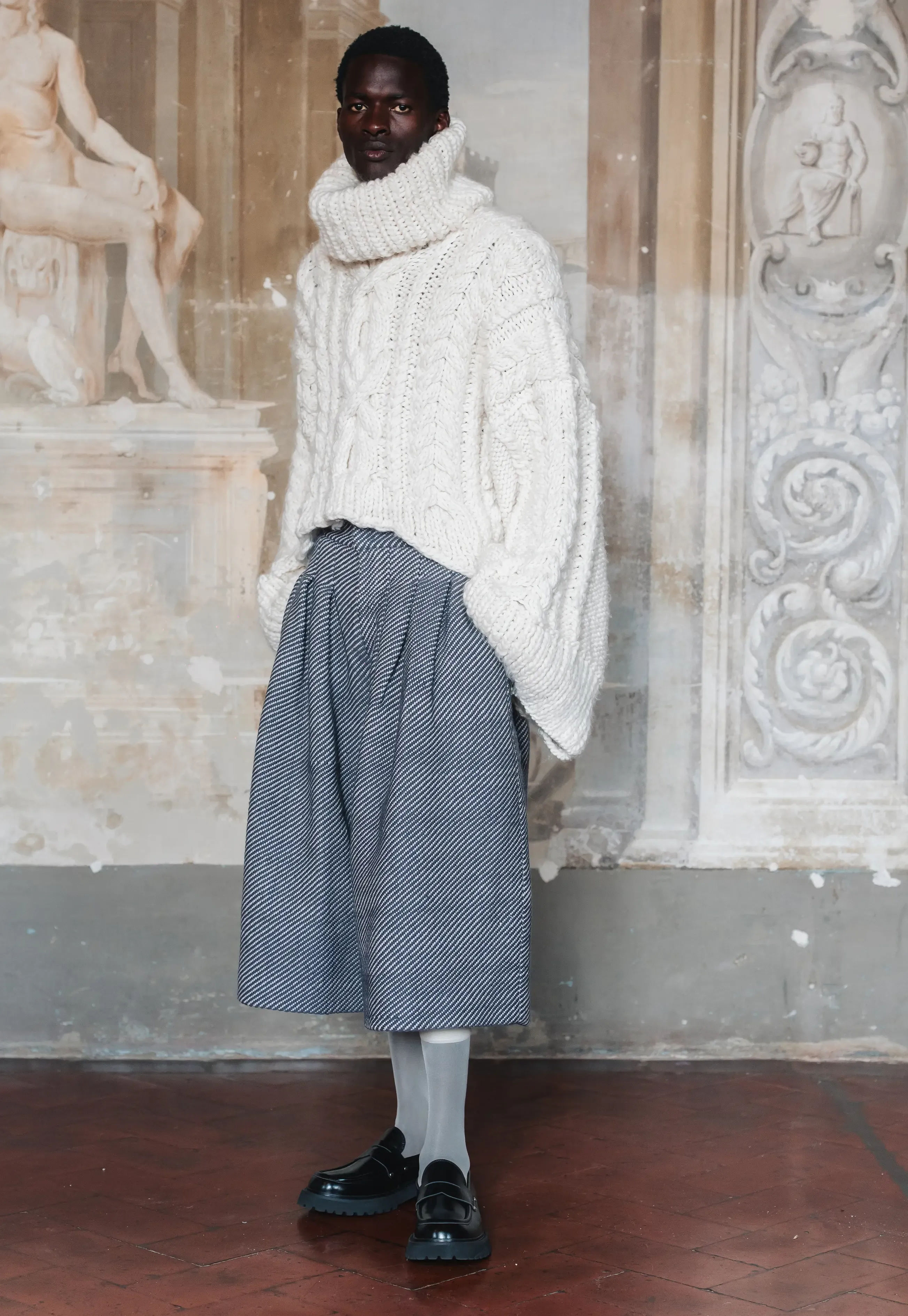
She turned to men’s outerwear from the late nineteenth and early twentieth centuries, when rigid construction and structured silhouettes conveyed authority. By reworking those historical codes through oversized volumes and deep folds that envelop the body, she offers a different interpretation of strength: imposing proportions become a form of shelter and create a new relationship with the wearer’s physical presence.
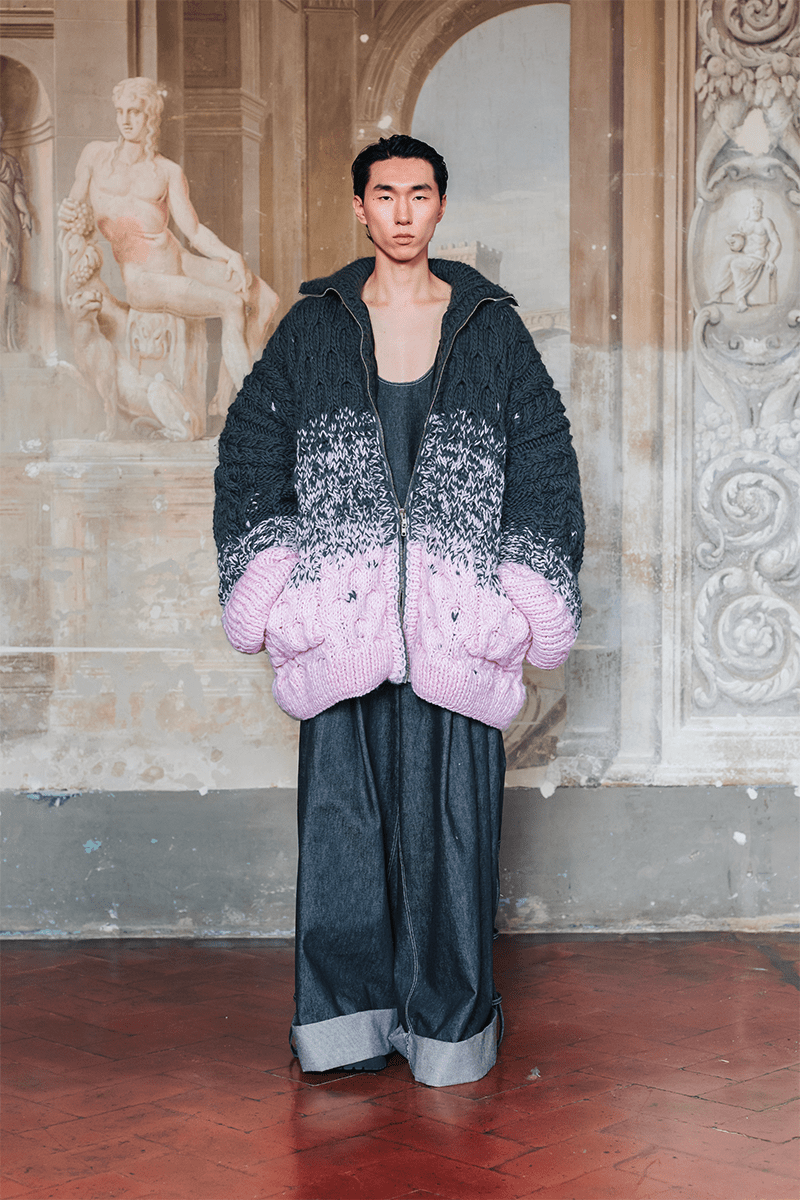
What Is an Aran Jumper? An Emerging Designer Reworks Fishermen’s Knitwear
Protection also informed her reinterpretation of traditional Aran fishermen’s jumpers, originally designed to withstand harsh weather. She enlarged their distinctive cable patterns into sculptural textures, giving the garments an almost architectural presence while retaining knitwear’s comforting quality.
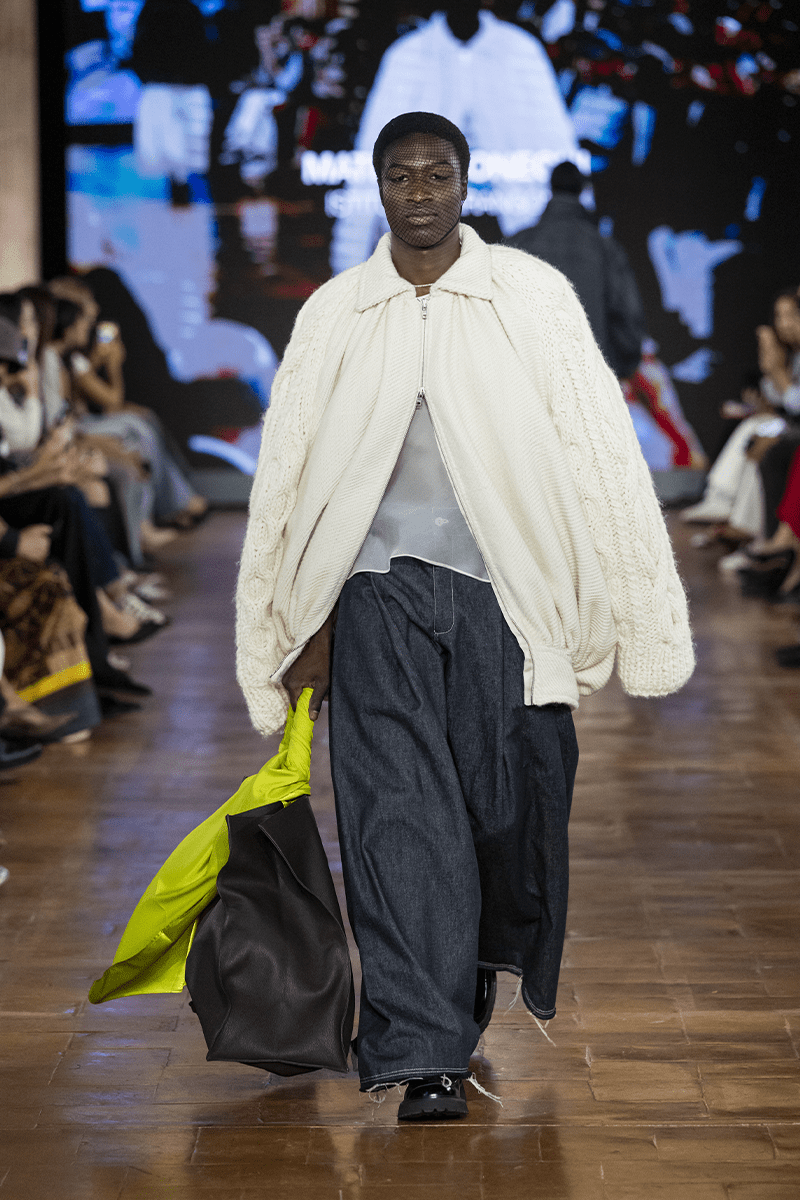
Can Wool Look Like Denim? A Handwoven Experiment
The dialogue between strength and softness continues in her choice of materials. Denim, associated with workwear and durability, meets chunky wool, whose tactile quality brings warmth and protection. At a loom, she developed a wool fabric that resembles denim. “For me, craftsmanship is an essential part of the creative process,” she points out. “I enjoy working directly with materials and understanding how they can determine the construction of a garment.”
Hands-on experimentation also brought some of the project’s biggest challenges. Making exaggerated silhouettes and complex knitwear wearable required repeated tests and technical adjustments; solutions that seemed promising at first often needed reconsideration.
Simplifying the designs would have made the process easier, but preserving the collection’s identity meant accepting uncertainty as part of the work. “The real courage was accepting the risks of experimentation without knowing exactly how things would turn out,” Bonechi adds.
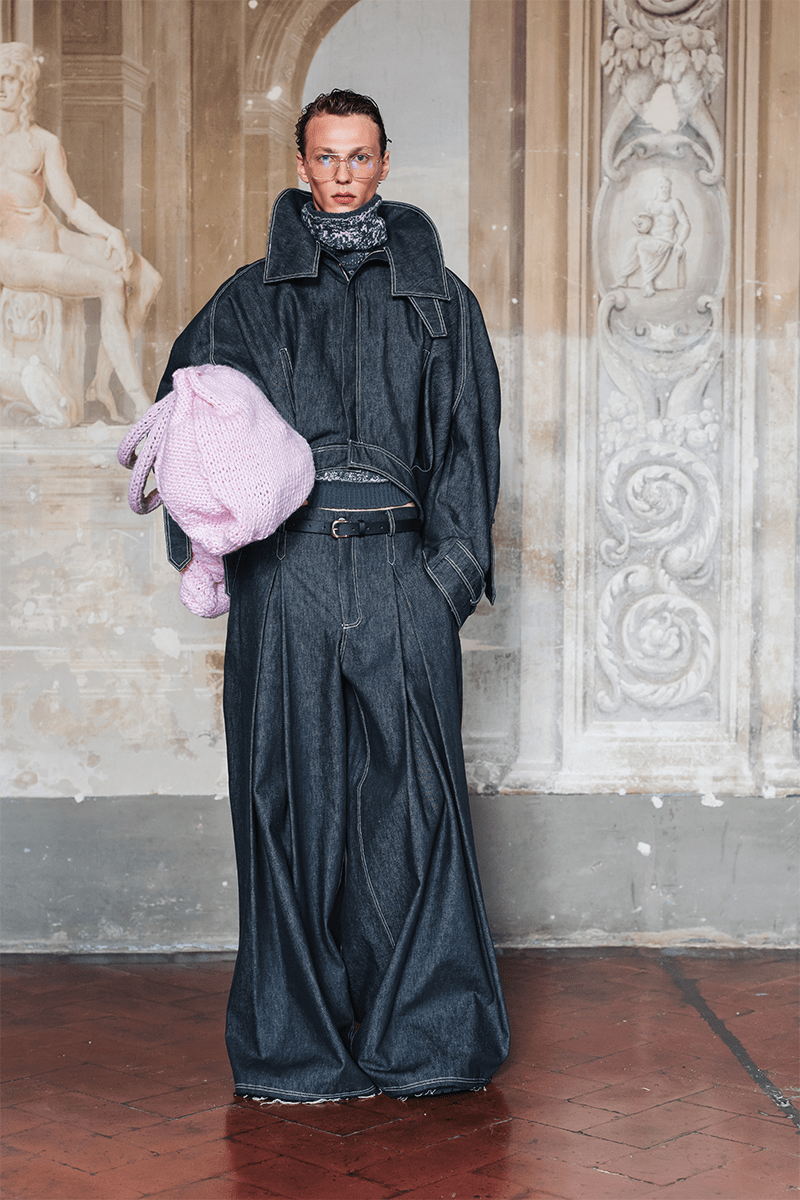
Can Menswear Make Room for Vulnerability?
A palette of black and grey, alongside denim tones, recalls a traditional masculine wardrobe, while pink and subtle gradients soften the structured silhouettes and challenge familiar associations between colour and gender. “I wanted to show that sensitivity and strength can exist within the same identity,” she notes.
Her vision extends beyond the collection, questioning expectations that have long shaped men’s clothing: “I imagine a masculinity free from the stereotypes that have shaped menswear for so long. A man can be strong and sensitive, and he can seek protection without that being seen as a weakness.”
The Challenges Facing Young Fashion Designers
Seeing her collection on the runway at Milano Moda Graduate was an emotional milestone. It showed her that a deeply personal creative vision could resonate with an audience. The recognition also brought the realities of emerging design into focus: the resources needed to produce a collection and the specialist skills required when quality materials and artisanal techniques are central.
While recognising how difficult it can be to maintain a distinctive identity today, Bonechi also believes fashion companies should invest more in young talent through professional collaborations and access to artisanal knowledge, giving emerging designers practical experience as they develop their ideas. She also sees the freedom to experiment and make mistakes as essential, allowing creativity to evolve before commercial expectations begin to dictate every decision.
AI in Fashion Design: Can Designers Preserve Their Creative Voice?
Artificial intelligence and social media are opening up new possibilities in fashion, particularly in research and communication. Yet Bonechi’s approach remains rooted in the physical experience of making clothes. “Much of my work begins with drawing and experimenting directly with materials, observing how they behave and refining them until I achieve the result I’m looking for,” she stresses.
She views technology as a useful tool when it supports individual exploration, while creative identity develops through personal choices and direct engagement with design.
The same thinking shapes her approach to self-promotion. While social platforms provide young designers with unprecedented visibility, lasting recognition depends on the quality of their work and the technical knowledge behind it. “Above all, I want my work to speak for itself. Every garment should have its own identity and be able to communicate something without too much explanation,” Bonechi states.
After Fashion School: The Next Steps for an Emerging Designer
Florence continues to inspire, from its architecture and museums to the everyday atmosphere of Santo Spirito, one of Matilde Bonechi’s favourite neighbourhoods.
Following her success at Milano Moda Graduate, she hopes to gain experience with established fashion companies that value craftsmanship and remain open to innovation. She also wants to deepen her technical knowledge and broaden her understanding of the industry. Ultimately, she hopes to develop an independent project with a recognisable identity, guided by the curiosity that has always shaped her work.
Her ambition is less about dressing a particular celebrity and more about creating garments that resonate with individuals who see themselves reflected in her vision. “I’d love my clothes to be worn by people who see fashion as a way of expressing who they are,” she concludes.
For an emerging designer who began by questioning the relationship between clothing and the body, that ambition returns to a simple idea: fashion as a means of personal expression, made possible by the freedom to challenge conventions and keep exploring.
Gherardo Ulivi
Alumnus in Fashion Styling and Creative Direction, Firenze





 EMERGING DESIGNER Meet the 10 emerging fashion designers bringing innovation to Milano Fashion Week 01/10/2025