
WHERE INNOVATION MEETS FASHION DESIGN
Fashion design evolves through the intersection of research, technology and creative experimentation, opening new ways to develop ideas, visual languages and applications that respond to a rapidly changing industry landscape.
WHERE INNOVATION MEETS FASHION DESIGN
Fashion design is increasingly shaped by the intersection of creative research, emerging technologies, new materials and evolving cultural perspectives. Innovation therefore extends beyond the adoption of new tools: it influences how designers investigate ideas, develop visual languages, test alternatives and translate concepts into new forms of fashion practice.
Within the Master of Arts in Fashion Design & Innovation at Istituto Marangoni Milano, this intersection becomes part of the design process. Students combine research, experimentation and critical thinking with technologies including artificial intelligence and digital design tools, exploring how new approaches can contribute to more conscious, expressive and future-oriented ways of designing.
The following student projects offer five different interpretations of this relationship. Through print, surface design and digital experimentation, they show how research can move from an initial idea to a visual system, and from technological exploration to a fashion application.
From Academic Research to Fashion Experimentation
Research within the Fashion Design & Innovation programme connects creative practice with technology, sustainability, cultural analysis and changing industry contexts. Students are encouraged to investigate fashion beyond the final garment, considering the ideas, systems and tools that shape how contemporary design is conceived and produced.
The programme reflects this approach through projects involving AI-generated design, innovative materials, digital pattern making, CLO3D, trend research and critical reflection on the ethical dimensions of artificial intelligence. These activities align with Istituto Marangoni’s wider Research & Innovation approach, where research is developed through student projects, academic investigation and hands-on experimentation rather than being separated from the learning process.
For these students, print becomes a testing ground. Visual references are researched, transformed through generative systems, critically selected and developed into repeatable surfaces before being placed onto garments and fashion products.
WHERE INNOVATION STARTS
Explore Istituto Marangoni’s learning approach, where research, experimentation and international perspectives connect fashion, design, art and beauty with the skills, methods and creative mindset shaping tomorrow’s industries.
AI as part of the Design Process
The five projects demonstrate that there is no single way to use AI in fashion design.
In some cases, generative systems are used to question concepts such as randomness and repetition. In others, they translate sound data, physical sensations or symbolic narratives into visual structures. Students also experiment with prompting, image generation, editing, seamless pattern construction and digital garment visualisation.
The significance lies not simply in producing images with AI, but in learning how to direct, evaluate and transform them. Each project requires decisions about references, colour, composition, scale, repetition and application. This positions AI as one element within a broader design system—one that combines technological experimentation with research, technical knowledge and individual creative direction.
This interpretation is consistent with Istituto Marangoni’s broader approach to generative AI, which frames it as a project-based tool for designing, analysing, visualising and experimenting rather than as a substitute for creative talent.
Design with AI
Generative experiments turn abstract concepts into fashion prints
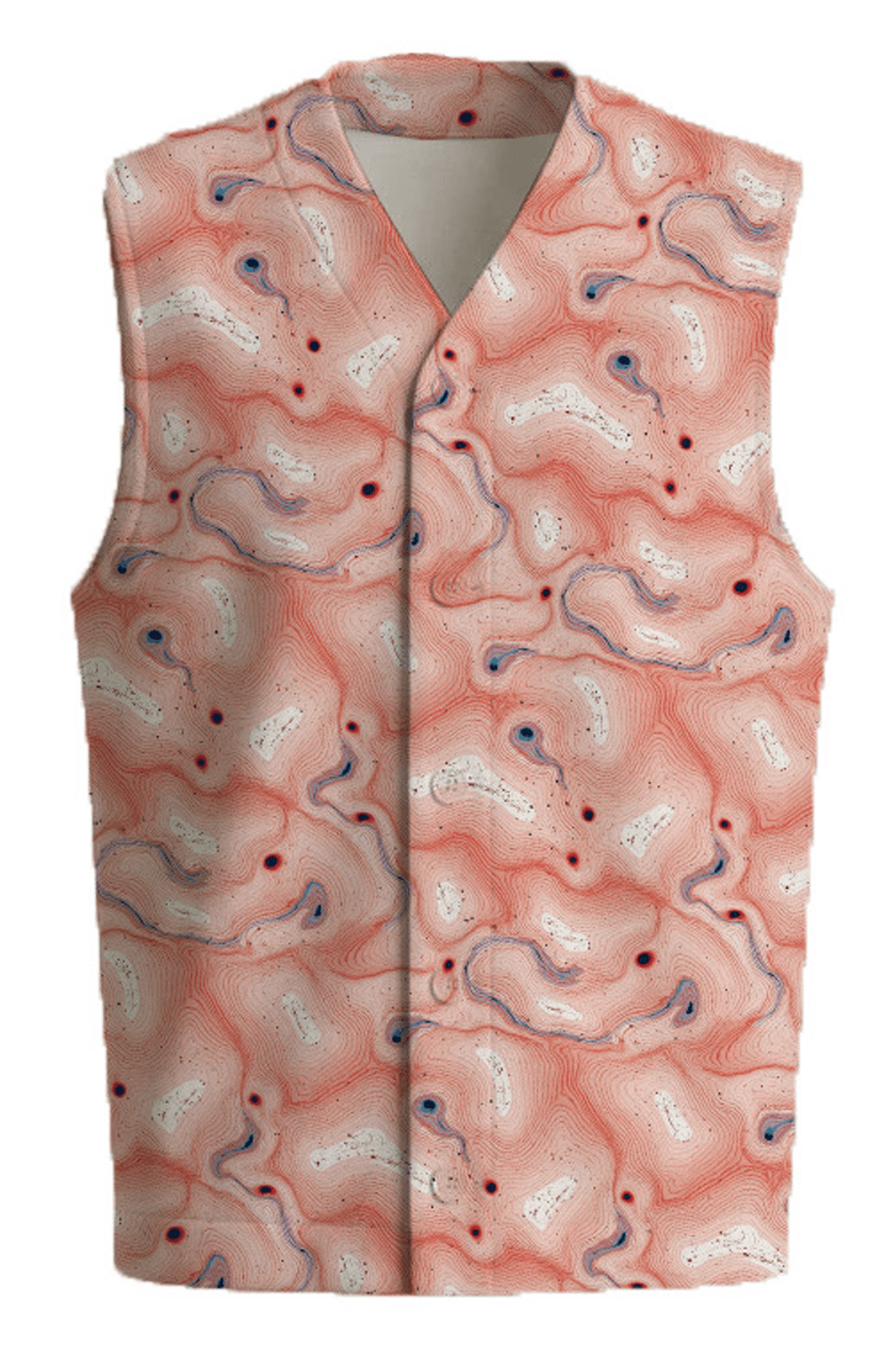
Lolie Bernard explores how generative AI can support textile design through five conceptual territories: randomness, repetition, sublimation, mismatch and the unseen. Artistic references, bodily textures, microscopic imagery and digital signals are translated into distinctive visual directions before being developed through iterative prompting. Rather than treating generated images as finished results, the project uses them as material for selection, refinement and pattern construction. The final motifs become seamless repeats applied to garments, connecting conceptual research with digital experimentation and practical fashion design.
Sonic Geometry
Sound data becomes wearable patterns through AI design
Hao Miaomiao transforms sound into a visual system for fashion print, using frequency, rhythm, amplitude and distortion as design parameters. Scientific references including spectrograms, wavelet scalograms, chromagrams and phase-space attractors inform prints inspired by earthquakes, volcanoes, thunderstorms, whale song and other sonic phenomena. AI supports the translation of acoustic information into colour, geometry and texture, while different tools are tested for image clarity and garment visualisation. The resulting modules and swatches demonstrate how data-inspired research can evolve into repeatable, wearable surfaces.
Atlas of Sin
Symbolic narratives become textile languages through generative design
Li Sik Yi develops a dark, symbolic print collection investigating themes including blood, flesh, hysteria, submission, surveillance, loneliness and refusal. Historical artworks, photography and recurring motifs such as serpents, eyes and fragmented organic forms provide the visual foundations for the project. Generative tools are used to reinterpret these references through painterly textures, repeat structures and controlled compositions, with Photoshop contributing to selected refinements. The prints are then applied to different garments and materials, exploring how narrative imagery can move from conceptual research into a coherent fashion surface.
Body Pain
Abstracted sensations evolve into refined repeatable fashion surfaces
Wang Zixuan investigates how sensations of pressure, bruising, swelling, fracture, burning and pulsation can be translated into textile design without relying on explicit anatomical imagery. Visual references are reduced to formal qualities such as compression, diffusion, branching structures, rhythm and surface tension. Through detailed prompting, AI is directed to generate abstract, seamless compositions suitable for fashion rather than literal representations of the body. The resulting patterns are tested through modules, larger swatches and garment applications, combining emotional research with controlled repeat construction and wearable design outcomes.
Textura Project
Material references evolve into modular prints for fashion
Chiara Maria Randazzo explores a broad range of material, natural and cultural references, from terracotta, water and ceramic cracks to circus imagery, coral, botanical forms and Baroque ornament. Each theme is developed through a specific colour palette and visual direction before being translated into seamless modular patterns using AI-assisted prompting. Several prints also include colour variations, allowing alternative interpretations of the same concept to be tested. The final modules are visualised across dresses, blouses, skirts, accessories and menswear, connecting research, surface development and product-oriented fashion experimentation.
From Digital Experiment to Fashion Application
A particularly strong element connecting the five projects is the transition from generated imagery to designed surface.
Students do not stop at creating an image. Motifs are selected and developed into modules, tested through repetition and adapted to the dimensions and visual behaviour of fashion products. Garment simulations then allow students to evaluate how pattern, proportion, placement and colour change once the design moves from a digital canvas to a three-dimensional fashion context.
This progression—from research to visual language, from AI experimentation to pattern construction, and from digital print to fashion application—illustrates how technology can become meaningful when embedded within an established design process.
It also connects directly with the programme’s wider emphasis on combining creativity, sustainability and technology, including digital fashion tools, material experimentation, fashion engineering and future-oriented design strategies.
Research And Innovation Through Student Practice
These projects offer a concrete expression of Istituto Marangoni’s approach to Research & Innovation: research becomes valuable when it generates questions, experimentation and new ways of approaching creative practice.
Across five very different visual territories, students investigate what generative systems can—and cannot—contribute to fashion design. The outcomes reveal AI not as a single aesthetic or shortcut, but as a tool whose value depends on the research, creative judgement and technical decisions surrounding it.
By connecting academic investigation with digital experimentation and fashion application, the projects demonstrate how emerging technologies can become part of a critical, human-directed design practice.