
How do you redesign a historic hotel without recreating the past?
Three Istituto Marangoni Milano Design students rethink Cures Marines, a historic hotel and spa in Normandy, through heritage, light and quiet luxury
A historic hotel does not need to recreate its past to remain faithful to it. That is the premise behind Illuminated Memory, a conceptual redesign of Cures Marines Hotel & Spa in Trouville-sur-Mer, Normandy, developed by Christina Kontopoulou, Agostina Dalle Palle and Nicholas Kambanis, students in the Master’s in Luxury Boutique Hotel Interior Design at Istituto Marangoni Milano Design.
Built in 1912 as a casino, Cures Marines overlooks the English Channel. Its identity is tied to Trouville-sur-Mer’s transformation from fishing village to Belle Époque seaside resort. Sea bathing, artistic life, and marine therapy all played a part in that history.
How can a hotel with such a past embrace the present without reducing its heritage to a mere theme? The students answer with memory. “We wanted to work with its memory,” they explain, using light, craftsmanship, materiality, and sensory comfort to make the past perceptible without restaging it. Illuminated Memory becomes a contemporary reading of Belle Époque elegance and historic seaside travel. From the lobby to the guestrooms and spa, the project is conceived as a “poetic maritime journey,” held together by noble materials, soft textures, warm natural tones, and the sea’s presence.
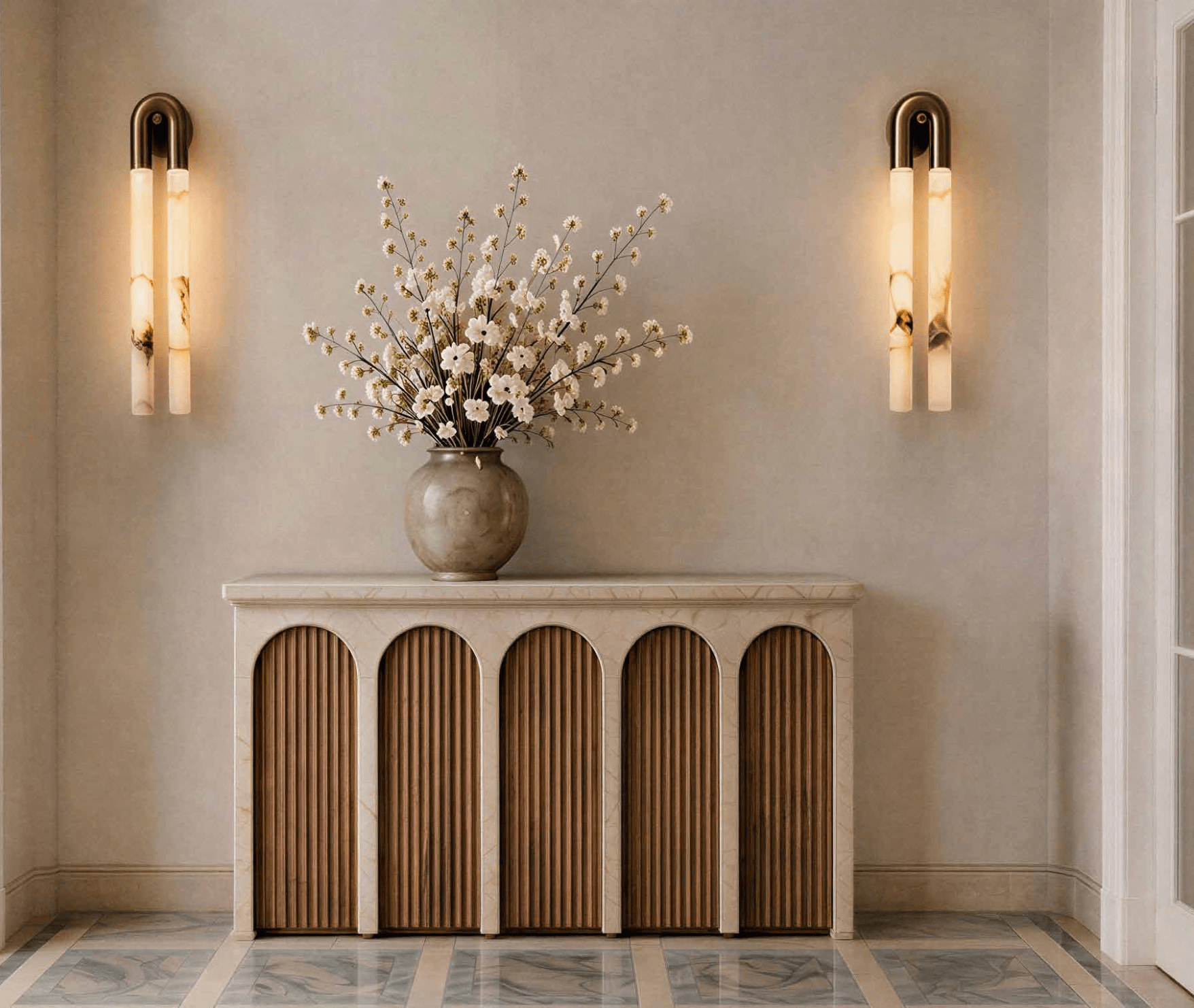
Illuminated Memory, a contemporary hotel interior design concept for Cures Marines Hotel & Spa in Trouville-sur-Mer, Normandy, is designed by emerging designers Christina Kontopoulou, Agostina Dalle Palle and Nicholas Kambanis. The project reinterprets the hotel’s Belle Époque heritage through quiet luxury, natural materials, atmospheric lighting and contemporary wellness design.
What Does Quiet Luxury Mean in Historic Hotel Design?
The redesign also asks who contemporary luxury hospitality is for. In developing Illuminated Memory, the students imagine what they call “the modern voyager:” a traveller interested in curated experiences and cultural authenticity, seeking privacy, restorative wellness, and a genuine sense of place. For this guest, luxury is defined by discretion, personalisation and carefully designed moments of retreat.
The project places this idea within Cures Marines’ identity as part of MGallery Collection, Accor’s portfolio of distinctive hotels with a strong sense of place. Here, intimate heritage, ritualistic healing, and curated globalism centre local identity and modern elegance, allowing the property to retain its individual character.
Their idea of quiet luxury is direct: “For us, quiet luxury is about creating value without excess,” they explain. “It is expressed through the quality of materials, craftsmanship, proportion, light, texture, and carefully considered details rather than through obvious statements of luxury.”
How Do You Preserve Heritage in a Hotel Redesign?
Working with heritage raises a practical question: what should be preserved? At Cures Marines, students identify sophistication, ritual, craftsmanship, marine wellbeing, and the relationship with the coast as qualities worth carrying forward. Rather than reproducing Belle Époque interiors, they reinterpret these qualities into a new language of hospitality.
The same principle applies to Normandy. Trouville-sur-Mer is not reduced to a collection of familiar coastal symbols. Its presence emerges through atmosphere, materials and, above all, light. “The changing coastal light became a way of connecting the interior to the landscape and also of expressing time and memory,” the students explain.
The result they sought was “familiar yet difficult to place,” evoking the sensation of recalling a journey that may never have happened. The sea carries this blend of nostalgia, escape, and the longing to return.
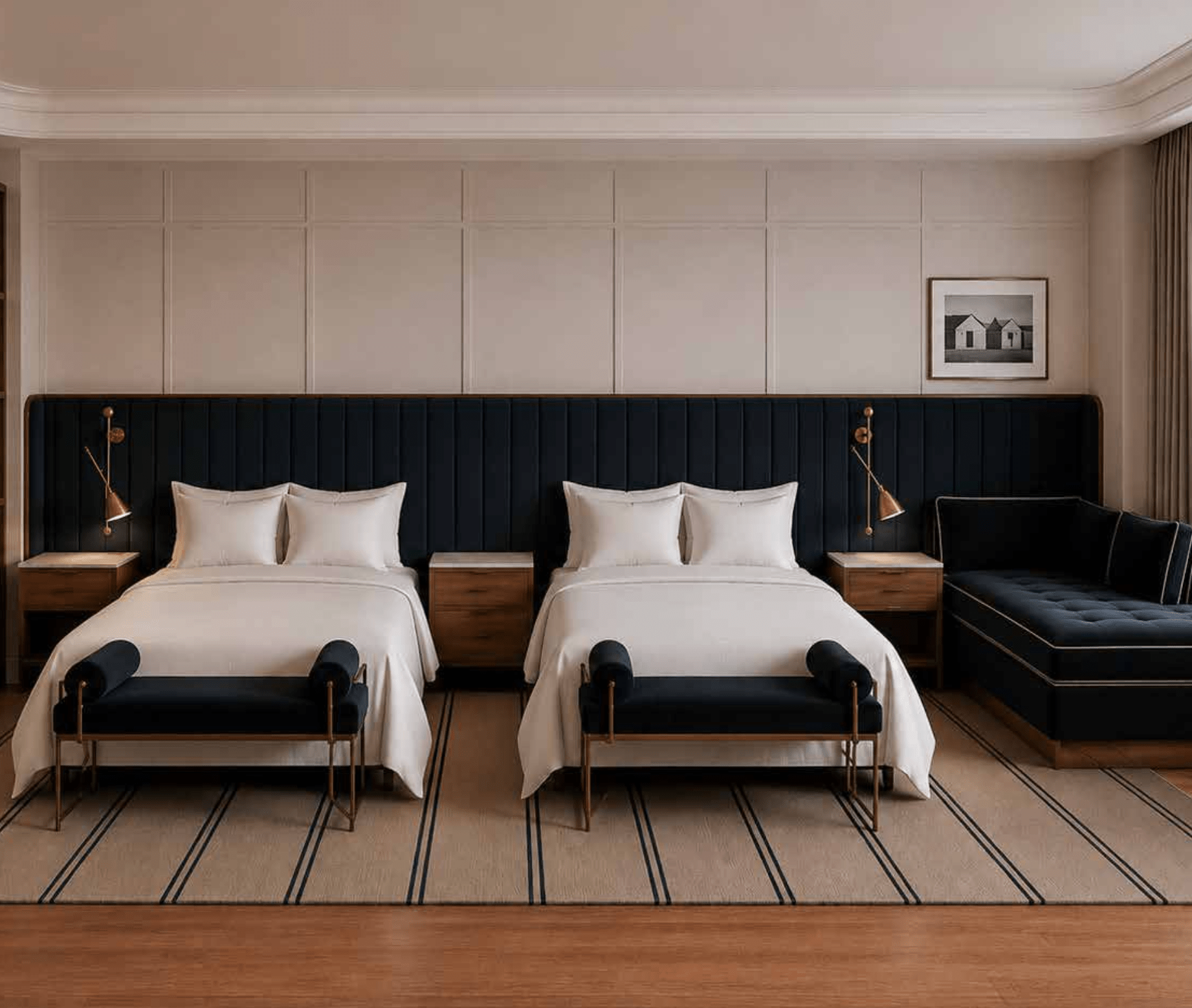
The twin room
Hotel Interior Design: One Guest Journey, Three Interpretations
Three projects form a cohesive sequence. Christina Kontopoulou designed the lobby and reception, Agostina Dalle Palle the guestrooms, and Nicholas Kambanis the spa. Their shared references include the Norman coast, Belle Époque seaside culture, historic ocean travel, marine wellness, and natural light.
The connection between them is “more emotional and material than stylistic”, they explain. Collectively, the three interventions signify arrival, retreat, and restoration.
Hotel Lobby Design: Making Arrival Part of the Experience
For Kontopoulou, Luminous Drift begins with arrival. Her project guides guests through the entrance, transitional airlock, lobby, reception, and concierge lounge. It draws inspiration from the sunset in Trouville-sur-Mer, when sea and light seem to merge, and the coast takes on an almost timeless quality.
Light becomes a material and organising principle, reflected and filtered through glass, warm metallic finishes, and layered illumination. A sculptural 3D glass panel serves as a focal point, its layered relief and reflective qualities creating a dynamic interplay with light.
French limestone, travertine, French oak, champagne glass, bronze, linen, and soft ivory finishes complete the palette. “I wanted guests to experience the coast through luminosity, reflection, and atmosphere rather than through an obvious visual representation of the sea,” Kontopoulou says.
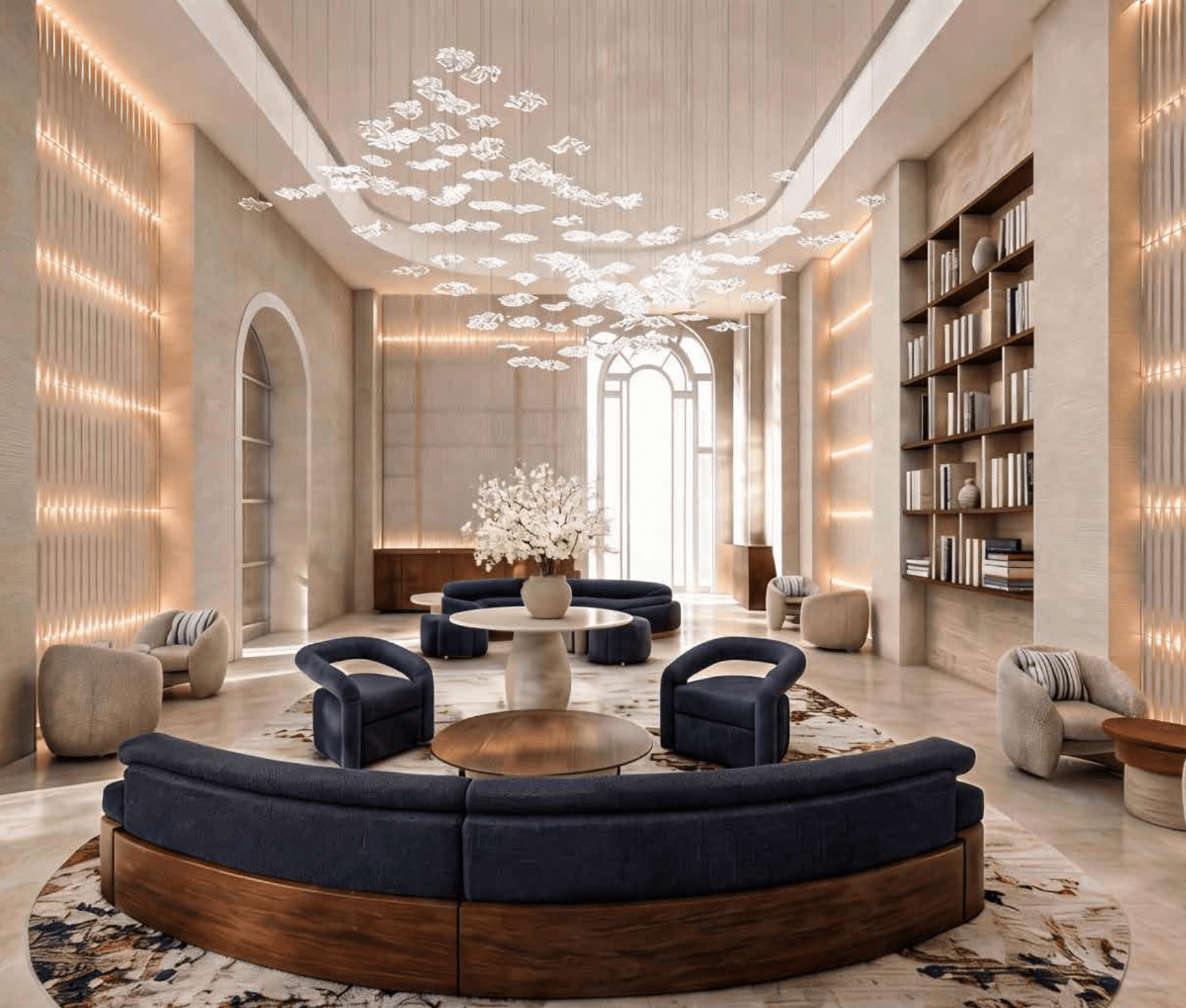
The lobby
How Can a Hotel Room Evoke Travel Without Becoming Themed?
With The Cabins, Dalle Palle brings the idea of travel into the guestrooms. Inspired by the grand ocean liners of Belle Époque travel, the rooms feature warm wood, brushed brass, natural linen, and softly textured finishes to evoke the cosy feel of a private cabin at sea.
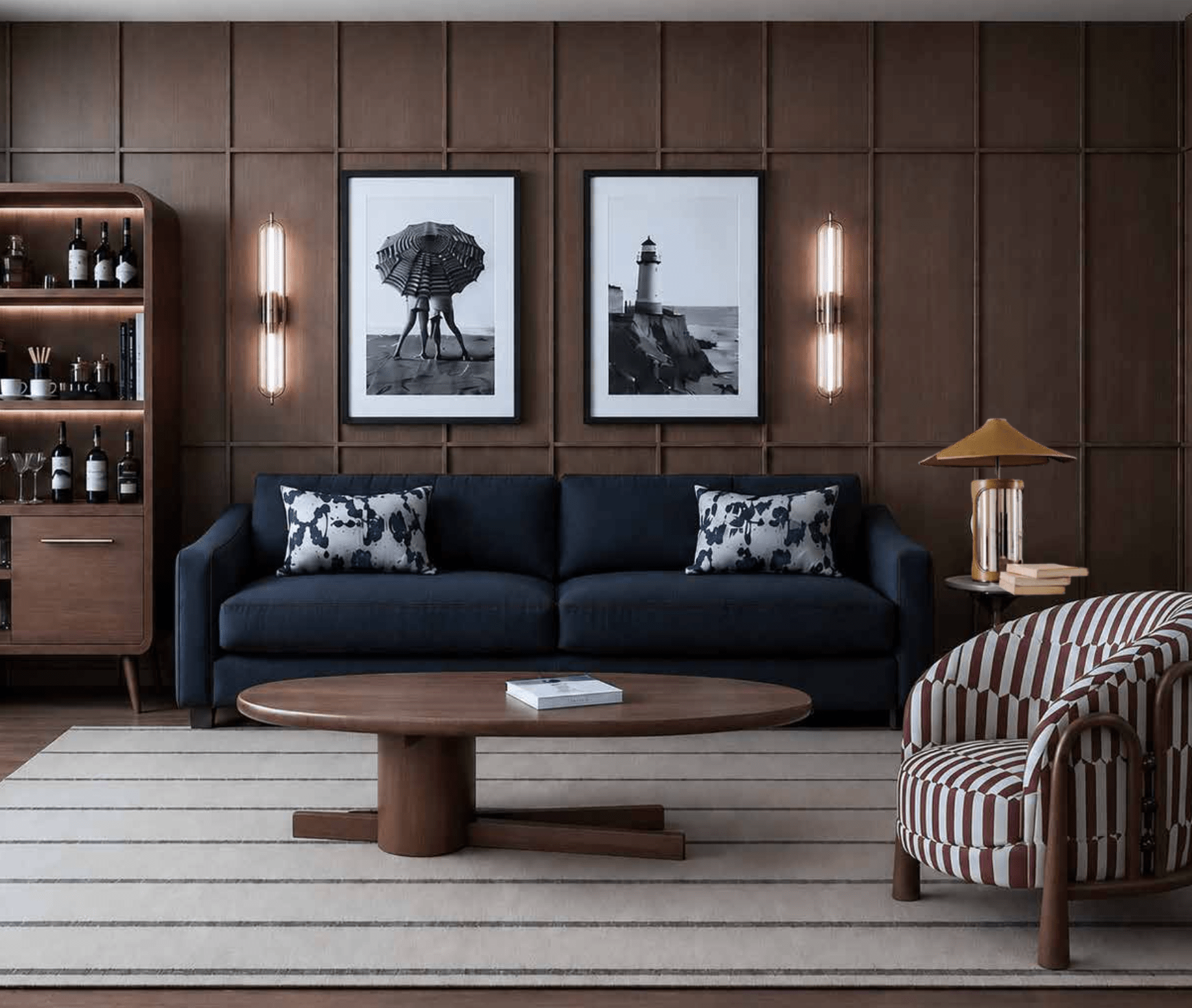
The livingroom Rather than relying on the clichés of a nautical-themed hotel room, the project expresses its maritime character through craftsmanship: rich oak panelling, architectural detailing, and tailored textiles with piping nod to classic interiors while still feeling fresh. Deep navy tones, subtle stripes, and vintage black-and-white photos of Trouville-sur-Mer strengthen the connection to the coast.
Another, less visible part of the material research is the use of air-purifying paint on walls and ceilings, selected to reduce indoor pollutants and create a healthier space.
As Dalle Palle puts it, the goal was for guests to “sense the romance of a voyage without stepping into a themed ‘nautical’ room”.
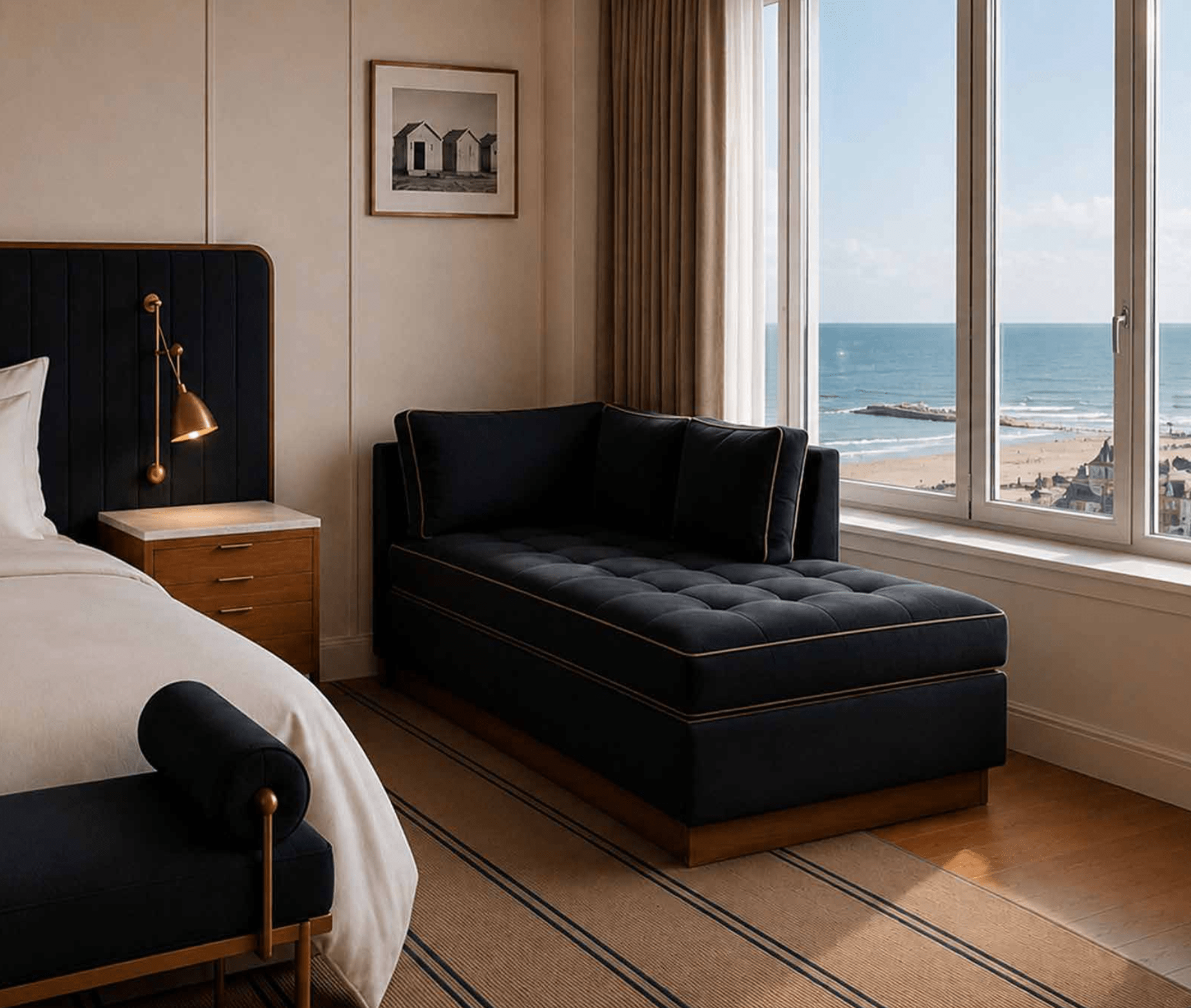
The twin room
How Does Thalassotherapy Shape a Hotel Spa?
While the guestrooms hold the memory of travel, Nicholas Kambanis’ Veiled Luminance brings another part of Cures Marines’ heritage into the present: its connection with thalassotherapy and marine healing.
Here, technology supports contemporary wellness but is meant to stay in the background. “For me, technology needed to remain almost invisible,” Kambanis explains. Circadian lighting allows the atmosphere to respond more naturally to the body’s rhythms, while hydrothermal paths gently lead guests through the spa’s sensory journey.
Water, temperature, light, and materials work together to shape how guests feel, move, and experience the space. At Cures Marines, technology extends the hotel’s long relationship with water and healing, reimagining wellbeing today with an emphasis on ritual, transition, and restoration.
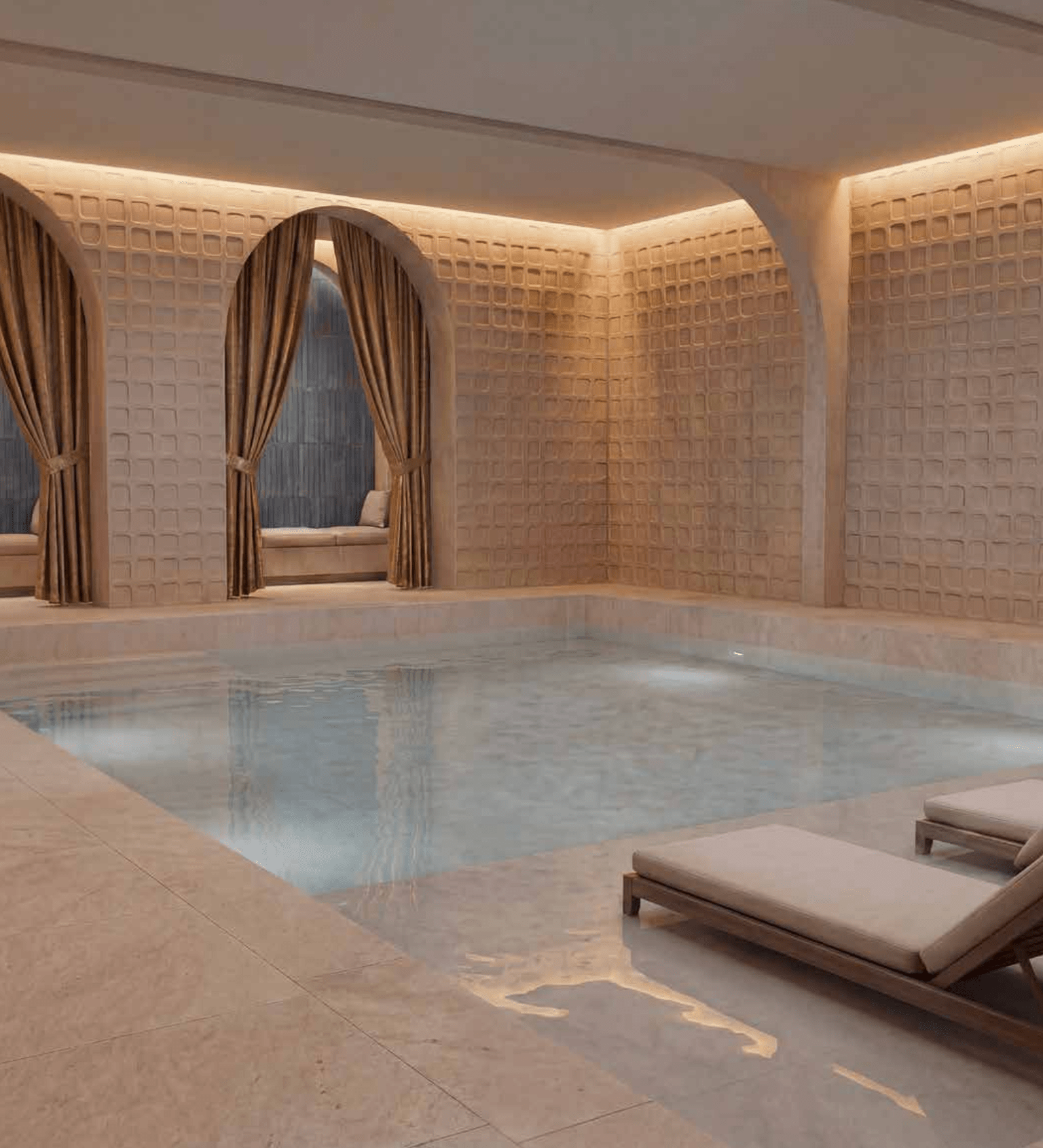
The spa
What Should a Designer Preserve in a Historic Hotel?
This question connects all three projects. The challenge in redesigning Cures Marines was to identify which parts of its identity could survive without direct copying.
Under Patricia Urquiola’s supervision, the final presentation asked Kontopoulou, Dalle Palle, and Kambanis to consider their proposals as a single hospitality experience. The concept, materials, atmosphere, and guest journey had to belong to the same place. It also encouraged them to question whether every design choice contributed to the project, or just looked good on paper.
Illuminated Memory suggests that the identity of a historic hotel survives outside the forms of its past. It lives on in the materials, rituals, changing light, the sensation of moving through water, or the vague familiarity of a room that reminds you of a different journey. Redesigning the past means understanding what made it worth remembering.
Paola Toia
Editor, Milano




 EMERGING DESIGNER 10 Emerging designers at Istituto Marangoni Milano: What do clothes say about identity? 30/09/2026
-copy-3.gif) EMERGING DESIGNER Meet the 10 emerging fashion designers bringing innovation to Milano Fashion Week 01/10/2025
EMERGING DESIGNER Meet the 10 emerging fashion designers bringing innovation to Milano Fashion Week 01/10/2025 

 EMERGING DESIGNER What makes Pineapples Don’t Have Sleeves the Colombian fashion brand to Know? Meet Johanna Nodier 30/09/2026
 .jpg)